 Fin's Fish Guide

Mediterranean banded killifish
The Mediterranean banded killifish (Aphanius fasciatus) is a fish that lives in both fresh and salt water of the family Cyprinodontidae that grows up to 7 cm.
Coastal and brackish waters around the Mediterranean Sea, in lagoons, salt pans and river mouths.
Description
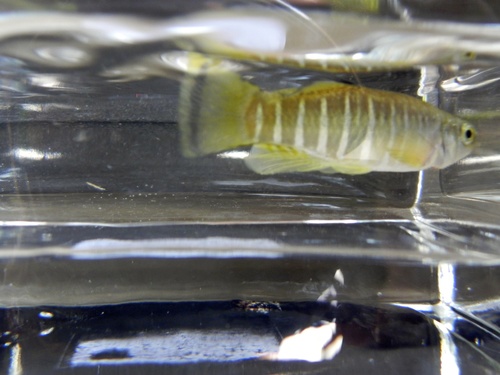
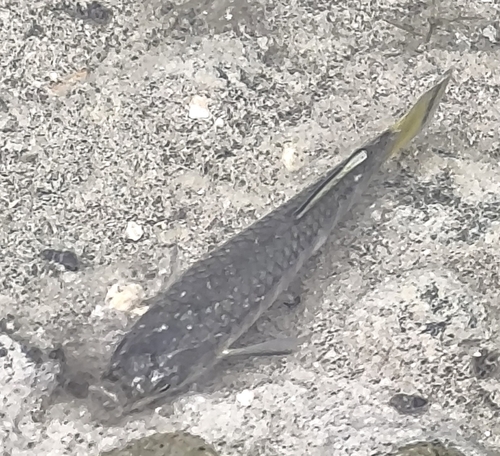
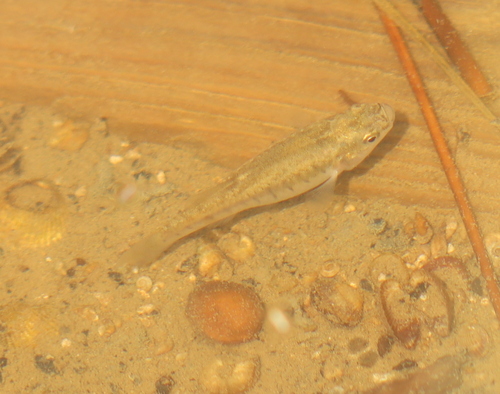
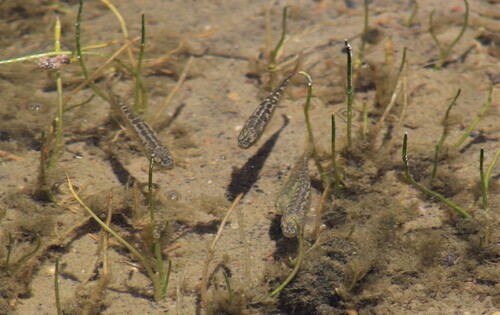
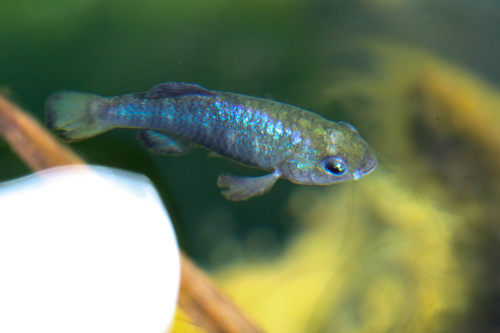
The Mediterranean banded killifish is a small egg-laying toothcarp of the family Cyprinodontidae reaching about 7 cm. The species shows a clear colour difference: males have a grey-silver body with rows of silvery-blue cross-bars, while females are inconspicuously spotted. It lives in coastal and brackish waters around the Mediterranean, such as lagoons, salt pans and river mouths, and tolerates strongly varying salinity and temperature exceptionally well. As an omnivore it feeds on algae, midge larvae and small zooplankton. In the warm season it spawns in shallow water, where the eggs are laid among water plants. Through habitat loss and competition with introduced mosquitofish many populations are under pressure, though the species is still assessed as not threatened globally.
Frequently asked questions
How do you recognise the Mediterranean banded killifish?
The Mediterranean banded killifish has a torpedo-shaped body, is mainly silver-grey and shows a vertical stripes pattern. Small, hardy brackish-water toothcarp; males have rows of silver-blue vertical bars, females are inconspicuously blotched.
Where does the Mediterranean banded killifish live?
The Mediterranean banded killifish lives in both fresh and salt water and is mostly found around mixed bottom. Coastal and brackish waters around the Mediterranean Sea, in lagoons, salt pans and river mouths.
How big does the Mediterranean banded killifish get?
The Mediterranean banded killifish grows to a maximum of about 7 cm.
Is the Mediterranean banded killifish dangerous to humans?
No, the Mediterranean banded killifish is harmless to humans. None required: this species is harmless to humans.
Is the Mediterranean banded killifish edible?
The Mediterranean banded killifish is not usually eaten.
More photos


Want the complete picture on the Mediterranean banded killifish?
Point your camera at the fish and Fin names the species in seconds. Free, and the Mediterranean banded killifish is one of 12,519 species in the app.
All data
Identification
Appearance
Habitat & distribution
Behaviour & biology
For anglers
Safety
Status & sources
Same genus Aphanius




More from the family Cyprinodontidae

Want the complete picture on the Mediterranean banded killifish?
Point your camera at the fish and Fin names the species in seconds. Free, and the Mediterranean banded killifish is one of 12,519 species in the app.