 Fin's Fish Guide

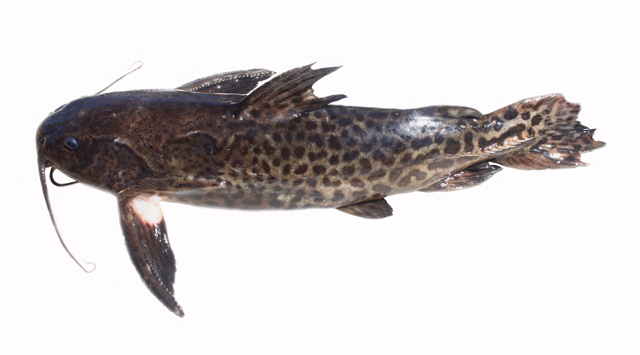
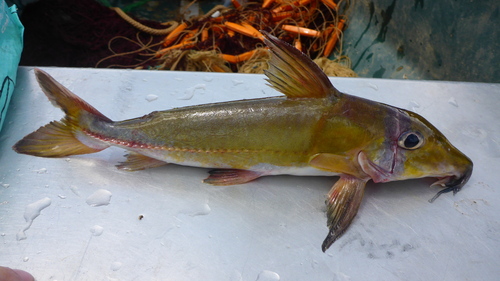
The Thorny catfish (Doras carinatus) is a brackish-water fish of the family Doradidae that grows up to 30 cm.
Northern South America: Essequibo basin and coastal rivers eastward to the mouth of the Amazon.
Description
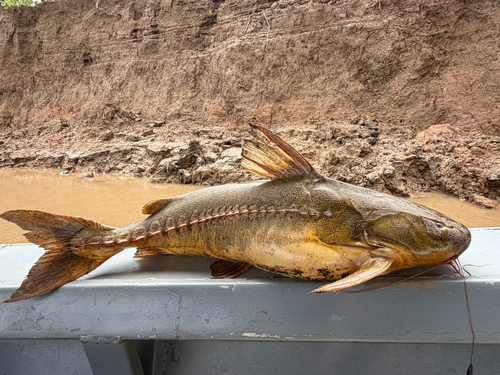
Doras carinatus is a thorny catfish (family Doradidae) of northern South America. The species grows to about 30 cm and has a scaleless body with a row of 33 to 35 bony, thorny plates along the lateral line, a pointed, laterally compressed head and an inferior mouth. It carries a pair of branched maxillary barbels and four short mandibular barbels. The fish lives demersally in fresh and brackish water. With its pectoral-fin spines it can produce sounds. Its diet indicates a herbivorous to omnivorous habit. The species is harmless to humans.
Frequently asked questions
How do you recognise the Thorny catfish?
The Thorny catfish has an elongate, eel-like body, is mainly brown and shows a plain pattern. Row of bony thorn plates along the lateral line; branched barbels; can make sound with its pectoral fin spines.
Where does the Thorny catfish live?
The Thorny catfish lives in brackish water and is mostly found around sand or mud bottom. Northern South America: Essequibo basin and coastal rivers eastward to the mouth of the Amazon.
How big does the Thorny catfish get?
The Thorny catfish grows to a maximum of about 30 cm.
Is the Thorny catfish dangerous to humans?
No, the Thorny catfish is harmless to humans. None required: this species is harmless to humans.
Is the Thorny catfish edible?
The Thorny catfish is rarely eaten.

Want the complete picture on the Thorny catfish?
Point your camera at the fish and Fin names the species in seconds. Free, and the Thorny catfish is one of 12,519 species in the app.
All data
Identification
Appearance
Habitat & distribution
Behaviour & biology
For anglers
Safety
Status & sources
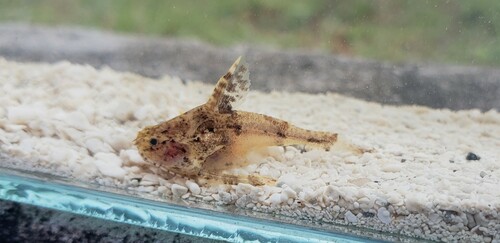
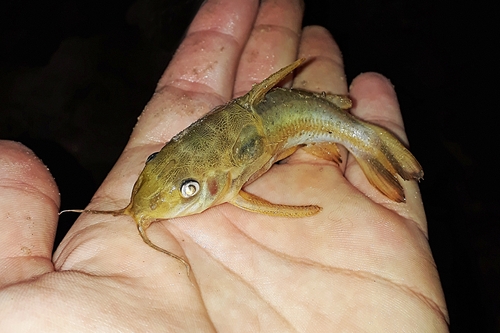
Same genus Doras
More from the family Doradidae



Want the complete picture on the Thorny catfish?
Point your camera at the fish and Fin names the species in seconds. Free, and the Thorny catfish is one of 12,519 species in the app.