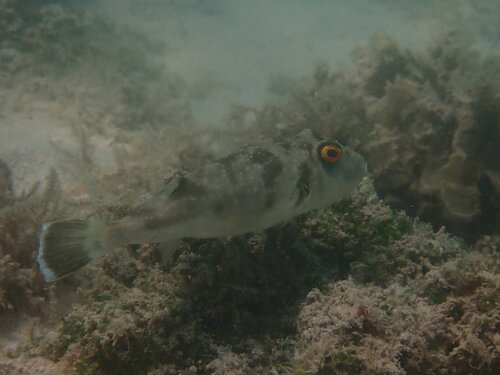
Home · Tetraodontidae · Bandtail puffer
Bandtail puffer (Sphoeroides spengleri) — Tetraodontidae

Bandtail puffer

Sphoeroides spengleri
LC · Least Concern

The Bandtail puffer (Sphoeroides spengleri) is a brackish-water fish of the family Tetraodontidae that grows up to 30 cm.

Length
30 cm
Water
Brackish
Depth
2.0–70.0 m
Diet
Carnivore
Behaviour
Solitary
Activity
Diurnal
Body shape
Torpedo-shaped
Substrate
Stone or rock
Danger
Venomous / poisonous
Range
Western Atlantic from Massachusetts to Santa Catarina (Brazil); associated with seagrass beds and reef flats.
Edibility
Not eaten

Want the complete picture on the Bandtail puffer?

Get the app

Description

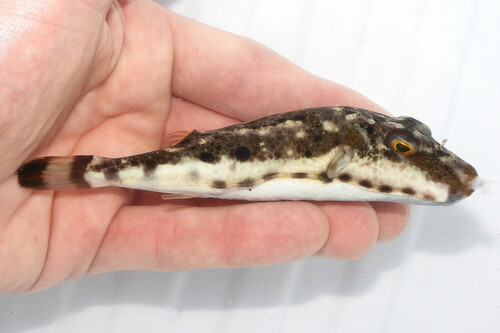
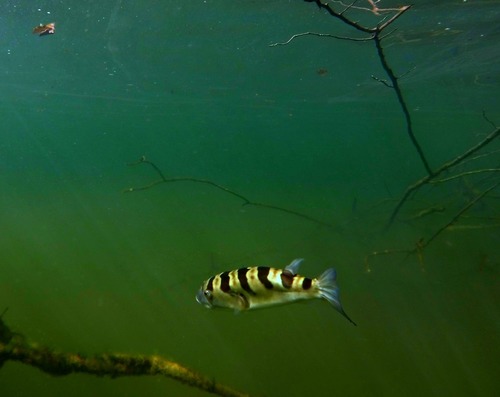
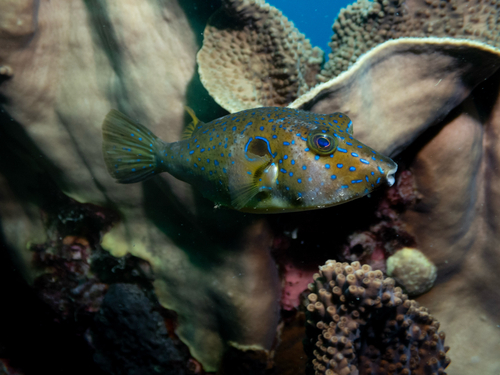
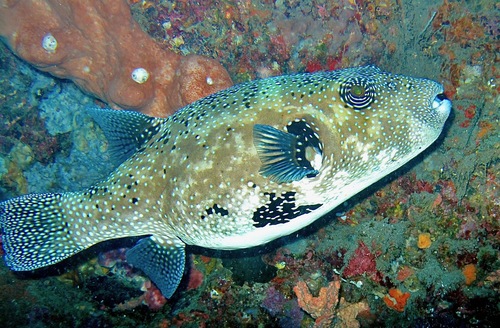
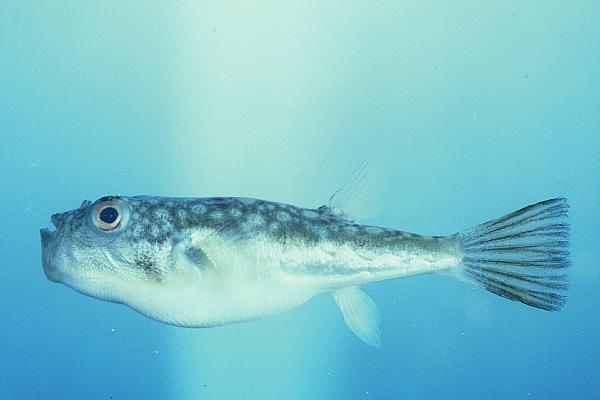
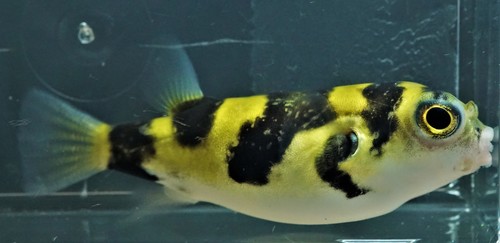
The bandtail puffer is a small pufferfish of the family Tetraodontidae reaching about 30 cm but usually around 12 cm. A row of 11 to 14 sharply defined round black spots runs along the underside of the head and body; the jaw teeth form a beak. Like all puffers it can inflate with water as a defence, and its flesh contains the toxic tetrodotoxin. It lives over seagrass beds and reef flats in the western Atlantic at depths of 2 to 70 m, feeding on molluscs, crustaceans, echinoderms and worms. The bandtail puffer is not eaten but is traded in the aquarium hobby.

Frequently asked questions

How do you recognise the Bandtail puffer?

The Bandtail puffer has a torpedo-shaped body, is mainly brown and shows a spots pattern. Small pufferfish with a row of 11-14 sharply defined round black spots along the underside; can inflate itself with water and contains tetrodotoxin. Please note: in tropical areas this species can cause ciguatera poisoning when eaten; large specimens of coral reef predators can accumulate the toxin. Eat with care or avoid in risk areas.

Where does the Bandtail puffer live?

The Bandtail puffer lives in brackish water and is mostly found around stony or rocky ground. Western Atlantic from Massachusetts to Santa Catarina (Brazil); associated with seagrass beds and reef flats.

How big does the Bandtail puffer get?

The Bandtail puffer grows to a maximum of about 30 cm. On average the species is around 12 cm.

Is the Bandtail puffer dangerous to humans?

The Bandtail puffer is venomous — handle spines with care and seek medical help after a sting if needed. Do not eat: the flesh may contain lethal tetrodotoxin. If poisoning is suspected (tingling, muscle weakness, breathing difficulty), call emergency services immediately.

Is the Bandtail puffer edible?

The Bandtail puffer is not usually eaten.

More photos

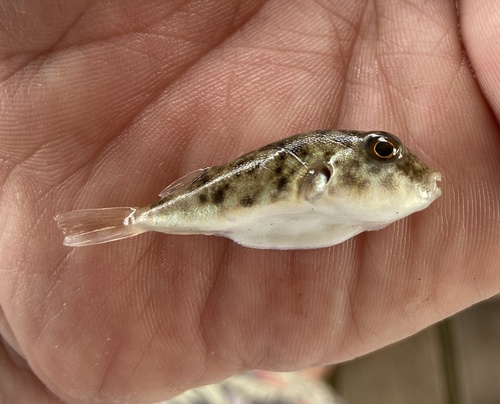
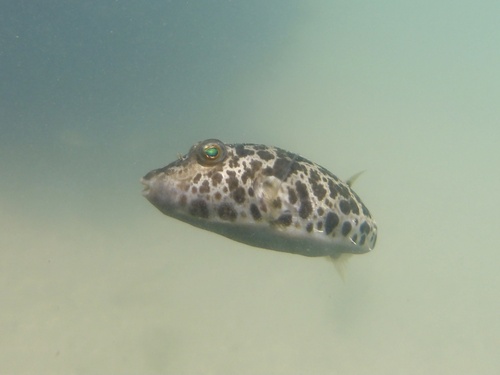
Bandtail puffer (Sphoeroides spengleri) — Tetraodontidae — 2
Wikimedia Commons — Williams, J. T.; Carpenter, K. E.; Van Tassell, J. L.; Hoetjes, P.; Toller, W.; Etnoyer, P.; Smith, M. (CC BY 2.5)
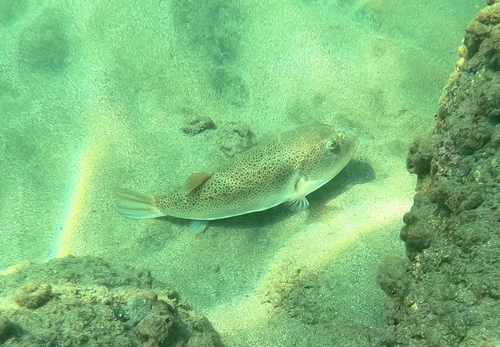
Bandtail puffer (Sphoeroides spengleri) — Tetraodontidae — 3
iNaturalist ((c) Emilio Concari, some rights reserved (CC BY-NC))
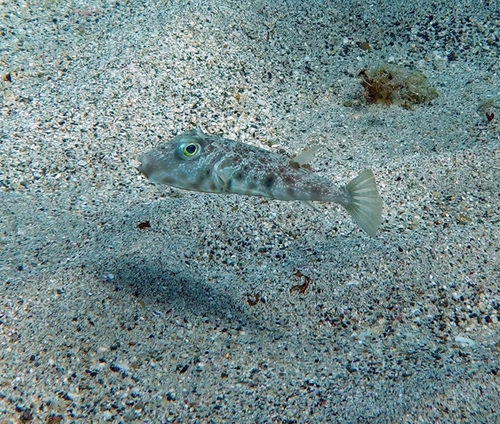
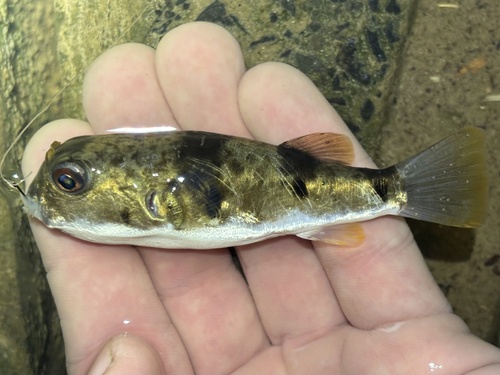
Bandtail puffer (Sphoeroides spengleri) — Tetraodontidae — 4
Wikimedia Commons — Andrew David, NOAA/NMFS/SEFSC Panama City; Lance Horn, UNCW/NURC - Phantom II ROV operator. (Public domain)
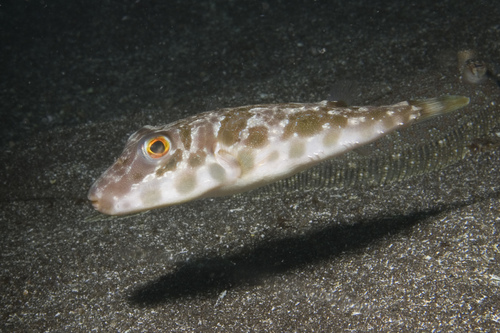
Bandtail puffer (Sphoeroides spengleri) — Tetraodontidae — 5
Wikimedia Commons — SEFSC Pascagoula Laboratory; Collection of Brandi Noble, NOAA/NMFS/SEFSC. (Public domain)
Fin

Want the complete picture on the Bandtail puffer?

Point your camera at the fish and Fin names the species in seconds. Free, and the Bandtail puffer is one of 12,519 species in the app.

Get the app →

All data

Identification

English name
Bandtail puffer verified
Scientific name
Sphoeroides spengleri
Family
Tetraodontidae
Other names
Bandtail Puffer; Bandtail puffer; Bandtail pufferfish; Puffer verified

Appearance

Size class
Medium verified
Max length (cm)
30.0 verified
Average length (cm)
12.0 verified
Body shape
Torpedo-shaped sourced
Dominant colour
Brown sourced
Pattern
Spots sourced
Tail shape
Rounded sourced
Mouth position
Beak-shaped inferred
Lips
Thin inferred
Barbels
No verified
Dorsal fins
One continuous sourced
Dorsal spines
No verified

Habitat & distribution

Water type
Brackish sourced
Substrate
Stone or rock sourced
Min depth (m)
2.0 verified
Max depth (m)
70.0 verified
Natural range
Western Atlantic from Massachusetts to Santa Catarina (Brazil); associated with seagrass beds and reef flats. verified
Origin
Native verified

Behaviour & biology

Diet
Carnivore verified
Diet (detail)
Small fishes, crustaceans and invertebrates inferred
Social behaviour
Solitary verified
Territorial
No verified
Activity
Diurnal sourced
Reproduction
Separate sexes verified
Sexual dimorphism
No verified
Seasonality
Oviparous reef species that is common in shallow coastal habitats. sourced
Special features
Small pufferfish with a row of 11-14 sharply defined round black spots along the underside; can inflate itself with water and contains tetrodotoxin. Please note: in tropical areas this species can cause ciguatera poisoning when eaten; large specimens of coral reef predators can accumulate the toxin. Eat with care or avoid in risk areas. verified

For anglers

Edibility
Not eaten verified
Fishing method
Fishing with natural bait (fish, shrimp, worm) or lures close to reef and rock structures. inferred
Regulations source
FishBase ↗ inferred

Safety

Danger to humans
Venomous / poisonous sourced
First aid
Do not eat: the flesh may contain lethal tetrodotoxin. If poisoning is suspected (tingling, muscle weakness, breathing difficulty), call emergency services immediately. sourced

Status & sources

Sources
FishBase via GBIF (DwC-A), CC-BY-NC 4.0

Same genus Sphoeroides

More from the family Tetraodontidae
Fin

Want the complete picture on the Bandtail puffer?

Point your camera at the fish and Fin names the species in seconds. Free, and the Bandtail puffer is one of 12,519 species in the app.

Get the app →
Is this the Bandtail puffer? Get the app