 Fin's Fish Guide

The Angolan catfish (Clarias angolensis) is a freshwater fish of the family Clariidae that grows up to 35 cm.
Fresh water of West and Central Africa, in slow-moving water of forest streams, rivers and swamps.
Description
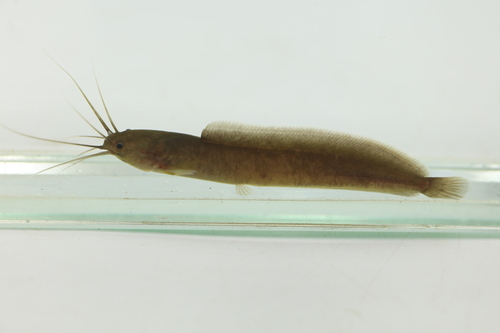
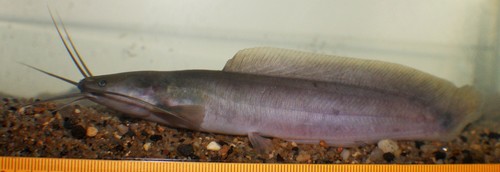
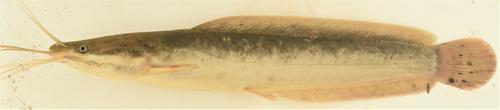
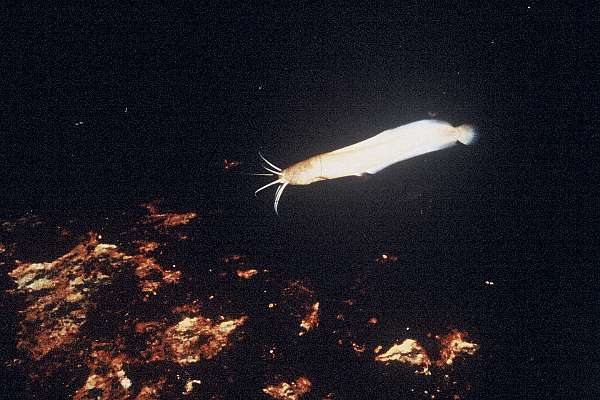
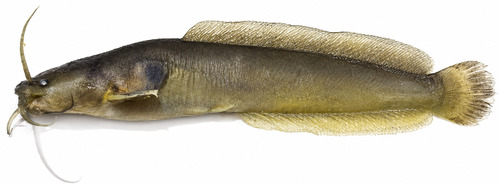
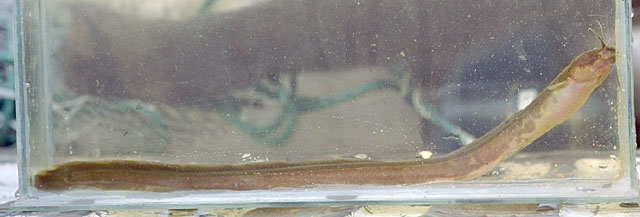
The Angolan catfish is an eel-like air-breathing catfish of the family Clariidae reaching about 35 cm. The elongate, scaleless body has four pairs of barbels around the broad mouth and a very long dorsal and anal fin. Like other Clarias species it has a tree-shaped accessory breathing organ above the gills with which it can breathe air, allowing it to survive in oxygen-poor forest and swamp water and even crawl over moist ground to reach new water. The species comes from West and Central Africa and lives in slow water of forest streams, rivers and swamps. As an omnivore it eats insects, worms, crustaceans, small fish and plant matter. It is a valued food fish, with stout, serrated pectoral spines.
Frequently asked questions
How do you recognise the Angolan catfish?
The Angolan catfish has an elongate, eel-like body, is mainly brown and shows a plain pattern. Eel-like air-breathing catfish with four pairs of barbels and a very long dorsal fin; survives oxygen-poor forest and swamp water.
Where does the Angolan catfish live?
The Angolan catfish lives in fresh water and is mostly found around sand or mud bottom. Fresh water of West and Central Africa, in slow-moving water of forest streams, rivers and swamps.
How big does the Angolan catfish get?
The Angolan catfish grows to a maximum of about 35 cm.
Is the Angolan catfish dangerous to humans?
The Angolan catfish can cause injury; handle it with care. The pectoral and dorsal fins bear stout, serrated spines that can cause painful puncture or cut wounds; handle a caught animal carefully and clean any wound.
Is the Angolan catfish edible?
Yes, the Angolan catfish is a highly prized food fish.
More photos


Want the complete picture on the Angolan catfish?
Point your camera at the fish and Fin names the species in seconds. Free, and the Angolan catfish is one of 12,519 species in the app.
All data
Identification
Appearance
Habitat & distribution
Behaviour & biology
For anglers
Safety
Status & sources
Same genus Clarias
More from the family Clariidae



Want the complete picture on the Angolan catfish?
Point your camera at the fish and Fin names the species in seconds. Free, and the Angolan catfish is one of 12,519 species in the app.