 Fin's Fish Guide
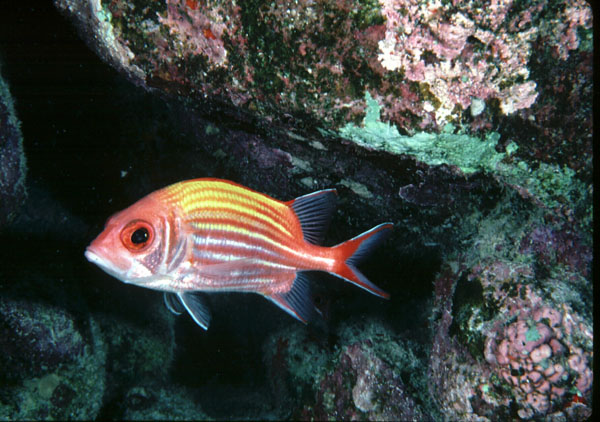
The Yellow-striped squirrelfish (Sargocentron ensifer) is a saltwater fish of the family Holocentridae that grows up to 23 cm.
Oceania: American Samoa, China, Taiwan/Ch Taipei, French Polynesia, Guam, Japan and others
Description
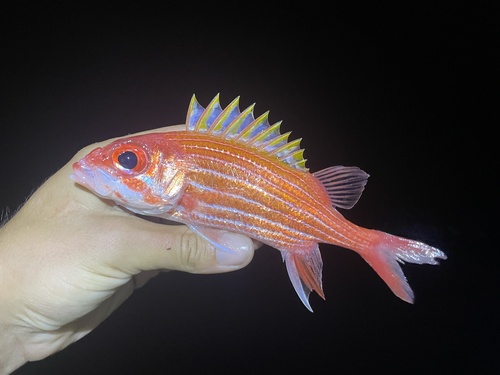
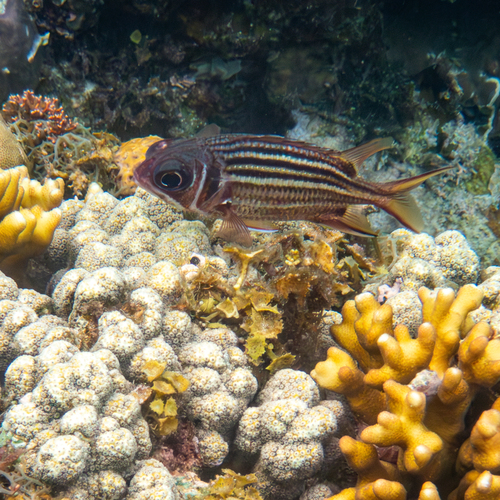
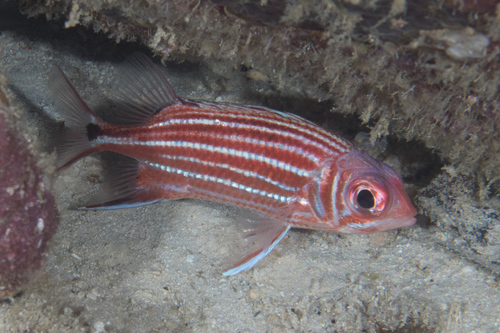
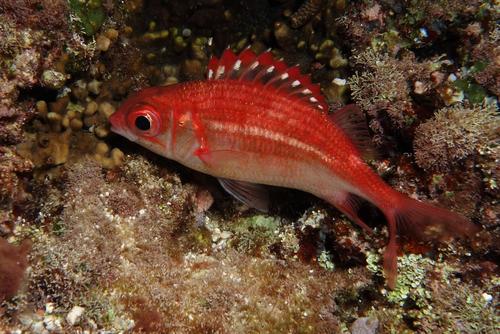
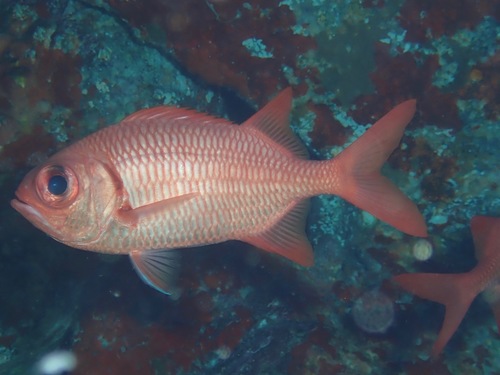
The Yellow-striped squirrelfish is a squirrelfish (Holocentridae) from reef water of the Indo-West Pacific, including Hawaii. The species grows to about 25 cm and has an elongate, bright-red body with white-silver longitudinal stripes, conspicuously large eyes and rough scales. As a nocturnal fish it shelters by day in crevices and caves and hunts crustaceans and small fish by night. On the edge of the gill cover it bears a sharp spine that can give a cut when handled carelessly.
Frequently asked questions
How do you recognise the Yellow-striped squirrelfish?
The Yellow-striped squirrelfish has a torpedo-shaped body, is mainly red-orange and shows a horizontal stripes pattern. Bears sharp spines, plates or strong jaws that can cause cuts or puncture wounds; handle with care.
Where does the Yellow-striped squirrelfish live?
The Yellow-striped squirrelfish lives in the sea (marine waters) and is mostly found around stony or rocky ground. Oceania: American Samoa, China, Taiwan/Ch Taipei, French Polynesia, Guam, Japan and others
How big does the Yellow-striped squirrelfish get?
The Yellow-striped squirrelfish grows to a maximum of about 23 cm. On average the species is around 15 cm.
Is the Yellow-striped squirrelfish dangerous to humans?
The Yellow-striped squirrelfish can cause injury; handle it with care. For a cut or puncture from a sharp fin spine or gill cover: rinse the wound with clean water, apply pressure to stop bleeding and cover with a sterile dressing. Check that no spine fragment remains and watch for signs of infection; for a deep wound update tetanus protection.
Is the Yellow-striped squirrelfish edible?
Yes, the Yellow-striped squirrelfish is commonly eaten.
More photos
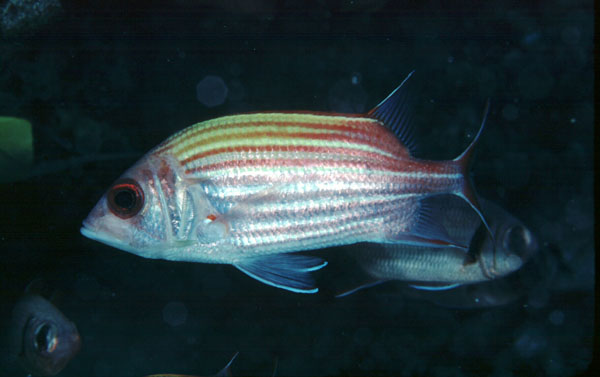



Want the complete picture on the Yellow-striped squirrelfish?
Point your camera at the fish and Fin names the species in seconds. Free, and the Yellow-striped squirrelfish is one of 12,519 species in the app.
All data
Identification
Appearance
Habitat & distribution
Behaviour & biology
For anglers
Safety
Status & sources
Same genus Sargocentron
More from the family Holocentridae


Want the complete picture on the Yellow-striped squirrelfish?
Point your camera at the fish and Fin names the species in seconds. Free, and the Yellow-striped squirrelfish is one of 12,519 species in the app.