 Fin's Fish Guide

The Threebanded pencilfish (Nannostomus trifasciatus) is a freshwater fish of the family Lebiasinidae that grows up to 4 cm.
Description
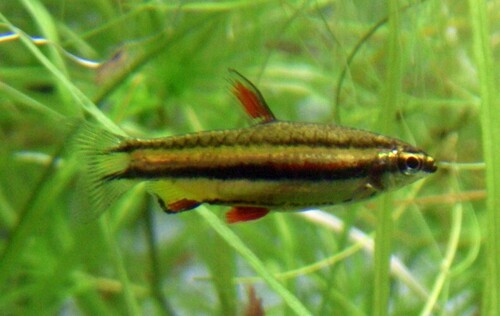
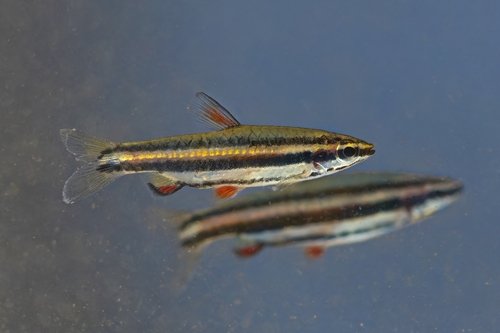
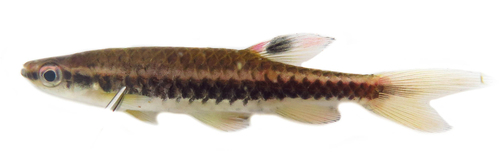
The threestripe pencilfish is a small pencilfish of the family Lebiasinidae from northern South America. The species grows to about 6 cm and has an elongate, pencil-shaped body with three black lengthwise stripes, alternating with gold, and red spots near the fins. It lives in schools in calm, plant-rich streams and pools, often in blackwater. As a small predator it picks small zooplankton, worms, crustaceans and insects. It is popular in the aquarium hobby. The species is harmless to humans.
Frequently asked questions
How do you recognise the Threebanded pencilfish?
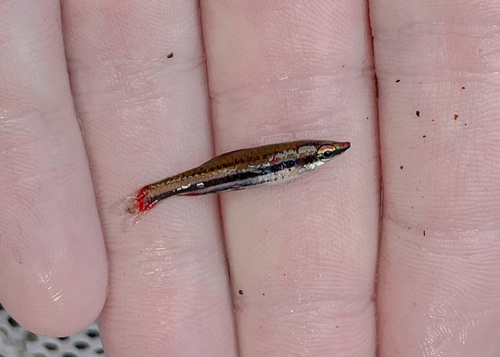
The Threebanded pencilfish has a torpedo-shaped body, is mainly yellow-gold and shows a horizontal stripes pattern. Pencil-shaped body with three black longitudinal stripes and red blotches; schooling aquarium fish.
Where does the Threebanded pencilfish live?
The Threebanded pencilfish lives in fresh water and is mostly found around mixed bottom. Northern South America; quiet plant-rich streams and pools.
How big does the Threebanded pencilfish get?
The Threebanded pencilfish grows to a maximum of about 4 cm.
Is the Threebanded pencilfish dangerous to humans?
No, the Threebanded pencilfish is harmless to humans. None required: this species is harmless to humans.
Is the Threebanded pencilfish edible?
The Threebanded pencilfish is not usually eaten.
More photos


Want the complete picture on the Threebanded pencilfish?
Point your camera at the fish and Fin names the species in seconds. Free, and the Threebanded pencilfish is one of 12,519 species in the app.
All data
Identification
Appearance
Habitat & distribution
Behaviour & biology
For anglers
Safety
Status & sources
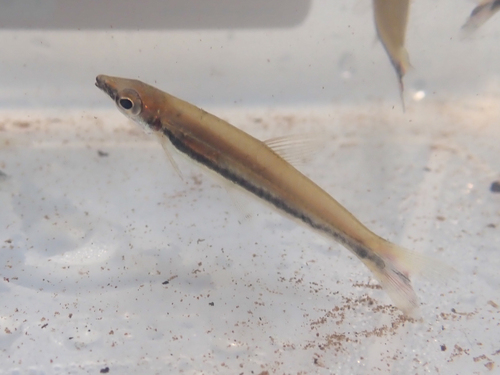
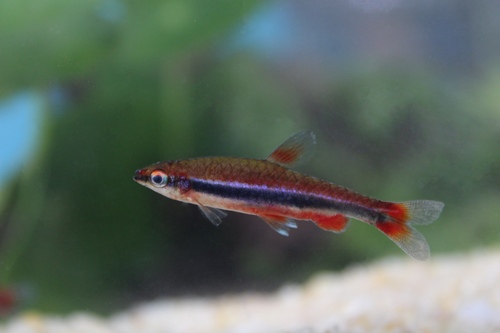
Same genus Nannostomus


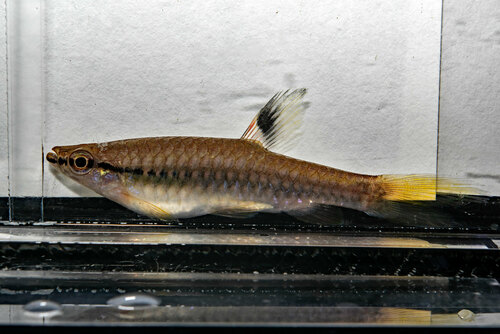
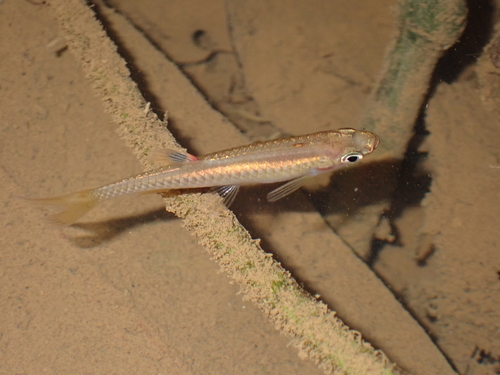
More from the family Lebiasinidae

Want the complete picture on the Threebanded pencilfish?
Point your camera at the fish and Fin names the species in seconds. Free, and the Threebanded pencilfish is one of 12,519 species in the app.