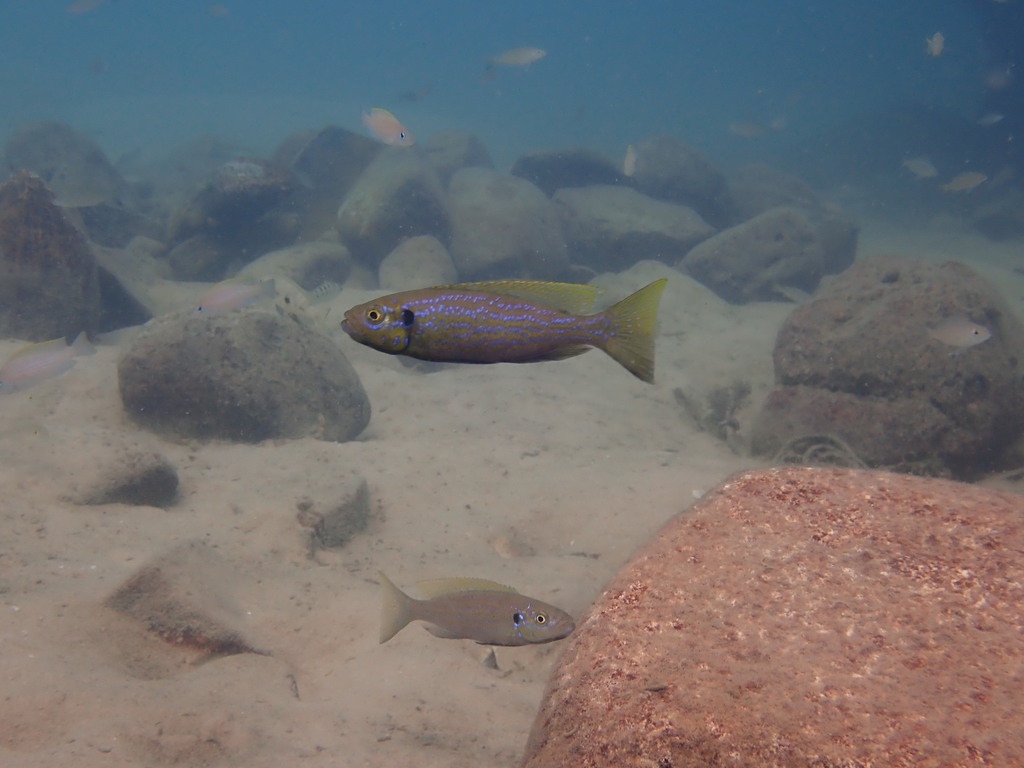
The Scale-eating cichlid (Perissodus microlepis) is a freshwater fish of the family Cichlidae that grows up to 11 cm.
Description
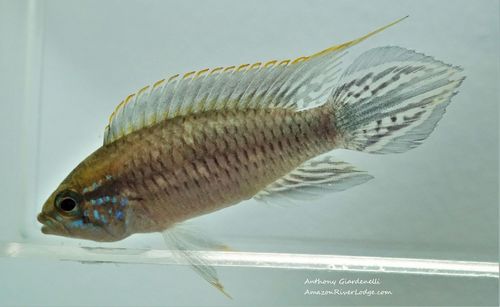
Perissodus microlepis is a cichlid endemic to Lake Tanganyika in East Africa. The species is famous for its specialised diet: it is a scale-eater (lepidophage) that bites scales from the flanks of other fishes. Its mouth is asymmetrically directed to the left or right, a celebrated example of evolutionarily balanced polymorphism. The fish reaches about 11 cm, has a streamlined body and preys mainly on fishes that are inattentive or that graze the algal layer. Like many Tanganyika cichlids the species is a mouthbrooder.
Frequently asked questions
How do you recognise the Scale-eating cichlid?
The Scale-eating cichlid has a torpedo-shaped body and shows a vertical stripes pattern.
Where does the Scale-eating cichlid live?
The Scale-eating cichlid lives in fresh water and is mostly found around sand or mud bottom.
How big does the Scale-eating cichlid get?
The Scale-eating cichlid grows to a maximum of about 11 cm.
Is the Scale-eating cichlid dangerous to humans?
No, the Scale-eating cichlid is harmless to humans.
Is the Scale-eating cichlid edible?
Yes, the Scale-eating cichlid is commonly eaten.
Download Fin's Fish Guide
Identify fish in seconds, log your catches and dives. Join the TestFlight beta.
All data
Identification
Appearance
Habitat & distribution
Behaviour & biology
For anglers
Safety
Status & sources
More from the family Cichlidae



Download Fin's Fish Guide
Identify fish in seconds, log your catches and dives. Join the TestFlight beta.