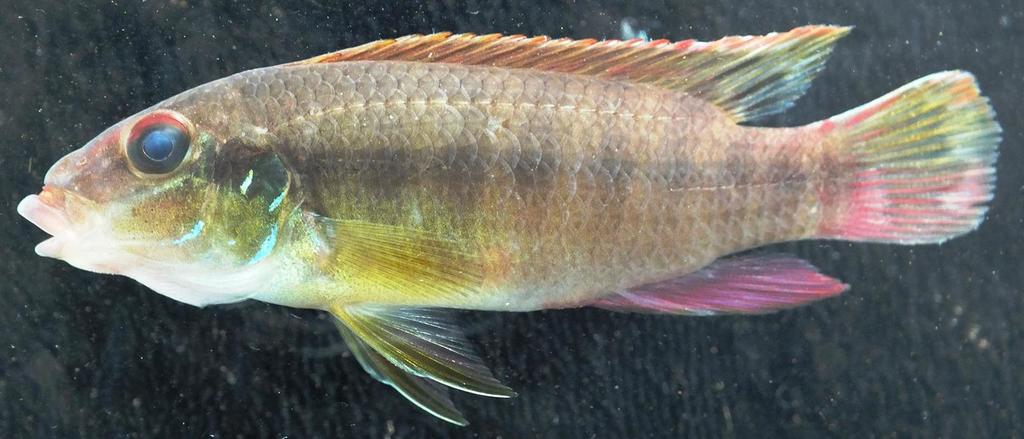
The Giant kribensis (Pelvicachromis humilis) is a freshwater fish of the family Cichlidae that grows up to 13 cm.
Description
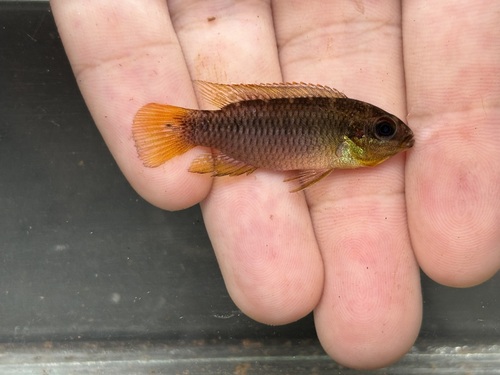
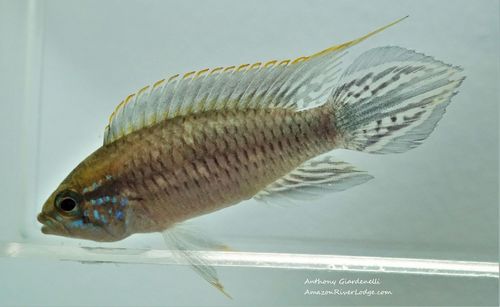
Pelvicachromis humilis is the largest species of the krib cichlids (family Cichlidae) and occurs in West Africa. The species reaches about 12 cm and has an elongate body with a dark lateral stripe and, especially in sexually mature fish, red and yellow tones. It inhabits rivers in Guinea, Sierra Leone and Liberia, in soft to moderately hard, neutral water. Reproduction is by pair-bonding and cave-spawning, with the female tending the clutch. Its diet consists of small invertebrates, algae and detritus. The species is harmless to humans and is kept in the aquarium hobby.
Frequently asked questions
How do you recognise the Giant kribensis?
The Giant kribensis has a torpedo-shaped body, is mainly brown and shows a horizontal stripes pattern.
Where does the Giant kribensis live?
The Giant kribensis lives in fresh water and is mostly found around stony or rocky ground.
How big does the Giant kribensis get?
The Giant kribensis grows to a maximum of about 13 cm.
Is the Giant kribensis dangerous to humans?
No, the Giant kribensis is harmless to humans.
Is the Giant kribensis edible?
The Giant kribensis is not usually eaten.
Download Fin's Fish Guide
Identify fish in seconds, log your catches and dives. Join the TestFlight beta.
All data
Identification
Appearance
Habitat & distribution
Behaviour & biology
For anglers
Safety
Status & sources
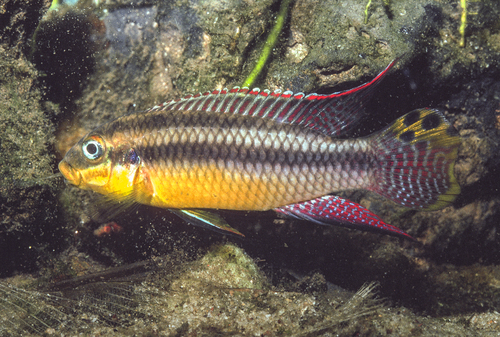
Same genus Pelvicachromis
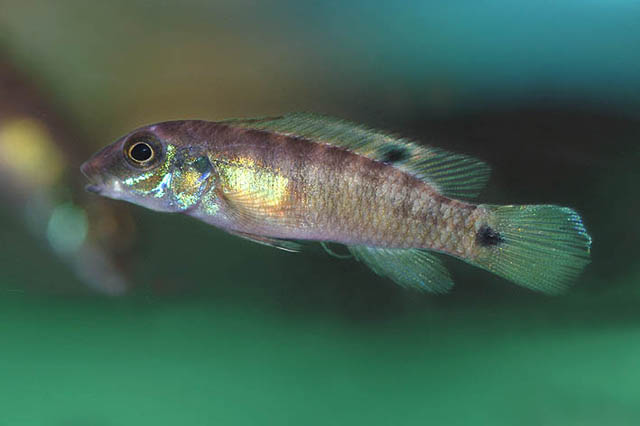

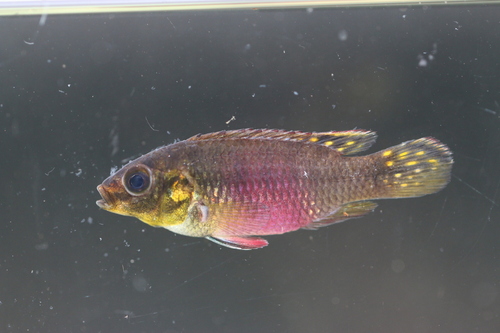

More from the family Cichlidae



Download Fin's Fish Guide
Identify fish in seconds, log your catches and dives. Join the TestFlight beta.