
The Umbee cichlid (Kronoheros umbriferus) is a fish of the family Cichlidae that grows up to 30 cm.
Description
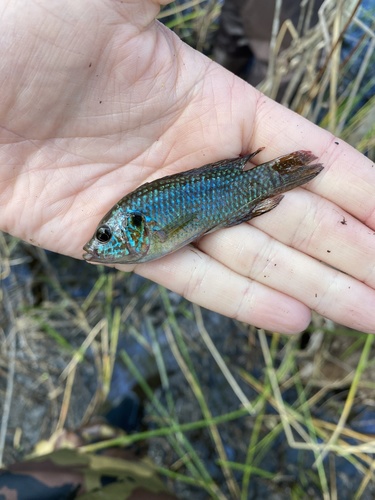
The umbee cichlid is a large cichlid (Cichlidae) from clear and turbid rivers of Panama and northwestern Colombia in Central and South America. The species grows to about 30 cm and has a deep, robust, grey-blue body with dark blotches and, in adult males, a head bump. As a bottom-oriented predator it shelters by stones and wood and seizes fish, crustaceans and snails. It is a caring, fiercely defending parental brooder. The fish is harmless to humans.
Frequently asked questions
How do you recognise the Umbee cichlid?
The Umbee cichlid is mainly blue and shows a spots pattern.
Where does the Umbee cichlid live?
The Umbee cichlid is mostly found around sand or mud bottom.
How big does the Umbee cichlid get?
The Umbee cichlid grows to a maximum of about 30 cm.
Is the Umbee cichlid dangerous to humans?
No, the Umbee cichlid is harmless to humans.
Download Fin's Fish Guide
Identify fish in seconds, log your catches and dives. Join the TestFlight beta.
All data
Identification
Appearance
Habitat & distribution
Behaviour & biology
For anglers
Safety
Status & sources
More from the family Cichlidae



Download Fin's Fish Guide
Identify fish in seconds, log your catches and dives. Join the TestFlight beta.