 Fin's Fish Guide

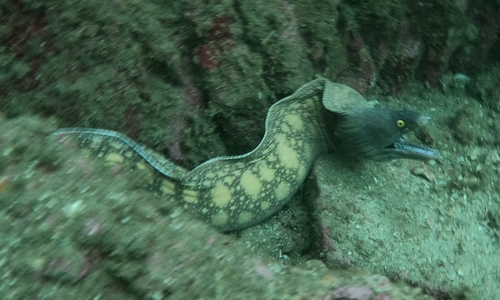
The Headspot moray (Gymnothorax cephalospilus) is a saltwater fish of the family Muraenidae that grows up to 20 cm.
Description
The %s is a moray eel (Muraenidae) from rocky and coral-reef water around Australia and the Indo-West Pacific. The species grows to about 50 cm and has a slender, snake-like, scaleless body without pectoral fins and sharp teeth. As a nocturnal ambush predator it shelters in crevices with only the head showing by day and seizes small fish, crustaceans and squid at night. When threatened or handled carelessly it can bite fiercely.
Frequently asked questions
How do you recognise the Headspot moray?
The Headspot moray has a snake-like body and is mainly brown. Can bite with sharp teeth or powerful jaws; handle with care.
Where does the Headspot moray live?
The Headspot moray lives in the sea (marine waters) and is mostly found around stony or rocky ground. Oceania: Australia
How big does the Headspot moray get?
The Headspot moray grows to a maximum of about 20 cm.
Is the Headspot moray dangerous to humans?
The Headspot moray can bite, but is otherwise not dangerous to humans. For a bite: rinse the wound with clean water, apply pressure to stop bleeding and cover it. Bite wounds easily become infected; for a deep or dirty wound see a doctor and check tetanus status.
Is the Headspot moray edible?
Yes, the Headspot moray is commonly eaten.

Want the complete picture on the Headspot moray?
Point your camera at the fish and Fin names the species in seconds. Free, and the Headspot moray is one of 12,519 species in the app.
All data
Identification
Appearance
Habitat & distribution
Behaviour & biology
For anglers
Safety
Status & sources
Same genus Gymnothorax


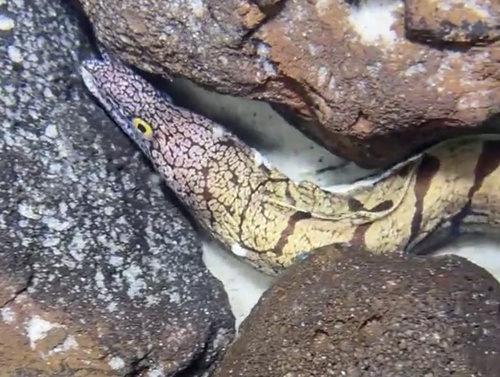
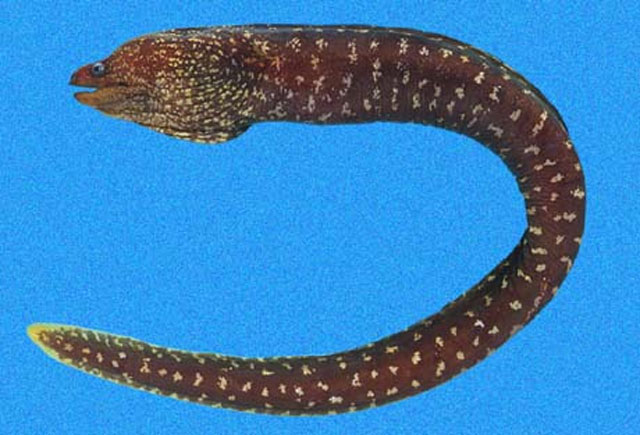
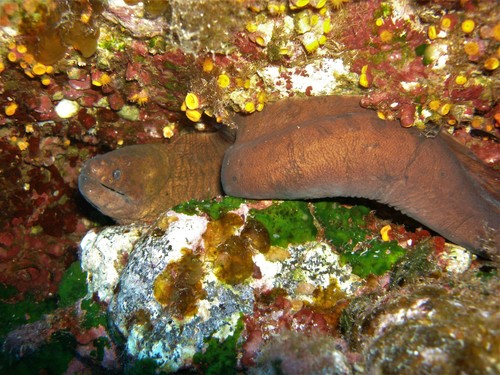
More from the family Muraenidae
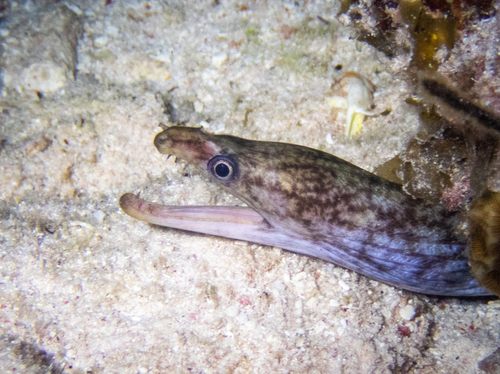



Want the complete picture on the Headspot moray?
Point your camera at the fish and Fin names the species in seconds. Free, and the Headspot moray is one of 12,519 species in the app.