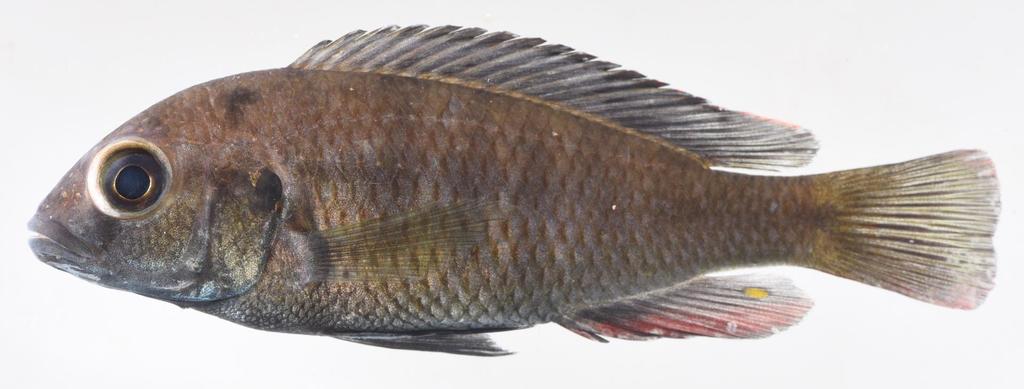
The Fewtooth haplo (Haplochromis paucidens) is a freshwater fish of the family Cichlidae that grows up to 11 cm.
Description
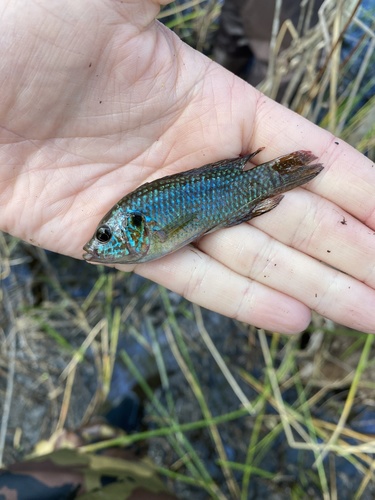
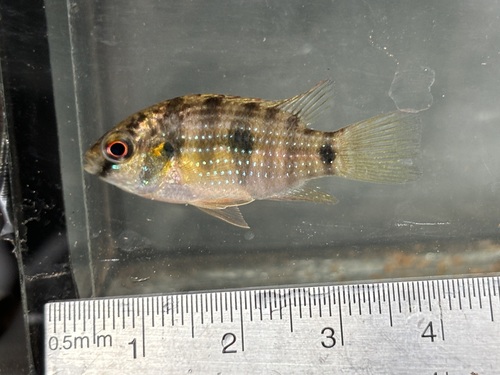
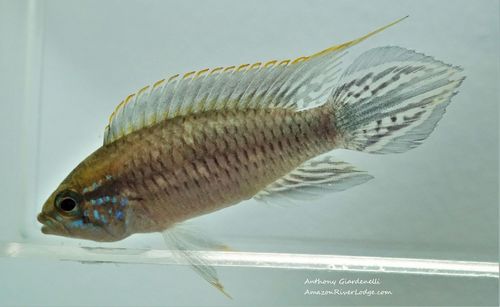
The fewtooth haplo is a small, colourful lake cichlid of the family Cichlidae reaching about 11 cm. Outside the breeding season it is inconspicuous, but the breeding male colours up vivid yellow-blue with dark cross-bands. Characteristic is its reproduction: the female takes the fertilised eggs into her mouth and broods them there, after which the young still retreat into the mouth when threatened (mouthbrooder). The species comes from Lake Kivu and surroundings in East Africa and lives near rocky and vegetated shores. As a small predator it hunts insect larvae, small crustaceans, snails and small fish. Like other haplochromine cichlids it is part of the rich, rapidly evolved species flock of the East African lakes.
Frequently asked questions
How do you recognise the Fewtooth haplo?
The Fewtooth haplo has an elongate, eel-like body, is mainly yellow-gold and shows a vertical stripes pattern.
Where does the Fewtooth haplo live?
The Fewtooth haplo lives in fresh water and is mostly found around stony or rocky ground.
How big does the Fewtooth haplo get?
The Fewtooth haplo grows to a maximum of about 11 cm.
Is the Fewtooth haplo dangerous to humans?
No, the Fewtooth haplo is harmless to humans.
Is the Fewtooth haplo edible?
The Fewtooth haplo is rarely eaten.
Download Fin's Fish Guide
Identify fish in seconds, log your catches and dives. Join the TestFlight beta.
All data
Identification
Appearance
Habitat & distribution
Behaviour & biology
For anglers
Safety
Status & sources
Same genus Haplochromis




More from the family Cichlidae



Download Fin's Fish Guide
Identify fish in seconds, log your catches and dives. Join the TestFlight beta.