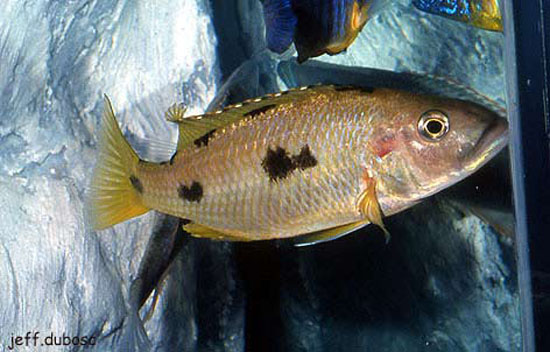
The Hook-jaw hunter (Exochochromis anagenys) is a freshwater fish of the family Cichlidae that grows up to 20 cm.
Description
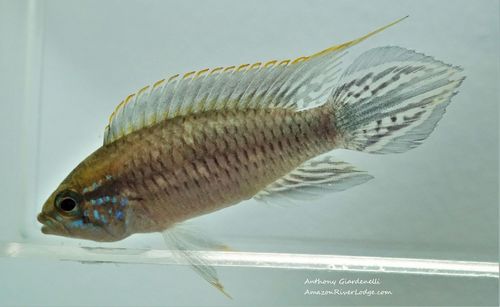
The hook-jaw hunter is a cichlid (Cichlidae) from Lake Malawi in East Africa. The species grows to about 25 cm and has an elongate, streamlined body with a pointed, slightly hooked jaw; dominant males colour up bright blue. As a fast predator it hunts small fish along the rocky shore and sometimes picks scales. It is a mouthbrooder: the female protects eggs and young in her mouth. The fish is harmless to humans.
Frequently asked questions
How do you recognise the Hook-jaw hunter?
The Hook-jaw hunter has a torpedo-shaped body and is mainly blue.
Where does the Hook-jaw hunter live?
The Hook-jaw hunter lives in fresh water and is mostly found around stony or rocky ground.
How big does the Hook-jaw hunter get?
The Hook-jaw hunter grows to a maximum of about 20 cm.
Is the Hook-jaw hunter dangerous to humans?
No, the Hook-jaw hunter is harmless to humans.
Is the Hook-jaw hunter edible?
Yes, the Hook-jaw hunter is commonly eaten.
Download Fin's Fish Guide
Identify fish in seconds, log your catches and dives. Join the TestFlight beta.
All data
Identification
Appearance
Habitat & distribution
Behaviour & biology
For anglers
Safety
Status & sources
More from the family Cichlidae



Download Fin's Fish Guide
Identify fish in seconds, log your catches and dives. Join the TestFlight beta.