Home · Carcharhinidae · Common tiger shark
Common tiger shark (Galeocerdo cuvier) — Carcharhinidae

Common tiger shark

Galeocerdo cuvier
NT · Near Threatened
NativeIntroduced

The Common tiger shark (Galeocerdo cuvier) is a brackish-water fish of the family Carcharhinidae that grows up to 750 cm.

Length
750 cm
Water
Brackish
Depth
0.0–800.0 m
Diet
Carnivore
Behaviour
Solitary
Body shape
Torpedo-shaped
Substrate
Mixed bottom
Danger
Can cause injury
Range
Tropical and warm-temperate seas worldwide, from the coast to the open sea.
Edibility
Commonly eaten

Want the complete picture on the Common tiger shark?

Get the app

Description

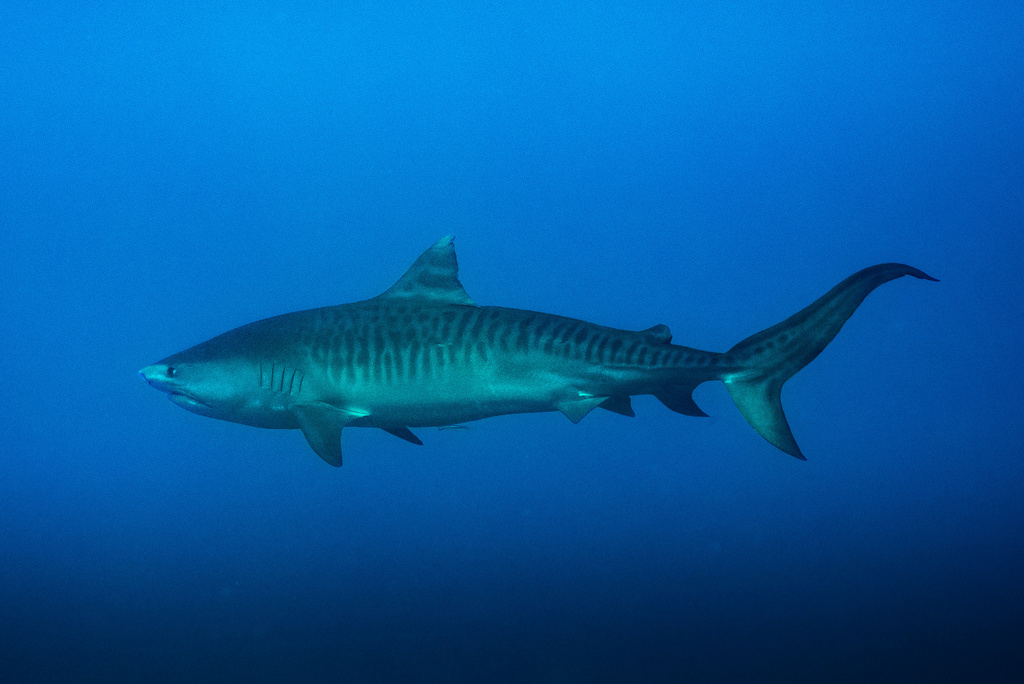
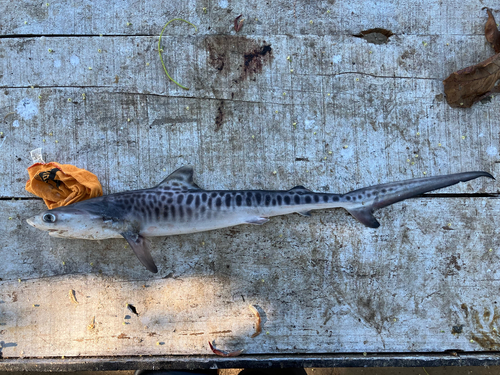
The tiger shark (Galeocerdo cuvier) is a large, powerful requiem shark of the family Carcharhinidae occurring worldwide in tropical and warm-temperate seas. The species owes its name to the dark vertical bars that are most distinct in young animals. It can reach several metres and lives from the coast to the open sea, often near river mouths, harbours and coral atolls. The tiger shark is an opportunistic predator that eats almost anything: fishes, sea turtles, seabirds, marine mammals and carrion. It is one of the few sharks regarded as dangerous to humans. Owing to fishing for fins and flesh the species is assessed as Near Threatened (NT).

Frequently asked questions

How do you recognise the Common tiger shark?

The Common tiger shark has a torpedo-shaped body, is mainly silver-grey and shows a vertical stripes pattern. Dark tiger stripes (especially in juveniles); opportunistic omnivore and one of the few sharks dangerous to humans (NT).

Where does the Common tiger shark live?

The Common tiger shark lives in brackish water and is mostly found around mixed bottom. Tropical and warm-temperate seas worldwide, from the coast to the open sea.

How big does the Common tiger shark get?

The Common tiger shark grows to a maximum of about 750 cm. On average the species is around 500 cm.

Is the Common tiger shark dangerous to humans?

The Common tiger shark can cause injury; handle it with care. A bite from a large tiger shark can cause very serious, lacerating wounds with major blood loss. Get the victim out of the water immediately, control bleeding with firm pressure and/or a pressure bandage, elevate the limb and call emergency services; treat for shock and hypothermia.

Is the Common tiger shark edible?

Yes, the Common tiger shark is commonly eaten.

More photos

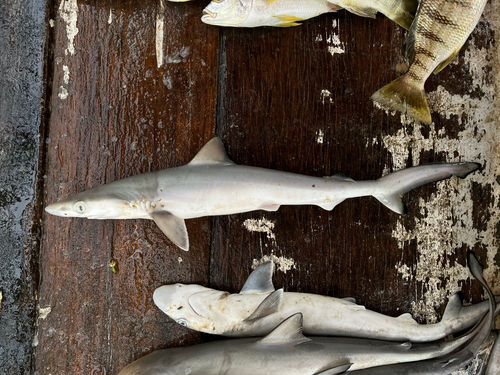
Common tiger shark (Galeocerdo cuvier) — Carcharhinidae — 2
iNaturalist ((c) wardcaleb, some rights reserved (CC BY-NC))
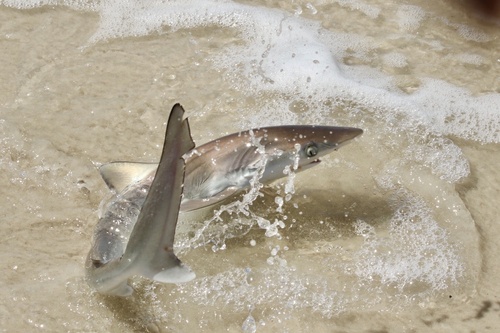
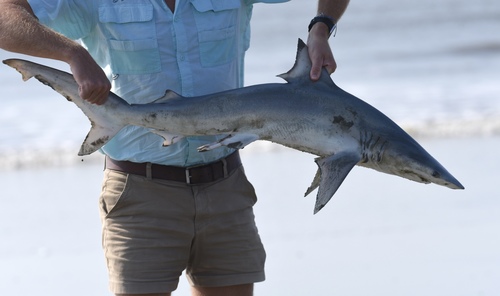
Common tiger shark (Galeocerdo cuvier) — Carcharhinidae — 3
iNaturalist ((c) Bjarne Amstrup, some rights reserved (CC BY-NC))
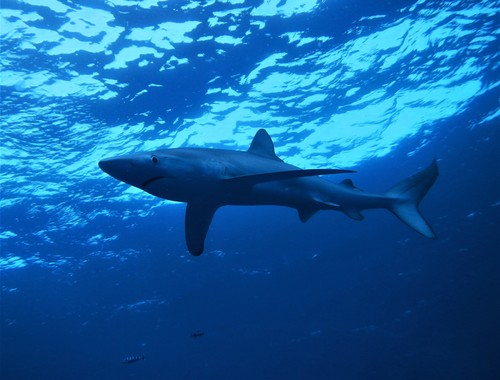
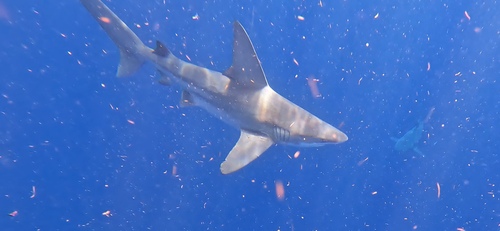
Common tiger shark (Galeocerdo cuvier) — Carcharhinidae — 4
iNaturalist ((c) Aarón, some rights reserved (CC BY-NC))
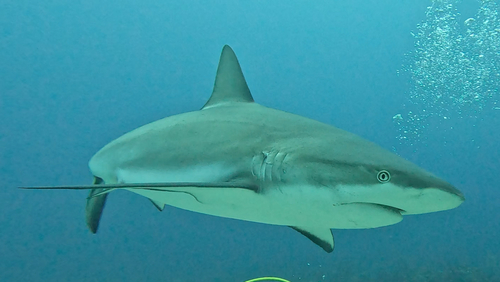
Common tiger shark (Galeocerdo cuvier) — Carcharhinidae — 5
iNaturalist ((c) Caio Henrique Cutrim, some rights reserved (CC BY-NC))

Easily confused with

These species look like the Common tiger shark and live in the same waters.
Fin

Want the complete picture on the Common tiger shark?

Point your camera at the fish and Fin names the species in seconds. Free, and the Common tiger shark is one of 12,519 species in the app.

Get the app →

All data

Identification

English name
Common tiger shark verified
Scientific name
Galeocerdo cuvier
Family
Carcharhinidae
Other names
Leopard shark; Maneater shark; Spotted shark; Tiger shark; Tiger-shark verified

Appearance

Size class
Extra large verified
Max length (cm)
750.0 verified
Average length (cm)
500.0 verified
Body shape
Torpedo-shaped sourced
Dominant colour
Silver / grey inferred
Pattern
Vertical bars inferred
Tail shape
Crescent (lunate) inferred
Mouth position
Inferior (downward) inferred
Lips
Thin inferred
Barbels
No sourced
Dorsal fins
Two separate inferred
Dorsal spines
No sourced

Habitat & distribution

Water type
Brackish sourced
Substrate
Mixed bottom sourced
Min depth (m)
0.0 verified
Max depth (m)
800.0 verified
Natural range
Tropical and warm-temperate seas worldwide, from the coast to the open sea. inferred
Origin
Native sourced

Behaviour & biology

Diet
Carnivore sourced
Diet (detail)
Fishes, sea turtles, seabirds, marine mammals and carrion sourced
Social behaviour
Solitary inferred
Territorial
No inferred
Reproduction
Separate sexes sourced
Sexual dimorphism
No inferred
levensduur_max_jaar
50.0 verified
Seasonality
Present year-round in its habitat; no pronounced seasonality known. inferred
Special features
Dark tiger stripes (especially in juveniles); opportunistic omnivore and one of the few sharks dangerous to humans (NT). sourced

For anglers

Edibility
Commonly eaten sourced
Fishing method
Caught by anglers with very heavy longline or boat tackle and large natural bait; given its status, release is preferred. sourced
Regulations source
FishBase ↗ inferred

Safety

Danger to humans
Can cause injury sourced
First aid
A bite from a large tiger shark can cause very serious, lacerating wounds with major blood loss. Get the victim out of the water immediately, control bleeding with firm pressure and/or a pressure bandage, elevate the limb and call emergency services; treat for shock and hypothermia. sourced

Status & sources

Sources
FishBase via GBIF (DwC-A), CC-BY-NC 4.0

More from the family Carcharhinidae
Fin

Want the complete picture on the Common tiger shark?

Point your camera at the fish and Fin names the species in seconds. Free, and the Common tiger shark is one of 12,519 species in the app.

Get the app →
Is this the Common tiger shark? Get the app