 Fin's Fish Guide

The Bullseye ctenopoma (Ctenopoma ocellatum) is a freshwater fish of the family Anabantidae that grows up to 14 cm.
Description
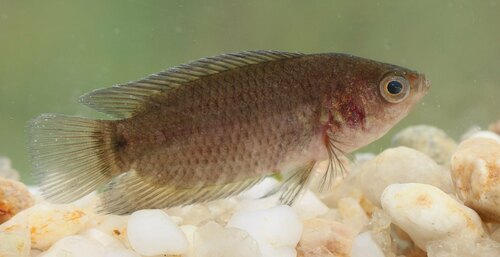
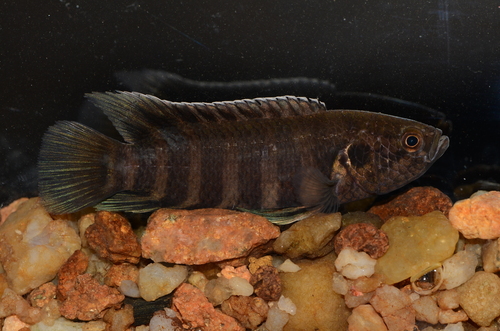
Ctenopoma ocellatum is an African labyrinth fish (family Anabantidae) of the Congo basin. The species reaches about 13 cm and has a stocky, brownish body with a conspicuous eyespot near the caudal peduncle, which can mislead predators. Like other labyrinth fishes it has an accessory breathing organ with which it can gulp air at the surface and tolerate low-oxygen waters. It lives in slow-flowing, vegetated waters and is a patient ambush predator hunting insects, crustaceans and small fishes. The species is harmless to humans and is occasionally kept as an aquarium fish.
Frequently asked questions
How do you recognise the Bullseye ctenopoma?
The Bullseye ctenopoma has a torpedo-shaped body, is mainly brown and shows a spots pattern. Labyrinth fish that can gulp air; eyespot near the caudal peduncle that misleads predators; patient stalking predator.
Where does the Bullseye ctenopoma live?
The Bullseye ctenopoma lives in fresh water and is mostly found around mixed bottom. Central Africa, in slow-flowing, vegetated waters of the Congo basin.
How big does the Bullseye ctenopoma get?
The Bullseye ctenopoma grows to a maximum of about 14 cm.
Is the Bullseye ctenopoma dangerous to humans?
No, the Bullseye ctenopoma is harmless to humans. None required: this species is harmless to humans.
Is the Bullseye ctenopoma edible?
The Bullseye ctenopoma is not usually eaten.

Want the complete picture on the Bullseye ctenopoma?
Point your camera at the fish and Fin names the species in seconds. Free, and the Bullseye ctenopoma is one of 12,519 species in the app.
All data
Identification
Appearance
Habitat & distribution
Behaviour & biology
For anglers
Safety
Status & sources
Same genus Ctenopoma


More from the family Anabantidae

Want the complete picture on the Bullseye ctenopoma?
Point your camera at the fish and Fin names the species in seconds. Free, and the Bullseye ctenopoma is one of 12,519 species in the app.