 Fin's Fish Guide

The Bonejack (Alosa mediocris) is a fish that lives in both fresh and salt water of the family Clupeidae that grows up to 60 cm.
Western Atlantic; anadromous between the sea and eastern North American rivers.
Description
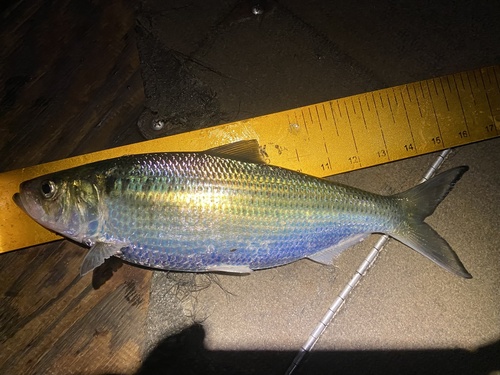
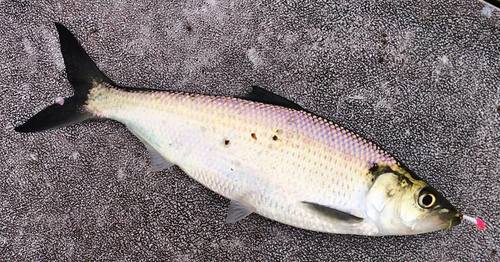
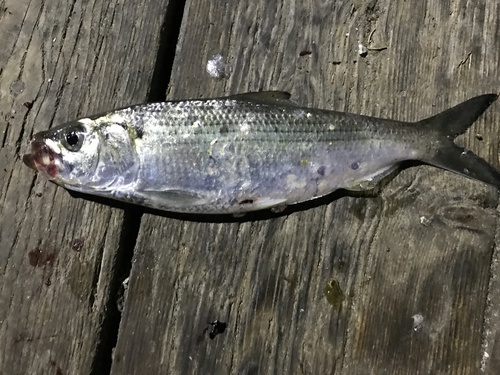
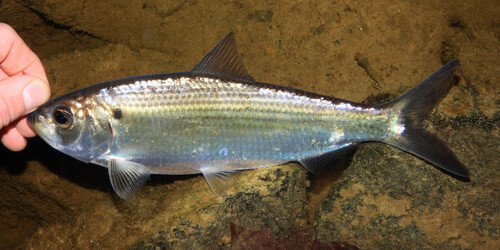
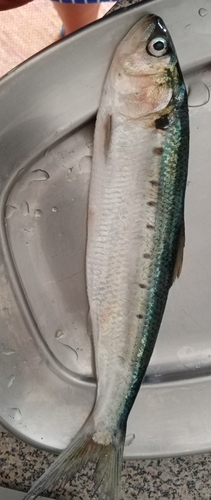
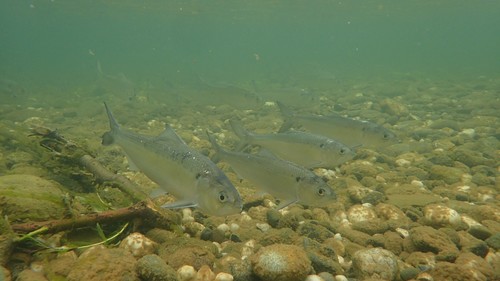
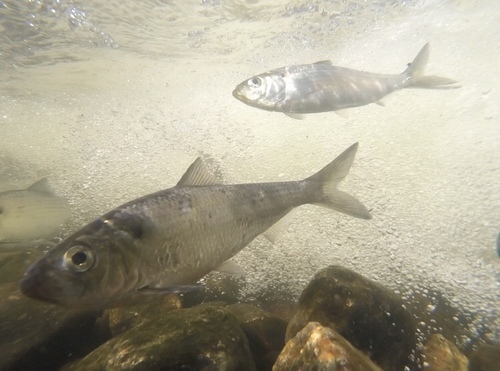
The hickory shad is a herring-like fish of the family Clupeidae from the western Atlantic off the east coast of North America. The species grows to about 60 cm and has an elongate, laterally compressed, silvery body with a projecting lower jaw and a row of dark spots behind the gill cover. It is an anadromous species: it lives in the sea and runs up rivers to spawn. Unlike most plankton-feeding shads the hickory shad is a decided fish-eating predator that also eats shrimps and small crustaceans. It is a valued sport fish and is harmless to humans.
Frequently asked questions
How do you recognise the Bonejack?
The Bonejack has a torpedo-shaped body, is mainly silver-grey and shows a spots pattern. Anadromous shad with a projecting lower jaw; unusually fish-eating for a herring-like fish.
Where does the Bonejack live?
The Bonejack lives in both fresh and salt water and is mostly found around open water. Western Atlantic; anadromous between the sea and eastern North American rivers.
How big does the Bonejack get?
The Bonejack grows to a maximum of about 60 cm. On average the species is around 34 cm.
Is the Bonejack dangerous to humans?
No, the Bonejack is harmless to humans. None required: this species is harmless to humans.
Is the Bonejack edible?
Yes, the Bonejack is commonly eaten.
More photos


Want the complete picture on the Bonejack?
Point your camera at the fish and Fin names the species in seconds. Free, and the Bonejack is one of 12,519 species in the app.
All data
Identification
Appearance
Habitat & distribution
Behaviour & biology
For anglers
Safety
Status & sources
Same genus Alosa
More from the family Clupeidae




Want the complete picture on the Bonejack?
Point your camera at the fish and Fin names the species in seconds. Free, and the Bonejack is one of 12,519 species in the app.