Home · Balistidae · Blackbar triggerfish
Blackbar triggerfish (Rhinecanthus aculeatus) — Balistidae

Blackbar triggerfish

Rhinecanthus aculeatus
Family: Balistidae
LC · Least Concern

The Blackbar triggerfish (Rhinecanthus aculeatus) is a saltwater fish of the family Balistidae that grows up to 30 cm.

Length
30 cm
Water
Saltwater
Depth
0.0–50.0 m
Diet
Omnivore
Behaviour
Solitary
Activity
Diurnal
Body shape
Flat / disc-shaped
Substrate
Stone or rock
Danger
Venomous / poisonous
Range
Indo-Pacific, on subtidal reef flats and in shallow sheltered lagoons.
Edibility
Rarely eaten

Want the complete picture on the Blackbar triggerfish?

Get the app

Description

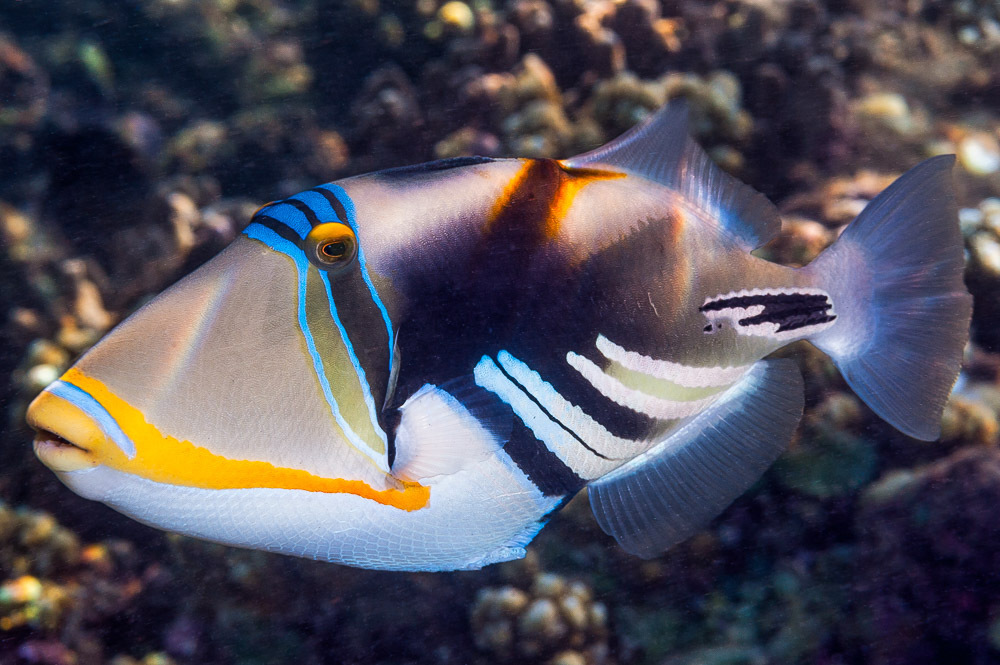
The white-banded triggerfish, also known as the Picasso triggerfish, is a strikingly coloured triggerfish (family Balistidae) of the Indo-Pacific. The species reaches about 30 cm and has a deep, laterally compressed body with a graphic pattern of white, black, blue and yellow bands and lines. It is common on subtidal reef flats and in shallow protected lagoons; juveniles shelter among rubble, adults defend a territory. It is an omnivore feeding on a variety of bottom organisms. It can lock the first dorsal spine upright. In parts of its range the flesh can contain ciguatera.

Frequently asked questions

How do you recognise the Blackbar triggerfish?

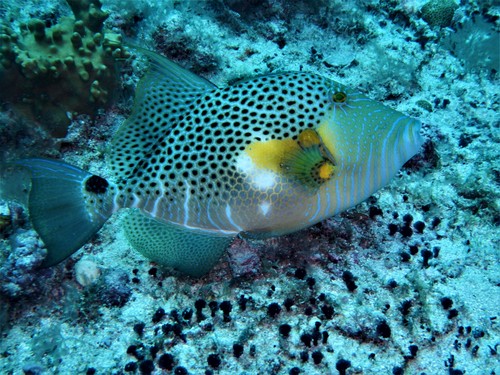
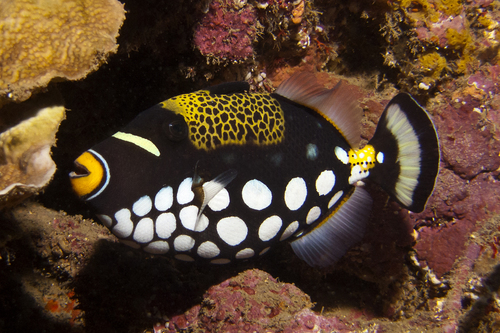
The Blackbar triggerfish has a flattened, disc-shaped body, is mainly multicoloured and shows a vertical stripes pattern. Strikingly graphic colour pattern; can lock the first dorsal fin spine; locally prone to ciguatera.

Where does the Blackbar triggerfish live?

The Blackbar triggerfish lives in the sea (marine waters) and is mostly found around stony or rocky ground. Indo-Pacific, on subtidal reef flats and in shallow sheltered lagoons.

How big does the Blackbar triggerfish get?

The Blackbar triggerfish grows to a maximum of about 30 cm. On average the species is around 15 cm.

Is the Blackbar triggerfish dangerous to humans?

The Blackbar triggerfish is venomous — handle spines with care and seek medical help after a sting if needed. The flesh can contain ciguatera in some tropical areas; do not eat large reef specimens from risk areas. In case of poisoning (tingling, gastrointestinal symptoms) seek medical advice.

Is the Blackbar triggerfish edible?

The Blackbar triggerfish is rarely eaten.

More photos

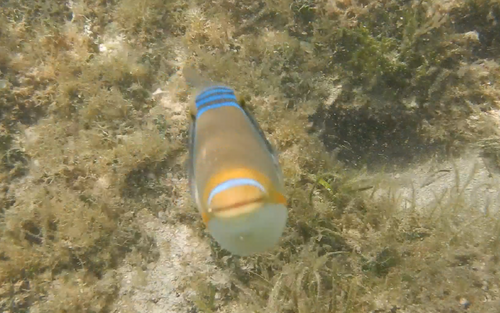
Blackbar triggerfish (Rhinecanthus aculeatus) — Balistidae — 2
Wikimedia Commons — User:janderk (Public domain)
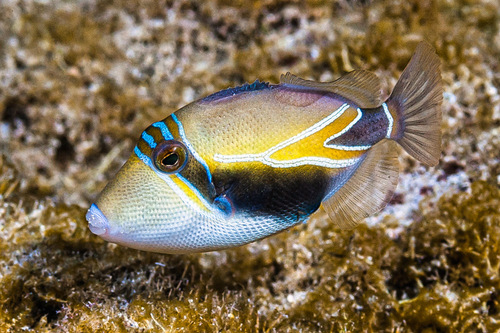
Blackbar triggerfish (Rhinecanthus aculeatus) — Balistidae — 3
Wikimedia Commons — Arpingstone (Public domain)
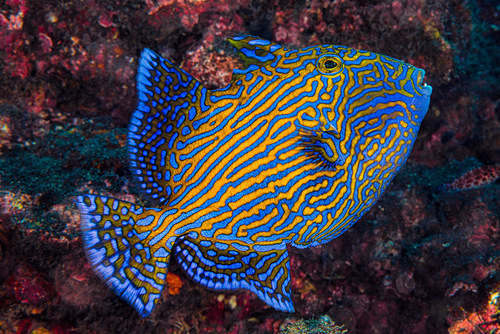
Blackbar triggerfish (Rhinecanthus aculeatus) — Balistidae — 4
Wikimedia Commons — No machine-readable author provided. Cocomero ryo assumed (based on copyright claims). (CC BY 2.5)
Blackbar triggerfish (Rhinecanthus aculeatus) — Balistidae — 5
iNaturalist ((c) Sam, some rights reserved (CC BY-NC))
Fin

Want the complete picture on the Blackbar triggerfish?

Point your camera at the fish and Fin names the species in seconds. Free, and the Blackbar triggerfish is one of 12,519 species in the app.

Get the app →

All data

Identification

English name
Blackbar triggerfish verified
Scientific name
Rhinecanthus aculeatus
Family
Balistidae
Other names
Blackbar triggerfish; Black-barred trigger-fish; White-banded triggerfish; Picassofish; Whitebanded triggerfish; Lagoon triggerfish; Picasso triggerfish; Hawaiian triggerfish; Hawaiian trigger-fish; Lagoon humu; Painted trigger; Picasso verified

Appearance

Size class
Medium verified
Max length (cm)
30.0 verified
Average length (cm)
15.0 verified
Body shape
Flat / disc-shaped sourced
Dominant colour
Multicoloured inferred
Pattern
Vertical bars inferred
Tail shape
Straight inferred
Mouth position
Terminal inferred
Lips
Thin inferred
Barbels
No sourced
Dorsal fins
Two separate inferred
Dorsal spines
Yes sourced

Habitat & distribution

Water type
Saltwater sourced
Substrate
Stone or rock sourced
Min depth (m)
0.0 verified
Max depth (m)
50.0 verified
Natural range
Indo-Pacific, on subtidal reef flats and in shallow sheltered lagoons. inferred
Origin
Native sourced

Behaviour & biology

Diet
Omnivore sourced
Diet (detail)
Various bottom organisms, including algae, crustaceans and molluscs sourced
Social behaviour
Solitary inferred
Territorial
Yes inferred
Activity
Diurnal inferred
Reproduction
Separate sexes sourced
Sexual dimorphism
No inferred
Seasonality
Present year-round in its habitat; no pronounced seasonality known. inferred
Special features
Strikingly graphic colour pattern; can lock the first dorsal fin spine; locally prone to ciguatera. sourced

For anglers

Edibility
Rarely eaten sourced
Fishing method
Fishing with natural bait (fish, shrimp, worm) or lures close to reef and rock structures. inferred
Regulations source
FishBase ↗ inferred

Safety

Danger to humans
Venomous / poisonous sourced
First aid
The flesh can contain ciguatera in some tropical areas; do not eat large reef specimens from risk areas. In case of poisoning (tingling, gastrointestinal symptoms) seek medical advice. sourced

Status & sources

Sources
FishBase via GBIF (DwC-A), CC-BY-NC 4.0

Same genus Rhinecanthus

More from the family Balistidae

Fin

Want the complete picture on the Blackbar triggerfish?

Point your camera at the fish and Fin names the species in seconds. Free, and the Blackbar triggerfish is one of 12,519 species in the app.

Get the app →
Is this the Blackbar triggerfish? Get the app