 Fin's Fish Guide
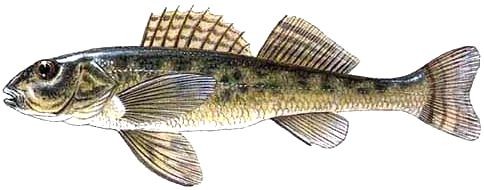
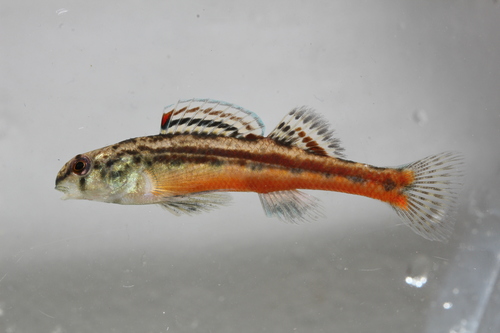
The Asprete (Romanichthys valsanicola) is a freshwater fish of the family Percidae that grows up to 11 cm.
Endemic to a few fast-flowing, cool and oxygen-rich mountain rivers in Romania, with coarse gravel and stones; today virtually restricted to a short stretch of the river Vâlsan.
Description
The asprete is a spindle-shaped, perch-like bottom fish of the family Percidae reaching about 11 cm. The almost cylindrical, brown-mottled body with two separate dorsal fins is strongly adapted to life among stones on the bottom of fast-flowing mountain rivers. The species is a living fossil: it is the only member of its genus and is regarded as one of the oldest and rarest fish in Europe. It is endemic to a few rivers in Romania but, through dams, deforestation and pollution, has become almost confined to a short stretch of the river Vâlsan. At night it hunts insect larvae and small invertebrates among the stones. With an extremely small population it is assessed as Critically Endangered (CR) and is the subject of intensive conservation.
Frequently asked questions
How do you recognise the Asprete?
The Asprete has an elongate, eel-like body, is mainly brown and shows a marbled pattern. Spindle-shaped, perch-like bottom-dweller with an almost cylindrical body; a living fossil and one of the rarest fishes in Europe.
Where does the Asprete live?
The Asprete lives in fresh water and is mostly found around stony or rocky ground. Endemic to a few fast-flowing, cool and oxygen-rich mountain rivers in Romania, with coarse gravel and stones; today virtually restricted to a short stretch of the river Vâlsan.
How big does the Asprete get?
The Asprete grows to a maximum of about 11 cm.
Is the Asprete dangerous to humans?
No, the Asprete is harmless to humans. None required: this species is harmless to humans.
Is the Asprete edible?
The Asprete is not usually eaten.
More photos


Want the complete picture on the Asprete?
Point your camera at the fish and Fin names the species in seconds. Free, and the Asprete is one of 12,519 species in the app.
All data
Identification
Appearance
Habitat & distribution
Behaviour & biology
For anglers
Safety
Status & sources
More from the family Percidae



Want the complete picture on the Asprete?
Point your camera at the fish and Fin names the species in seconds. Free, and the Asprete is one of 12,519 species in the app.