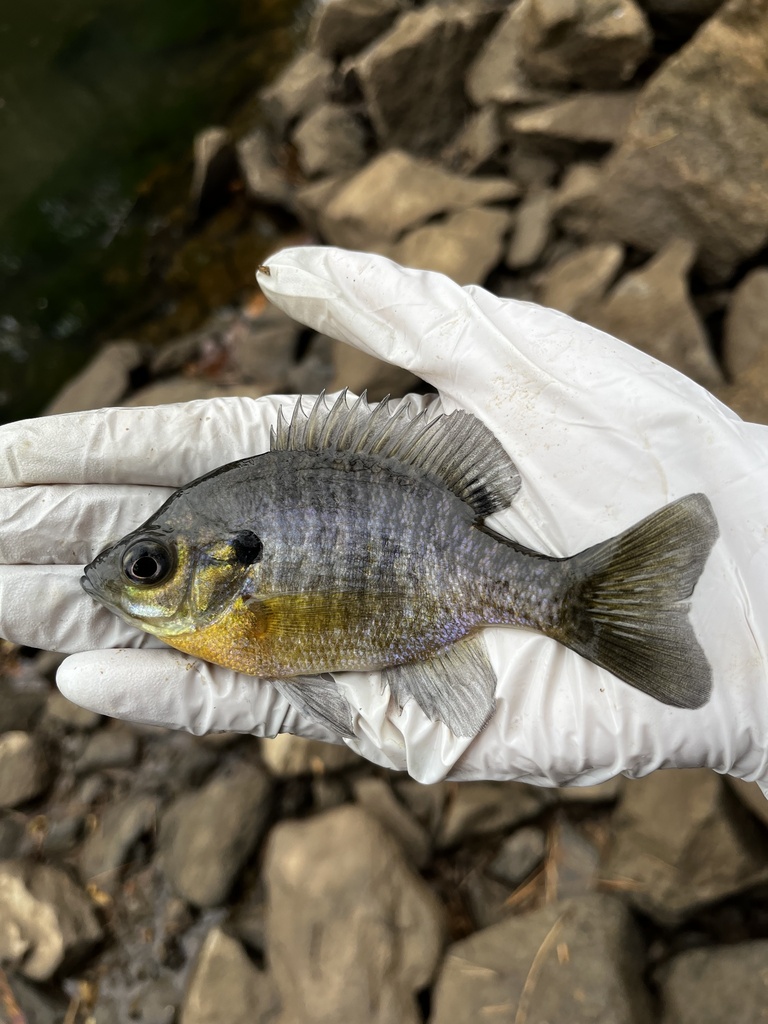
The Bluegill (Lepomis macrochirus) is a freshwater fish of the family Centrarchidae that grows up to 41 cm.
Description
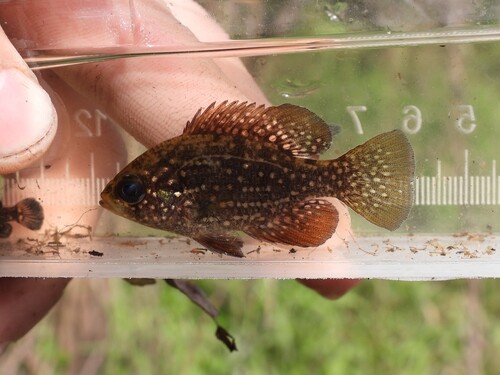
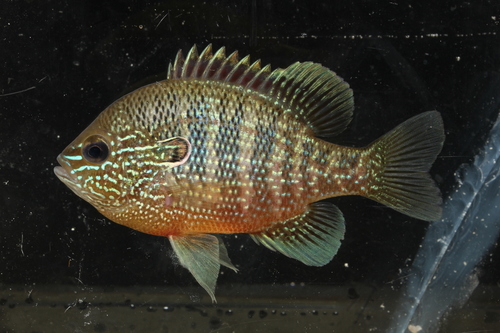
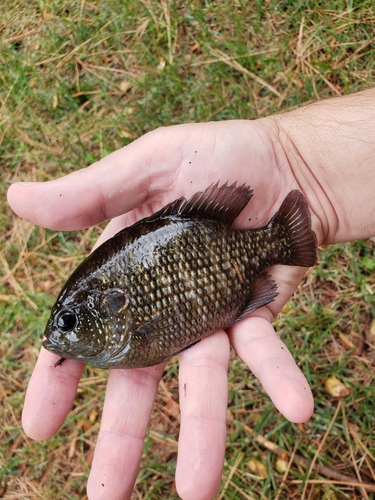
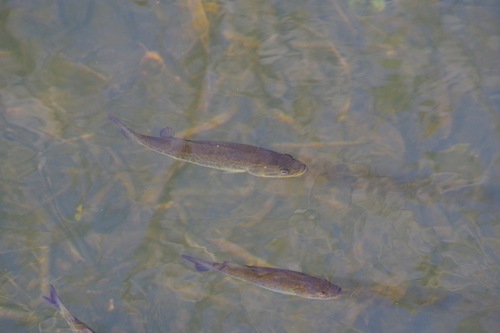
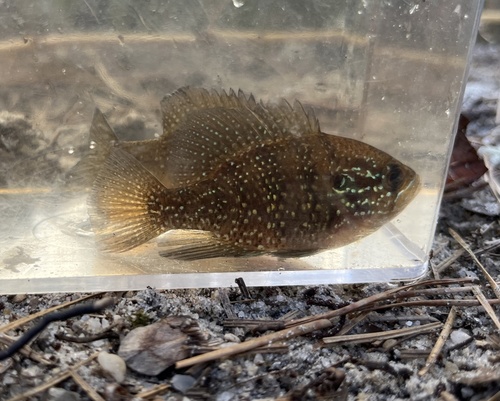
The bluegill is a deep, disc-shaped sunfish of the family Centrarchidae reaching about 41 cm, though usually smaller. The laterally compressed body has faint dark cross-bars, a blue-green sheen and a conspicuous black flap on the gill cover; adults often have an orange breast. The species is native to eastern and central North America and lives in slow-flowing rivers, lakes and ponds with abundant water plants. It eats insect larvae, small crustaceans, snails and fish eggs. In late spring the male sweeps a nest pit and guards the eggs and young. As a sport fish it has been introduced into parts of Europe, where it becomes locally invasive and competes with native fish.
Frequently asked questions
How do you recognise the Bluegill?
The Bluegill has a flattened, disc-shaped body, is mainly blue and shows a vertical stripes pattern.
Where does the Bluegill live?
The Bluegill lives in fresh water and is mostly found around algae or seagrass beds.
How big does the Bluegill get?
The Bluegill grows to a maximum of about 41 cm. On average the species is around 19 cm.
Is the Bluegill dangerous to humans?
No, the Bluegill is harmless to humans.
Is the Bluegill edible?
Yes, the Bluegill is commonly eaten.
Download Fin's Fish Guide
Identify fish in seconds, log your catches and dives. Join the TestFlight beta.
All data
Identification
Appearance
Habitat & distribution
Behaviour & biology
For anglers
Safety
Status & sources
Same genus Lepomis
More from the family Centrarchidae
Download Fin's Fish Guide
Identify fish in seconds, log your catches and dives. Join the TestFlight beta.