Home · Balistidae · Leatherjacket
Leatherjacket (Balistapus undulatus) — Balistidae

Leatherjacket

Balistapus undulatus
Family: Balistidae
LC · Least Concern

The Leatherjacket (Balistapus undulatus) is a saltwater fish of the family Balistidae that grows up to 30 cm.

Length
30 cm
Water
Saltwater
Depth
0.0–60.0 m
Diet
Omnivore
Behaviour
Solitary
Activity
Diurnal
Body shape
Flat / disc-shaped
Substrate
Stone or rock
Danger
Can cause injury
Range
Indian and Pacific Ocean, from the Red Sea and East Africa to the central part of the Pacific.
Edibility
Commonly eaten

Want the complete picture on the Leatherjacket?

Get the app

Description

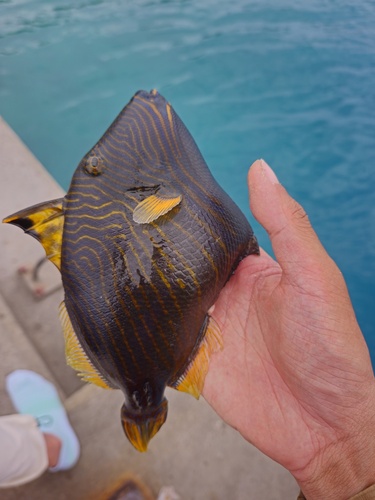
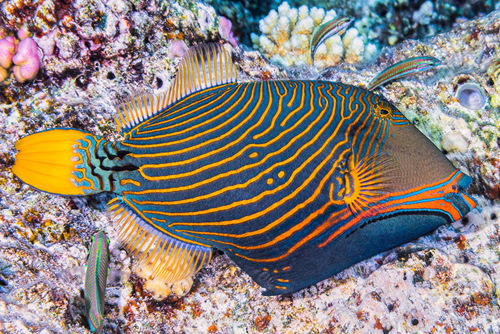
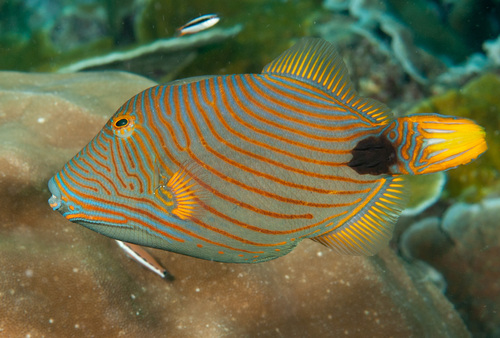
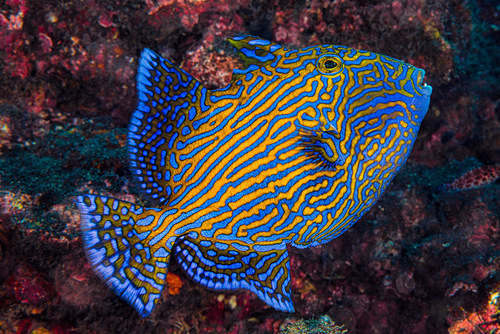
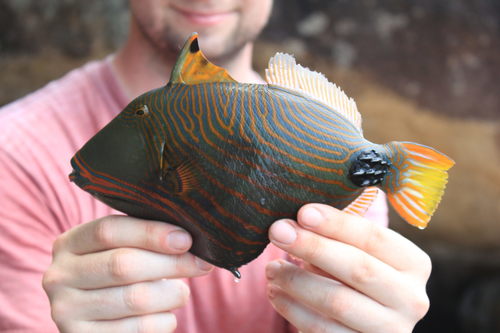
The orange-lined triggerfish is a striking triggerfish (family Balistidae) of the Indian and Pacific Oceans. The species grows to about 30 cm and has a deep, laterally compressed, dark green body with wavy orange lines. Like all triggerfishes it can erect the first dorsal spine and lock it with a second spine to wedge itself into crevices. Adults are territorial and live in coral-rich parts of lagoon and seaward reefs. As an omnivore it nibbles on a variety of bottom organisms, coral and algae. With its powerful teeth it can bite hard if handled carelessly.

Frequently asked questions

How do you recognise the Leatherjacket?

The Leatherjacket has a flattened, disc-shaped body, is mainly green and shows a flame-patterned pattern. Lockable dorsal spine (trigger mechanism) and winding orange lines; powerful teeth.

Where does the Leatherjacket live?

The Leatherjacket lives in the sea (marine waters) and is mostly found around stony or rocky ground. Indian and Pacific Ocean, from the Red Sea and East Africa to the central part of the Pacific.

How big does the Leatherjacket get?

The Leatherjacket grows to a maximum of about 30 cm. On average the species is around 26 cm.

Is the Leatherjacket dangerous to humans?

The Leatherjacket can cause injury; handle it with care. For a bite, clean and disinfect the wound, control bleeding and watch for infection; consult a doctor for a deep wound.

Is the Leatherjacket edible?

Yes, the Leatherjacket is commonly eaten.

More photos
Leatherjacket (Balistapus undulatus) — Balistidae — 2
iNaturalist ((c) Bradley Rasmussen, some rights reserved (CC BY-NC))
Leatherjacket (Balistapus undulatus) — Balistidae — 3
iNaturalist ((c) Drake Chen, some rights reserved (CC BY-NC))
Leatherjacket (Balistapus undulatus) — Balistidae — 4
iNaturalist ((c) François Libert, some rights reserved (CC BY-NC-SA))
Leatherjacket (Balistapus undulatus) — Balistidae — 5
iNaturalist ((c) Erik Schlögl, some rights reserved (CC BY-NC))
Fin

Want the complete picture on the Leatherjacket?

Point your camera at the fish and Fin names the species in seconds. Free, and the Leatherjacket is one of 12,519 species in the app.

Get the app →

All data

Identification

English name
Leatherjacket verified
Scientific name
Balistapus undulatus
Family
Balistidae
Other names
Orange striped triggerfish; Orange-lined triggerfish; Orangestriped triggerfish; Red-lined triggerfish; Vermiculated triggerfish; Orangestripe triggerfish; Striped triggerfish; Undulate triggerfish; Undulated triggerfish verified

Appearance

Size class
Medium verified
Max length (cm)
30.0 verified
Average length (cm)
26.0 verified
Body shape
Flat / disc-shaped sourced
Dominant colour
Green inferred
Pattern
Flame-patterned inferred
Tail shape
Straight inferred
Mouth position
Terminal inferred
Lips
Thin inferred
Barbels
No sourced
Dorsal fins
Two separate inferred
Dorsal spines
Yes sourced

Habitat & distribution

Water type
Saltwater sourced
Substrate
Stone or rock sourced
Min depth (m)
0.0 verified
Max depth (m)
60.0 verified
Natural range
Indian and Pacific Ocean, from the Red Sea and East Africa to the central part of the Pacific. inferred
Origin
Native sourced

Behaviour & biology

Diet
Omnivore sourced
Diet (detail)
Bottom organisms, coral and algae sourced
Social behaviour
Solitary inferred
Territorial
Yes inferred
Activity
Diurnal inferred
Reproduction
Separate sexes sourced
Sexual dimorphism
No inferred
Seasonality
Territorial pairs spawn in the warm months; the eggs are guarded on the bottom. inferred
Special features
Lockable dorsal spine (trigger mechanism) and winding orange lines; powerful teeth. sourced

For anglers

Edibility
Commonly eaten sourced
Fishing method
Fishing with natural bait (fish, shrimp, worm) or lures close to reef and rock structures. inferred
Regulations source
FishBase ↗ inferred

Safety

Danger to humans
Can cause injury sourced
First aid
For a bite, clean and disinfect the wound, control bleeding and watch for infection; consult a doctor for a deep wound. sourced

Status & sources

Sources
FishBase via GBIF (DwC-A), CC-BY-NC 4.0

More from the family Balistidae

Fin

Want the complete picture on the Leatherjacket?

Point your camera at the fish and Fin names the species in seconds. Free, and the Leatherjacket is one of 12,519 species in the app.

Get the app →
Is this the Leatherjacket? Get the app