 Fin's Fish Guide

The Jawslinger (Epibulus insidiator) is a saltwater fish of the family Labridae that grows up to 54 cm.
Description
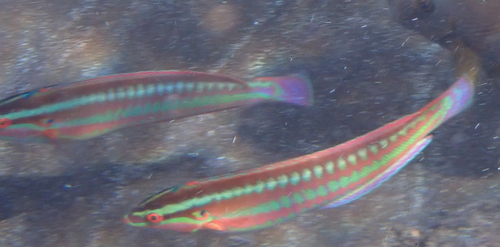
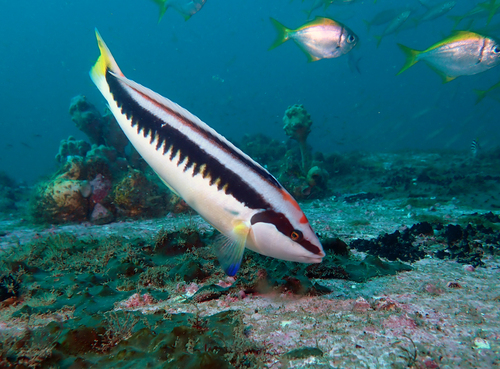
The slingjaw wrasse is a remarkable wrasse of the family Labridae from the Indo-Pacific. The species grows to about 54 cm and is famous for its extremely far-protrusible mouth: the jaws can be suddenly slung forward into a long tube to suck up prey, the most protrusible jaw of any fish. It inhabits coral-rich parts of lagoon and seaward reefs. As a predator it catches small fishes and crustaceans from crevices. The colour varies strongly by phase, from yellow or brown to a dark courtship dress. Like many wrasses it changes sex during life, from female to male. The species is harmless to humans.
Frequently asked questions
How do you recognise the Jawslinger?
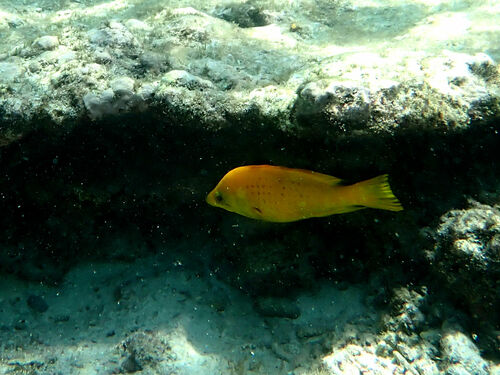
The Jawslinger has a flattened, disc-shaped body, is mainly yellow-gold and shows a plain pattern. The most protrusible jaws of all fishes: the jaws shoot forward like a tube to suck in prey.
Where does the Jawslinger live?
The Jawslinger lives in the sea (marine waters) and is mostly found around stony or rocky ground. Indo-Pacific; coral-rich parts of lagoon and seaward reefs.
How big does the Jawslinger get?
The Jawslinger grows to a maximum of about 54 cm.
Is the Jawslinger dangerous to humans?
The Jawslinger is venomous — handle spines with care and seek medical help after a sting if needed. None required: this species is harmless to humans.
Is the Jawslinger edible?
The Jawslinger is rarely eaten.
More photos



Want the complete picture on the Jawslinger?
Point your camera at the fish and Fin names the species in seconds. Free, and the Jawslinger is one of 12,519 species in the app.
All data
Identification
Appearance
Habitat & distribution
Behaviour & biology
For anglers
Safety
Status & sources
More from the family Labridae



Want the complete picture on the Jawslinger?
Point your camera at the fish and Fin names the species in seconds. Free, and the Jawslinger is one of 12,519 species in the app.