Home · Acanthuridae · Humpnose unicornfish
Humpnose unicornfish (Naso tuberosus) — Acanthuridae

Humpnose unicornfish

Naso tuberosus
Family: Acanthuridae

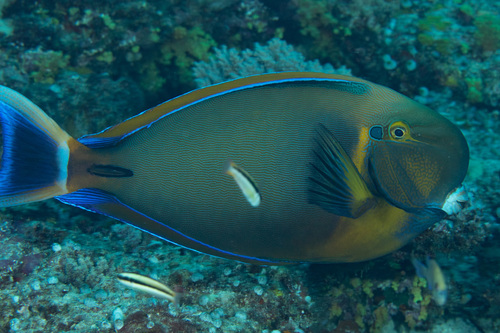
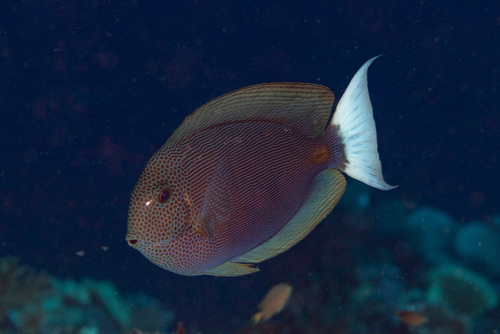
The Humpnose unicornfish (Naso tuberosus) is a brackish-water fish of the family Acanthuridae that grows up to 60 cm.

Length
60 cm
Water
Brackish
Diet
Herbivore
Activity
Diurnal
Body shape
Torpedo-shaped
Substrate
Stone or rock
Danger
Can cause injury
Range
Africa: Australia, Guam, India, Mauritius, Mozambique, Palau and others

Want the complete picture on the Humpnose unicornfish?

Get the app

Description

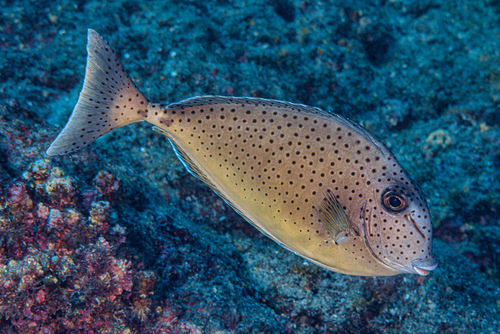
The humpnose unicornfish is a surgeonfish (Acanthuridae) from the Indo-West Pacific. The species grows to about 60 cm and has a deep, grey-brown body with a conspicuous fleshy bump on the snout in adults. On the tail base it carries two pairs of sharp, scalpel-like bony keels. As a reef-dweller it grazes weed and leafy algae from rocky and coral bottoms. The tail keels can cause deep cuts when handled; otherwise the fish is harmless to humans.

Frequently asked questions

How do you recognise the Humpnose unicornfish?

The Humpnose unicornfish has a torpedo-shaped body and is mainly brown. Bears sharp spines, plates or strong jaws that can cause cuts or puncture wounds; handle with care.

Where does the Humpnose unicornfish live?

The Humpnose unicornfish lives in brackish water and is mostly found around stony or rocky ground. Africa: Australia, Guam, India, Mauritius, Mozambique, Palau and others

How big does the Humpnose unicornfish get?

The Humpnose unicornfish grows to a maximum of about 60 cm.

Is the Humpnose unicornfish dangerous to humans?

The Humpnose unicornfish can cause injury; handle it with care. Do not grab the fish by the tail: surgeonfishes carry sharp, scalpel-like bony plates on the tail base that can cause deep cuts. For a cut: clean, apply pressure to stop bleeding and cover with a sterile dressing; for a deep wound seek medical assessment and check tetanus status.

More photos

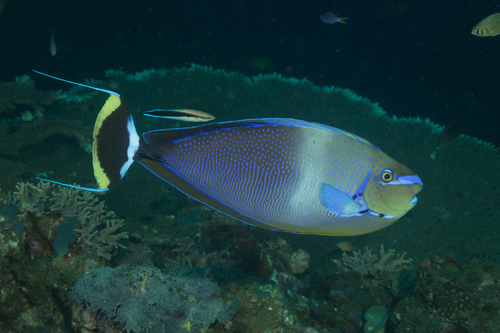
Humpnose unicornfish (Naso tuberosus) — Acanthuridae — 2
Wikimedia Commons — Randall, J.E. (CC BY 3.0)
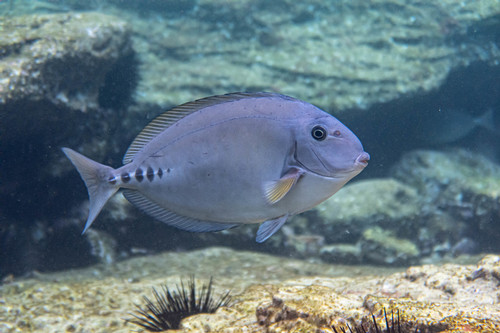
Humpnose unicornfish (Naso tuberosus) — Acanthuridae — 3
Wikimedia Commons — Jerome Huet (IFREMER, Délégation océan Indien (DOI), Département Ressources Biologiques et Environnement (RBE), F-97420 Le Port, France) (CC BY 4.0)
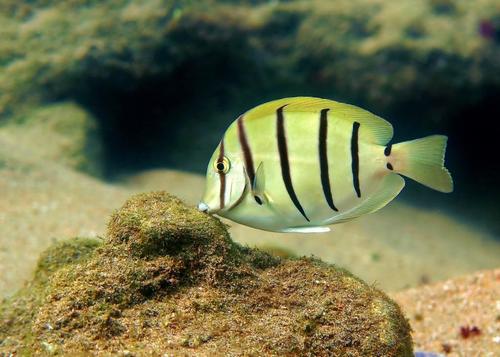
Humpnose unicornfish (Naso tuberosus) — Acanthuridae — 4
iNaturalist ((c) François Libert, some rights reserved (CC BY-NC))
Humpnose unicornfish (Naso tuberosus) — Acanthuridae — 5
Wikimedia Commons — Arjan de Groene (CC BY 3.0)
Fin

Want the complete picture on the Humpnose unicornfish?

Point your camera at the fish and Fin names the species in seconds. Free, and the Humpnose unicornfish is one of 12,519 species in the app.

Get the app →

All data

Identification

English name
Humpnose unicornfish sourced
Scientific name
Naso tuberosus
Family
Acanthuridae
Other names
Humpnose unicornfish verified

Appearance

Size class
Large verified
Max length (cm)
60.0 verified
Body shape
Torpedo-shaped sourced
Dominant colour
Brown sourced
Tail shape
Crescent (lunate) inferred

Habitat & distribution

Water type
Brackish sourced
Substrate
Stone or rock sourced
Natural range
Africa: Australia, Guam, India, Mauritius, Mozambique, Palau and others sourced
Origin
Native inferred

Behaviour & biology

Diet
Herbivore sourced
Diet (detail)
Algae, seaweeds and plant material inferred
Territorial
No inferred
Activity
Diurnal inferred
Reproduction
Separate sexes inferred
Sexual dimorphism
No inferred
levensduur_max_jaar
25.0 sourced
Seasonality
Present year-round in its habitat; no pronounced seasonality known. inferred
Special features
Bears sharp spines, plates or strong jaws that can cause cuts or puncture wounds; handle with care. inferred

For anglers

Fishing method
Fishing with natural bait (fish, shrimp, worm) or lures close to reef and rock structures. inferred
Regulations source
FishBase ↗ inferred

Safety

Danger to humans
Can cause injury verified
First aid
Do not grab the fish by the tail: surgeonfishes carry sharp, scalpel-like bony plates on the tail base that can cause deep cuts. For a cut: clean, apply pressure to stop bleeding and cover with a sterile dressing; for a deep wound seek medical assessment and check tetanus status. sourced

Status & sources

Sources
FishBase via GBIF (DwC-A), CC-BY-NC 4.0

Same genus Naso

More from the family Acanthuridae
Fin

Want the complete picture on the Humpnose unicornfish?

Point your camera at the fish and Fin names the species in seconds. Free, and the Humpnose unicornfish is one of 12,519 species in the app.

Get the app →
Is this the Humpnose unicornfish? Get the app