 Fin's Fish Guide
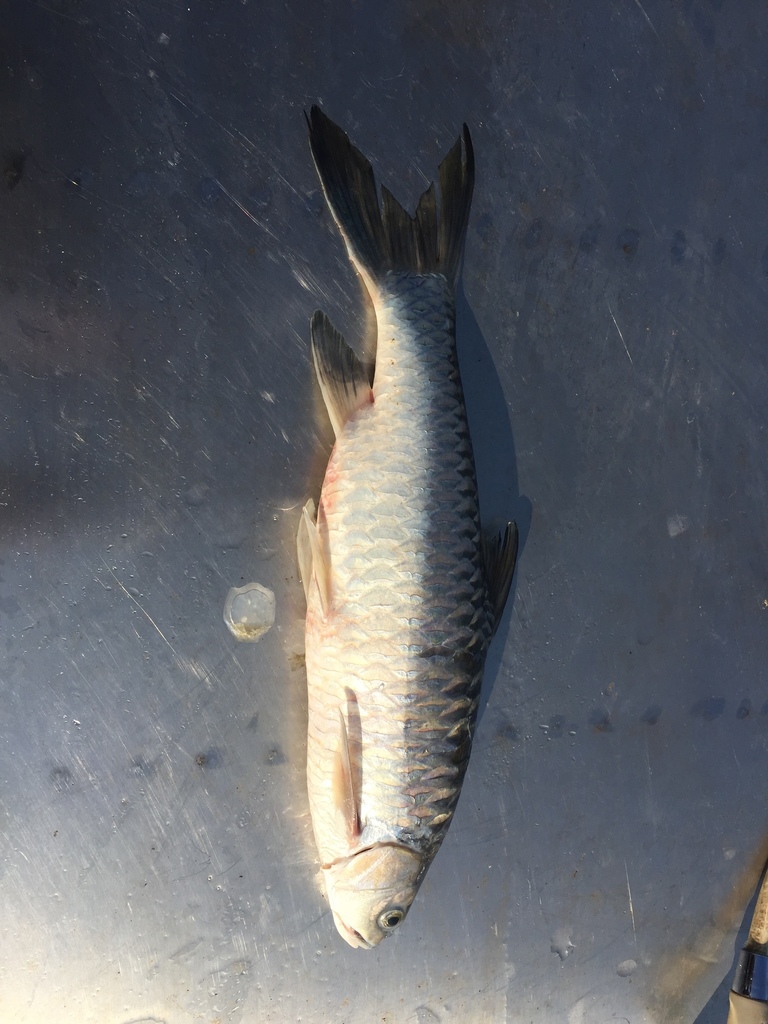
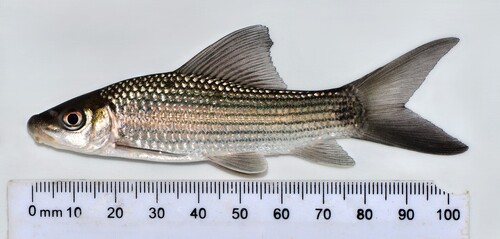
The Deep-bodied mahseer (Tor tor) is a freshwater fish of the family Cyprinidae that grows up to 200 cm.
Description
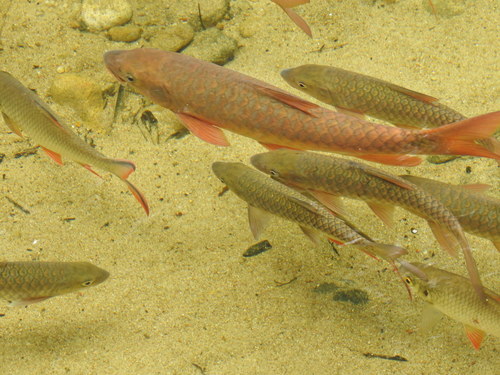
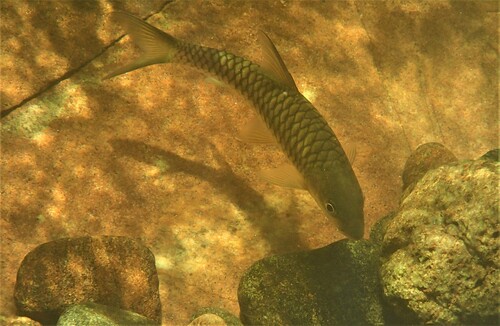
The deep-bodied mahseer is a large freshwater barb (Cyprinidae) from clear, fast-flowing rivers of South Asia, including the Ganges and Brahmaputra basins. The species grows to about 2 metres and has a powerful, streamlined, golden-brown body with large scales, thick lips and two pairs of barbels. As an omnivore it eats algae, water plants, fruit, insects and small invertebrates. It is a celebrated sport and food fish. The fish is harmless to humans.
Frequently asked questions
How do you recognise the Deep-bodied mahseer?
The Deep-bodied mahseer has a torpedo-shaped body and is mainly yellow-gold.
Where does the Deep-bodied mahseer live?
The Deep-bodied mahseer lives in fresh water and is mostly found around mixed bottom. Asia: Bangladesh, Bhutan, Myanmar, India, Nepal, Pakistan
How big does the Deep-bodied mahseer get?
The Deep-bodied mahseer grows to a maximum of about 200 cm. On average the species is around 18 cm.
Is the Deep-bodied mahseer dangerous to humans?
No, the Deep-bodied mahseer is harmless to humans. This species is harmless to humans. No specific first aid is needed. Still handle the fish with care: mind the fin rays and the sharp edges of the gill cover, and rinse any scratch with clean water and cover it. For a dirty or deep wound check tetanus status.
Is the Deep-bodied mahseer edible?
Yes, the Deep-bodied mahseer is commonly eaten.
More photos


Want the complete picture on the Deep-bodied mahseer?
Point your camera at the fish and Fin names the species in seconds. Free, and the Deep-bodied mahseer is one of 12,519 species in the app.
All data
Identification
Appearance
Habitat & distribution
Behaviour & biology
For anglers
Safety
Status & sources
Same genus Tor
More from the family Cyprinidae



Want the complete picture on the Deep-bodied mahseer?
Point your camera at the fish and Fin names the species in seconds. Free, and the Deep-bodied mahseer is one of 12,519 species in the app.