Home · Gempylidae · Castor oil fish
Castor oil fish (Ruvettus pretiosus) — Gempylidae

Castor oil fish

Ruvettus pretiosus
Family: Gempylidae
LC · Least Concern

The Castor oil fish (Ruvettus pretiosus) is a saltwater fish of the family Gempylidae that grows up to 300 cm.

Length
300 cm
Water
Saltwater
Depth
100.0–975.0 m
Diet
Carnivore
Behaviour
Solitary
Body shape
Elongated (eel-like)
Substrate
Mixed bottom
Danger
Venomous / poisonous
Range
Circumtropical and circumtemperate in all oceans (55°N-43°S).
Edibility
Rarely eaten

Want the complete picture on the Castor oil fish?

Get the app

Description

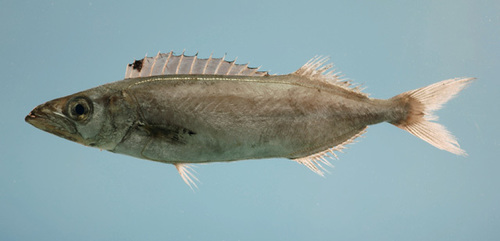
The oilfish is a large deep-sea predator of the family Gempylidae reaching about 300 cm. The brown to dark-brown body has a notably rough skin studded with bony tubercles and a keel along the belly. The species lives near the bottom in all warm and temperate oceans, usually between 200 and 400 m, mostly solitary or in pairs, hunting fish, crustaceans and squid. Its flesh is very oily owing to wax esters the body cannot digest; eating large amounts has a strong purgative effect. For this reason the oilfish is eaten only sparingly and has limited commercial value.

Frequently asked questions

How do you recognise the Castor oil fish?

The Castor oil fish has an elongate, eel-like body, is mainly brown and shows a plain pattern. Deep-sea predator with very rough skin full of small bony spines and a ventral keel; the flesh is strongly oily (wax esters) and acts as a laxative. Note: in tropical areas this species can cause ciguatera poisoning when eaten; large specimens of coral reef predators can accumulate the toxin. Eat with care or avoid in risk areas.

Where does the Castor oil fish live?

The Castor oil fish lives in the sea (marine waters) and is mostly found around mixed bottom. Circumtropical and circumtemperate in all oceans (55°N-43°S).

How big does the Castor oil fish get?

The Castor oil fish grows to a maximum of about 300 cm. On average the species is around 150 cm.

Is the Castor oil fish dangerous to humans?

The Castor oil fish is venomous — handle spines with care and seek medical help after a sting if needed. Harmless to handle, but the very oily flesh (wax esters) has a strong purgative effect; large portions can cause digestive upset. Eat only small amounts.

Is the Castor oil fish edible?

The Castor oil fish is rarely eaten.

Fin

Want the complete picture on the Castor oil fish?

Point your camera at the fish and Fin names the species in seconds. Free, and the Castor oil fish is one of 12,519 species in the app.

Get the app →

All data

Identification

English name
Castor oil fish verified
Scientific name
Ruvettus pretiosus
Family
Gempylidae
Other names
Castor oil fish; Escolar; Night barracuda; Oil fish; Oilfish; Plain-tail; Scour-fish verified

Appearance

Size class
Extra large verified
Max length (cm)
300.0 verified
Average length (cm)
150.0 verified
Body shape
Elongated (eel-like) sourced
Dominant colour
Brown sourced
Pattern
Plain sourced
Tail shape
Forked sourced
Mouth position
Terminal inferred
Lips
Thin inferred
Barbels
No verified
Dorsal fins
Two separate sourced
Dorsal spines
Yes verified

Habitat & distribution

Water type
Saltwater sourced
Substrate
Mixed bottom sourced
Min depth (m)
100.0 verified
Max depth (m)
975.0 verified
Natural range
Circumtropical and circumtemperate in all oceans (55°N-43°S). verified
Origin
Native verified

Behaviour & biology

Diet
Carnivore verified
Diet (detail)
Worms, crustaceans, molluscs and benthic invertebrates inferred
Social behaviour
Solitary verified
Territorial
No verified
Reproduction
Separate sexes verified
Sexual dimorphism
No verified
Seasonality
Near-bottom deep-sea fish, usually solitary or in pairs; migrates to the open sea. sourced
Special features
Deep-sea predator with very rough skin full of small bony spines and a ventral keel; the flesh is strongly oily (wax esters) and acts as a laxative. Note: in tropical areas this species can cause ciguatera poisoning when eaten; large specimens of coral reef predators can accumulate the toxin. Eat with care or avoid in risk areas. verified

For anglers

Edibility
Rarely eaten verified
Fishing method
Bottom fishing with natural bait (worm, shrimp or fish) on or just above the seabed. inferred
Regulations source
FishBase ↗ inferred

Safety

Danger to humans
Venomous / poisonous sourced
First aid
Harmless to handle, but the very oily flesh (wax esters) has a strong purgative effect; large portions can cause digestive upset. Eat only small amounts. sourced

Status & sources

Sources
FishBase via GBIF (DwC-A), CC-BY-NC 4.0

More from the family Gempylidae
Fin

Want the complete picture on the Castor oil fish?

Point your camera at the fish and Fin names the species in seconds. Free, and the Castor oil fish is one of 12,519 species in the app.

Get the app →
Is this the Castor oil fish? Get the app