Home · Cichlidae · Blue mbuna
Blue mbuna (Labeotropheus fuelleborni) — Cichlidae

Blue mbuna

Labeotropheus fuelleborni
Family: Cichlidae
LC · Least Concern
NativeIntroduced

The Blue mbuna (Labeotropheus fuelleborni) is a freshwater fish of the family Cichlidae that grows up to 30 cm.

Length
30 cm
Water
Freshwater
Depth
1.0–6.0 m
Diet
Herbivore
Behaviour
Small groups
Activity
Diurnal
Body shape
Flat / disc-shaped
Substrate
Mixed bottom
Danger
Harmless
Range
Endemic to Lake Malawi in East Africa.
Edibility
Commonly eaten

Want the complete picture on the Blue mbuna?

Get the app

Description

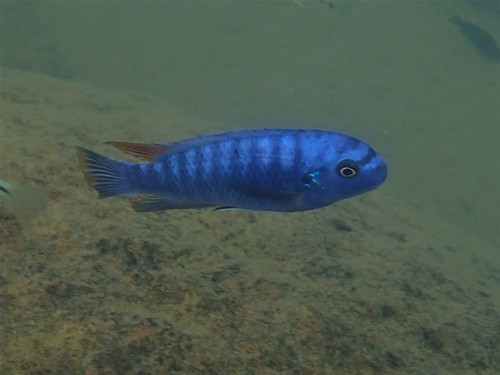
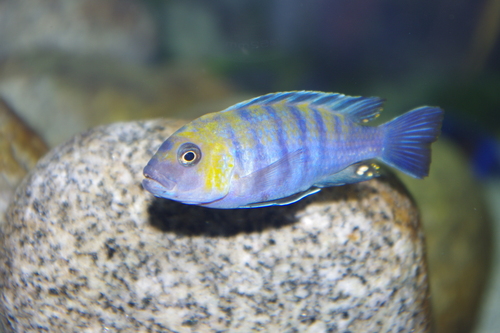
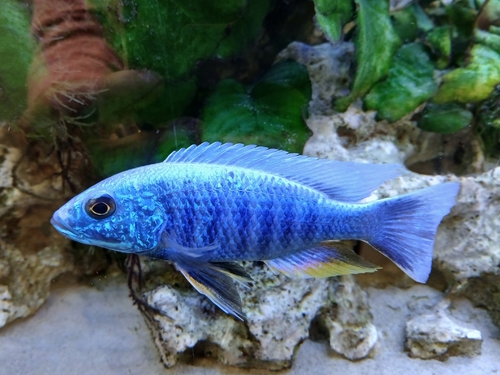
The blue mbuna is a cichlid endemic to Lake Malawi in East Africa. The species grows to about 18 cm and has a stocky body with a distinctly overhanging, downward-pointing snout. With it the fish scrapes the algal growth (aufwuchs) from rocks in shallow, rocky water. Males are usually blue, while females and some colour forms can be orange-blotched. The species is strongly territorial and is a maternal mouthbrooder: the female carries the eggs and young in her mouth. It is popular with aquarists and harmless to humans.

Frequently asked questions

How do you recognise the Blue mbuna?

The Blue mbuna has a flattened, disc-shaped body, is mainly blue and shows a vertical stripes pattern. Overhanging snout for scraping algae from rocks; maternal mouthbrooder.

Where does the Blue mbuna live?

The Blue mbuna lives in fresh water and is mostly found around mixed bottom. Endemic to Lake Malawi in East Africa.

How big does the Blue mbuna get?

The Blue mbuna grows to a maximum of about 30 cm.

Is the Blue mbuna dangerous to humans?

No, the Blue mbuna is harmless to humans. This species is harmless to humans. No specific first aid is needed. Still handle the fish with care: mind the fin rays and the sharp edges of the gill cover, and rinse any scratch with clean water and cover it. For a dirty or deep wound check tetanus status.

Is the Blue mbuna edible?

Yes, the Blue mbuna is commonly eaten.

More photos

Blue mbuna (Labeotropheus fuelleborni) — Cichlidae — 2
Wikimedia Commons — Jan Rehschuh (Public domain)
Blue mbuna (Labeotropheus fuelleborni) — Cichlidae — 3
Wikimedia Commons — Mikko Stenberg (Public domain)
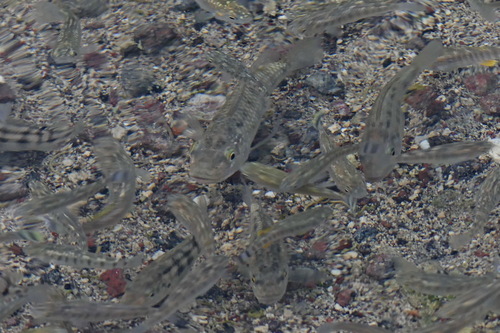
Blue mbuna (Labeotropheus fuelleborni) — Cichlidae — 4
Wikimedia Commons — Doronenko (CC BY 3.0)
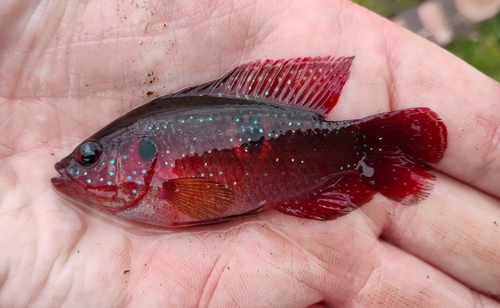
Blue mbuna (Labeotropheus fuelleborni) — Cichlidae — 5
iNaturalist ((c) markusgmeiner, some rights reserved (CC BY-NC))
Fin

Want the complete picture on the Blue mbuna?

Point your camera at the fish and Fin names the species in seconds. Free, and the Blue mbuna is one of 12,519 species in the app.

Get the app →

All data

Identification

English name
Blue mbuna verified
Scientific name
Labeotropheus fuelleborni
Family
Cichlidae
Other names
Blue mbuna; Fuelleborn's cichlid; Malawi blue cichlid verified

Appearance

Size class
Medium verified
Max length (cm)
30.0 verified
Body shape
Flat / disc-shaped sourced
Dominant colour
Blue inferred
Pattern
Vertical bars inferred
Tail shape
Straight inferred
Mouth position
Inferior (downward) inferred
Lips
Thin inferred
Barbels
No sourced
Dorsal fins
One continuous inferred
Dorsal spines
Yes sourced

Habitat & distribution

Water type
Freshwater sourced
Substrate
Mixed bottom sourced
Min depth (m)
1.0 verified
Max depth (m)
6.0 verified
Natural range
Endemic to Lake Malawi in East Africa. inferred
Origin
Native sourced

Behaviour & biology

Diet
Herbivore sourced
Diet (detail)
Algal film (aufwuchs) from rocks sourced
Social behaviour
Small groups inferred
Territorial
Yes inferred
Activity
Diurnal inferred
Reproduction
Separate sexes sourced
Sexual dimorphism
Yes inferred
Seasonality
Reproduction spread over the year; the female broods the eggs in her mouth. inferred
Special features
Overhanging snout for scraping algae from rocks; maternal mouthbrooder. sourced

For anglers

Edibility
Commonly eaten sourced
Fishing method
Bottom fishing with natural bait (worm, shrimp or fish) on or just above the seabed. inferred
Regulations source
FishBase ↗ inferred

Safety

Danger to humans
Harmless sourced
First aid
This species is harmless to humans. No specific first aid is needed. Still handle the fish with care: mind the fin rays and the sharp edges of the gill cover, and rinse any scratch with clean water and cover it. For a dirty or deep wound check tetanus status. verified

Status & sources

Sources
FishBase via GBIF (DwC-A), CC-BY-NC 4.0

Same genus Labeotropheus

More from the family Cichlidae

Fin

Want the complete picture on the Blue mbuna?

Point your camera at the fish and Fin names the species in seconds. Free, and the Blue mbuna is one of 12,519 species in the app.

Get the app →
Is this the Blue mbuna? Get the app