 Fin's Fish Guide
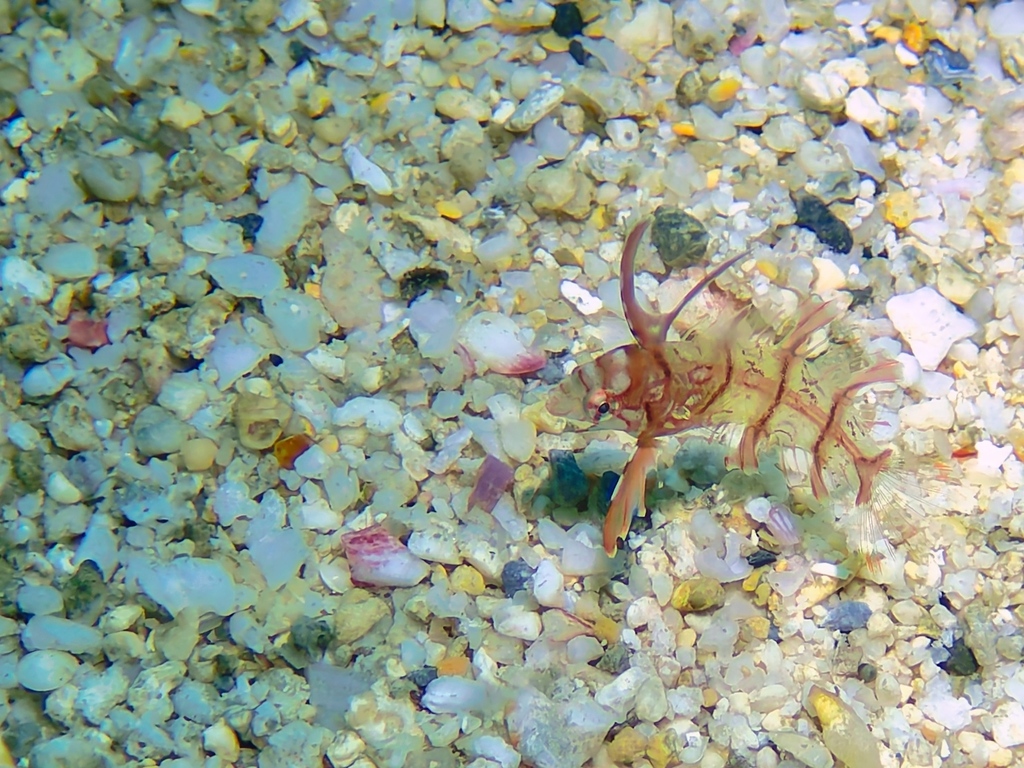
The Bar-cheeked wrasse (Novaculichthys taeniourus) is a saltwater fish of the family Labridae that grows up to 30 cm.
Description
The rockmover wrasse is a wrasse (Labridae) from the Indo-Pacific. The species grows to about 30 cm; juveniles mimic a drifting piece of weed with fluttering, ragged fins, while adults have a grey-green body with white spots and dark streaks. It inhabits semi-exposed reef flats, lagoons and seaward reefs in areas of mixed sand and rubble. It is known for shifting stones and coral pieces with its mouth to find hidden prey: crustaceans, molluscs, echinoderms and worms. Like many wrasses it is a protogynous hermaphrodite. The species is harmless to humans.
Frequently asked questions
How do you recognise the Bar-cheeked wrasse?
The Bar-cheeked wrasse has a torpedo-shaped body, is mainly green and shows a spots pattern. Shifts stones with the mouth to find prey; juveniles mimic drifting seaweed.
Where does the Bar-cheeked wrasse live?
The Bar-cheeked wrasse lives in the sea (marine waters) and is mostly found around stony or rocky ground. Indo-Pacific; reef flats, lagoons and seaward reefs.
How big does the Bar-cheeked wrasse get?
The Bar-cheeked wrasse grows to a maximum of about 30 cm.
Is the Bar-cheeked wrasse dangerous to humans?
No, the Bar-cheeked wrasse is harmless to humans. None required: this species is harmless to humans.
Is the Bar-cheeked wrasse edible?
The Bar-cheeked wrasse is rarely eaten.

Want the complete picture on the Bar-cheeked wrasse?
Point your camera at the fish and Fin names the species in seconds. Free, and the Bar-cheeked wrasse is one of 12,519 species in the app.
All data
Identification
Appearance
Habitat & distribution
Behaviour & biology
For anglers
Safety
Status & sources
More from the family Labridae



Want the complete picture on the Bar-cheeked wrasse?
Point your camera at the fish and Fin names the species in seconds. Free, and the Bar-cheeked wrasse is one of 12,519 species in the app.