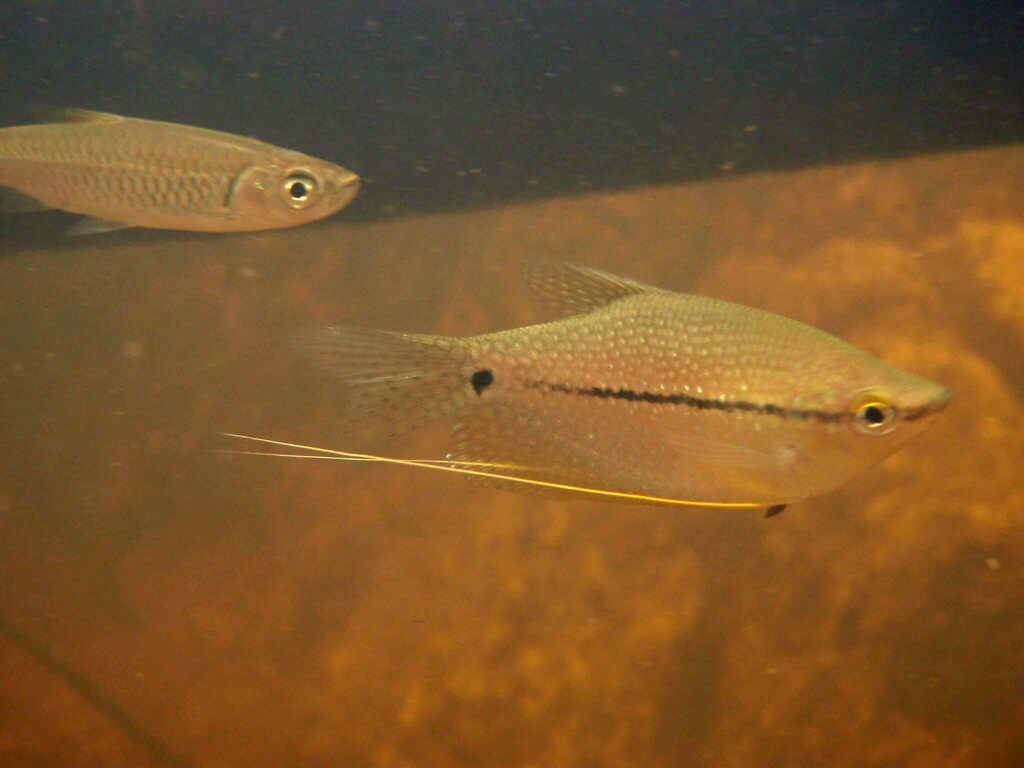
The Pearl gourami (Trichopodus leerii) is a freshwater fish of the family Osphronemidae that grows up to 12 cm.
Description
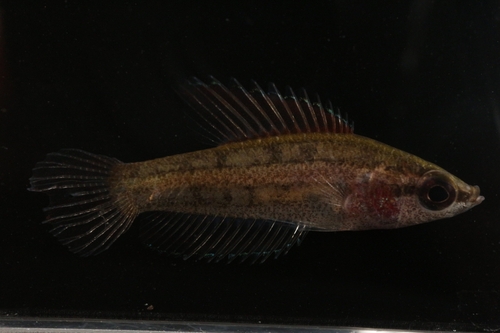
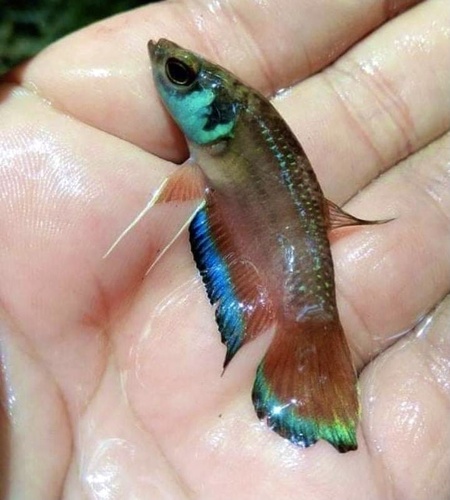
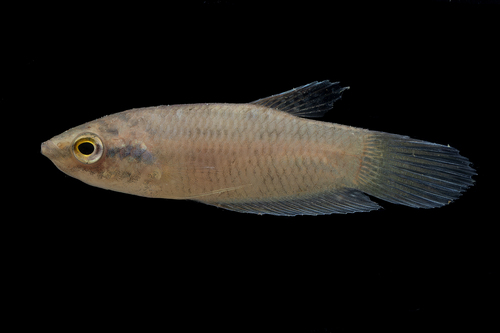
The pearl gourami is a labyrinth fish (Osphronemidae) from fresh water of Southeast Asia. The species grows to about 12 cm and has a deep, laterally compressed, brownish body with a fine, pearly white speckling and a dark longitudinal stripe; in courtship the male's throat turns orange-red. As a labyrinth fish it can gulp air at the surface. The thread-like pelvic fins serve as feelers. It eats small invertebrates, larvae and plant material. The fish is harmless to humans and is much loved in the aquarium trade.
Frequently asked questions
How do you recognise the Pearl gourami?
The Pearl gourami has a flattened, disc-shaped body.
Where does the Pearl gourami live?
The Pearl gourami lives in fresh water and is mostly found around mixed bottom.
How big does the Pearl gourami get?
The Pearl gourami grows to a maximum of about 12 cm.
Is the Pearl gourami dangerous to humans?
No, the Pearl gourami is harmless to humans.
Is the Pearl gourami edible?
Yes, the Pearl gourami is commonly eaten.
Download Fin's Fish Guide
Identify fish in seconds, log your catches and dives. Join the TestFlight beta.
All data
Identification
Appearance
Habitat & distribution
Behaviour & biology
For anglers
Safety
Status & sources
Same genus Trichopodus
More from the family Osphronemidae
Download Fin's Fish Guide
Identify fish in seconds, log your catches and dives. Join the TestFlight beta.