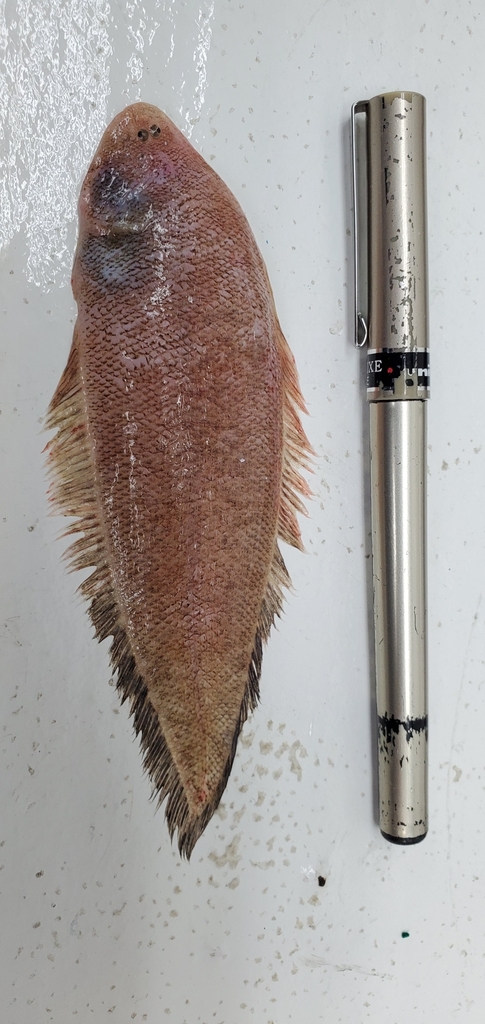
The Offshore tonguefish (Symphurus civitatium) is a saltwater fish of the family Cynoglossidae that grows up to 17 cm.
Description
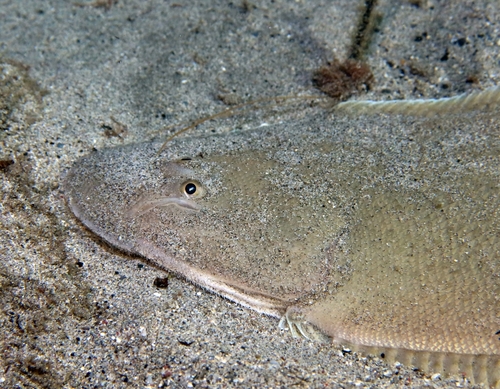
The offshore tonguefish is a small tonguefish (family Cynoglossidae) of the north-western Atlantic. The species reaches about 17 cm and has an elongate, leaf-shaped, brown body with both eyes on the left side and a continuous fin margin around the body. It lives demersally on sand and mud bottoms of bays and shallow coastal waters, typically between 11 and 45 m depth. Its diet consists of small bottom invertebrates. Because of its small size the species is of no fishery value and is harmless to humans; it often lies camouflaged buried in the sediment.
Frequently asked questions
How do you recognise the Offshore tonguefish?
The Offshore tonguefish has a flatfish-shaped body, is mainly brown and shows a plain pattern.
Where does the Offshore tonguefish live?
The Offshore tonguefish lives in the sea (marine waters) and is mostly found around sand or mud bottom.
How big does the Offshore tonguefish get?
The Offshore tonguefish grows to a maximum of about 17 cm.
Is the Offshore tonguefish dangerous to humans?
No, the Offshore tonguefish is harmless to humans.
Is the Offshore tonguefish edible?
The Offshore tonguefish is not usually eaten.
Download Fin's Fish Guide
Identify fish in seconds, log your catches and dives. Join the TestFlight beta.
All data
Identification
Appearance
Habitat & distribution
Behaviour & biology
For anglers
Safety
Status & sources
Same genus Symphurus


More from the family Cynoglossidae

Download Fin's Fish Guide
Identify fish in seconds, log your catches and dives. Join the TestFlight beta.