 Fin's Fish Guide
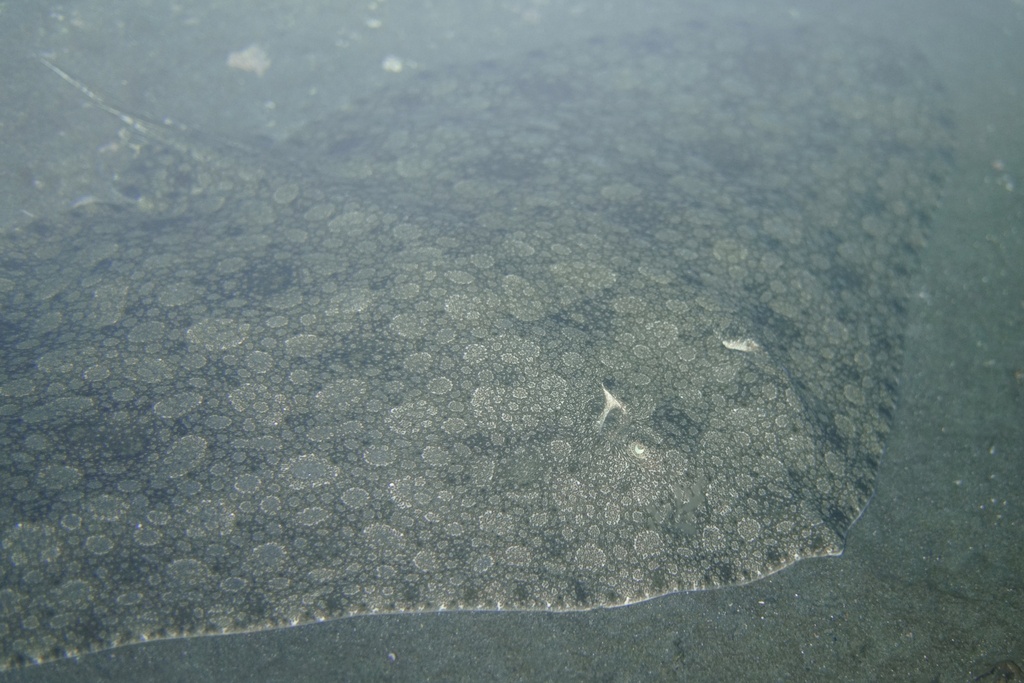
The Spiny butterfly ray (Gymnura altavela) is a brackish-water fish of the family Gymnuridae that grows up to 400 cm.
Atlantic Ocean on both sides and the Mediterranean Sea, over sandy bottoms of shallow, warm coastal waters and estuaries; tolerates brackish water.
Description
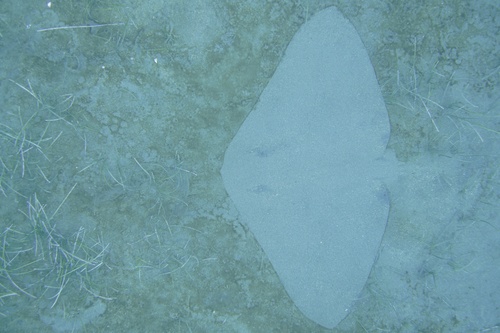
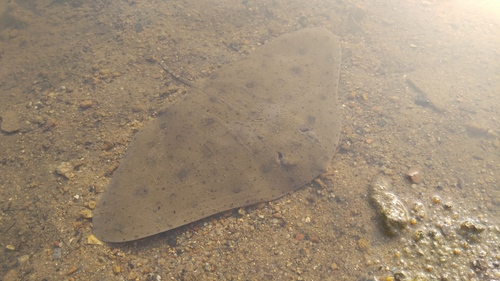
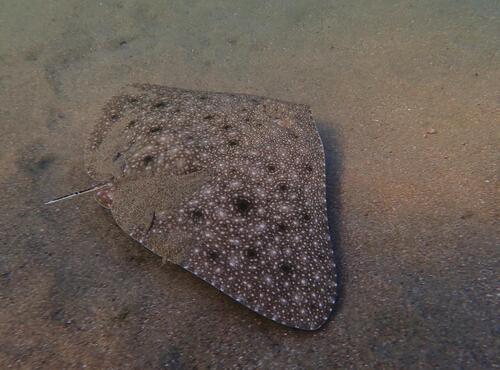
The spiny butterfly ray is a very broad, butterfly-shaped ray of the family Gymnuridae whose diamond-shaped disc is far wider than long, reaching a width of about 2 metres. The upper side is brown to grey-brown with a marbled pattern; the tail is notably short and bears a small venomous spine. Behind each spiracle sits a small tentacle, characteristic of the species. It lives on sand bottoms of shallow, warm coastal water and estuaries in the Atlantic and the Mediterranean and tolerates brackish water. On the bottom it hunts fish, crustaceans, molluscs and plankton. Through overfishing it has declined sharply; it is assessed as Endangered (EN) worldwide and Critically Endangered in the Mediterranean.
Frequently asked questions
How do you recognise the Spiny butterfly ray?
The Spiny butterfly ray has a flattened, disc-shaped body, is mainly brown and shows a spots pattern. Very broad, butterfly-shaped ray whose disc is much wider than long; short tail with a small venomous spine and a small tentacle behind the spiracle.
Where does the Spiny butterfly ray live?
The Spiny butterfly ray lives in brackish water and is mostly found around sand or mud bottom. Atlantic Ocean on both sides and the Mediterranean Sea, over sandy bottoms of shallow, warm coastal waters and estuaries; tolerates brackish water.
How big does the Spiny butterfly ray get?
The Spiny butterfly ray grows to a maximum of about 400 cm. On average the species is around 200 cm.
Is the Spiny butterfly ray dangerous to humans?
The Spiny butterfly ray is venomous — handle spines with care and seek medical help after a sting if needed. The long, whip-like tail bears one or more venomous spines: a sting is very painful. Immerse the wound for 30-90 minutes in water as hot as can be tolerated (about 45 C) and seek medical help.
Is the Spiny butterfly ray edible?
The Spiny butterfly ray is rarely eaten.
More photos

Want the complete picture on the Spiny butterfly ray?
Point your camera at the fish and Fin names the species in seconds. Free, and the Spiny butterfly ray is one of 12,519 species in the app.
All data
Identification
Appearance
Habitat & distribution
Behaviour & biology
For anglers
Safety
Status & sources
Same genus Gymnura



More from the family Gymnuridae

Want the complete picture on the Spiny butterfly ray?
Point your camera at the fish and Fin names the species in seconds. Free, and the Spiny butterfly ray is one of 12,519 species in the app.