 Fin's Fish Guide

The Scalloped hammerhead (Sphyrna lewini) is a saltwater fish of the family Sphyrnidae that grows up to 430 cm.
Widespread in warm and temperate seas worldwide, in coastal water, above the shelf and around islands and seamounts; young fish in shallow nursery areas.
Description
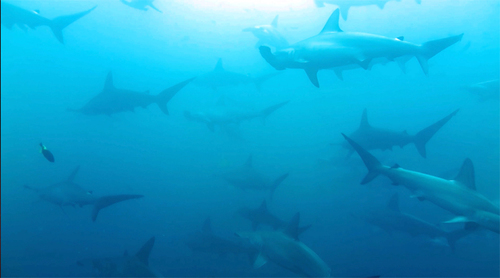
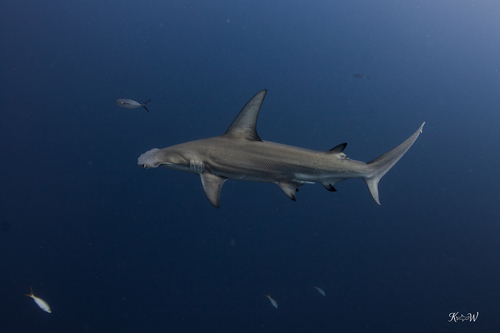
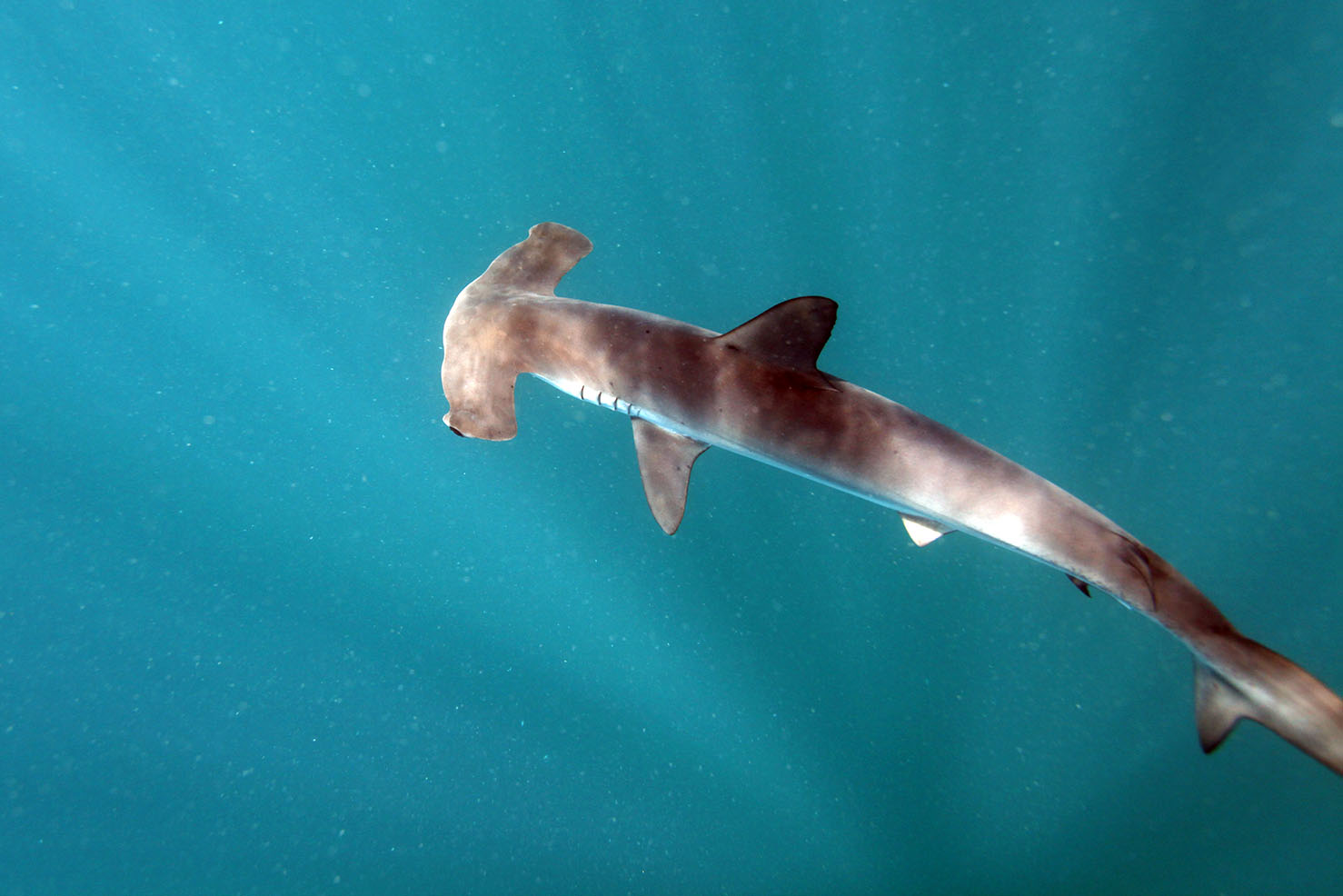
The scalloped hammerhead is a large shark of the family Sphyrnidae (hammerhead sharks) reaching about 4.3 metres. Characteristic is the broad, hammer-shaped head (cephalofoil) with a scalloped (wavy) front edge and the eyes and nostrils far out at the ends, which widens its vision and sense of smell and helps detect prey. The grey, streamlined body is otherwise like that of other requiem sharks. The species is widely distributed in warm seas worldwide, in coastal water and around islands and seamounts, where it sometimes forms enormous schools by day. It hunts mainly rays, small sharks and fish, and is viviparous. Through heavy fishing for the fin trade it is globally Critically Endangered (CR).
Frequently asked questions
How do you recognise the Scalloped hammerhead?
The Scalloped hammerhead has a torpedo-shaped body, is mainly silver-grey and shows a plain pattern. Large shark with a broad, hammer-shaped head with a scalloped front edge and the eyes far out at the ends; sometimes forms large shoals.
Where does the Scalloped hammerhead live?
The Scalloped hammerhead lives in the sea (marine waters) and is mostly found around open water. Widespread in warm and temperate seas worldwide, in coastal water, above the shelf and around islands and seamounts; young fish in shallow nursery areas.
How big does the Scalloped hammerhead get?
The Scalloped hammerhead grows to a maximum of about 430 cm. On average the species is around 360 cm.
Is the Scalloped hammerhead dangerous to humans?
The Scalloped hammerhead can bite, but is otherwise not dangerous to humans. Not venomous, but a large predatory shark with sharp teeth: keep your distance from a hooked or landed shark and handle only with proper equipment.
Is the Scalloped hammerhead edible?
The Scalloped hammerhead is rarely eaten.
More photos

Easily confused with
These species look like the Scalloped hammerhead and live in the same waters.

Want the complete picture on the Scalloped hammerhead?
Point your camera at the fish and Fin names the species in seconds. Free, and the Scalloped hammerhead is one of 12,519 species in the app.
All data
Identification
Appearance
Habitat & distribution
Behaviour & biology
For anglers
Safety
Status & sources
Same genus Sphyrna


More from the family Sphyrnidae

Want the complete picture on the Scalloped hammerhead?
Point your camera at the fish and Fin names the species in seconds. Free, and the Scalloped hammerhead is one of 12,519 species in the app.