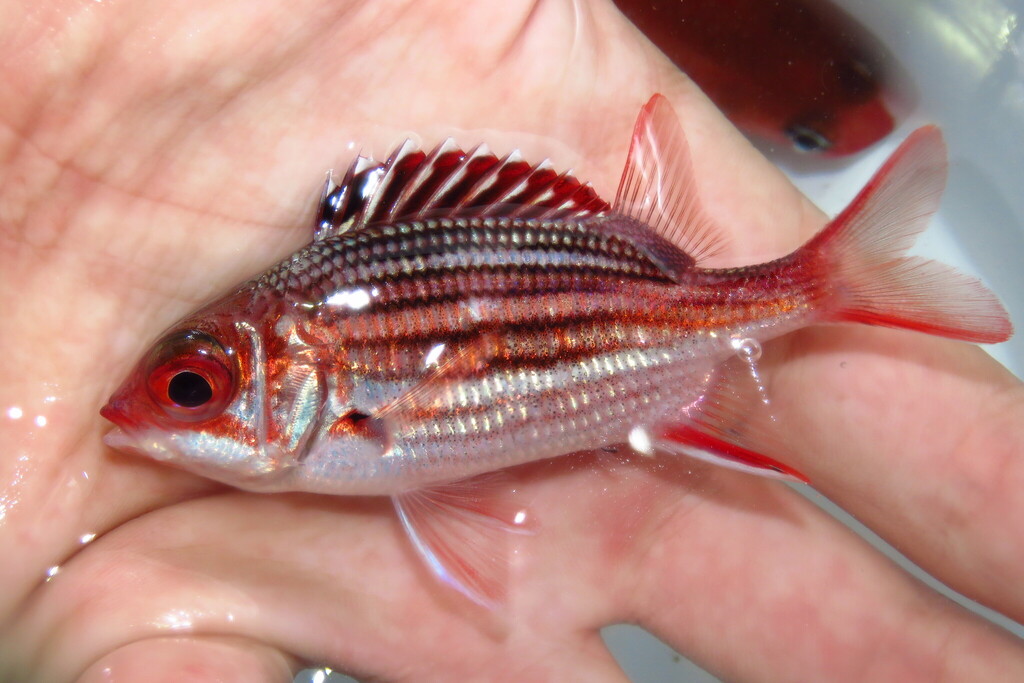
The Dusky squirrelfish (Sargocentron vexillarium) is a fish of the family Holocentridae that grows up to 14 cm.
Description
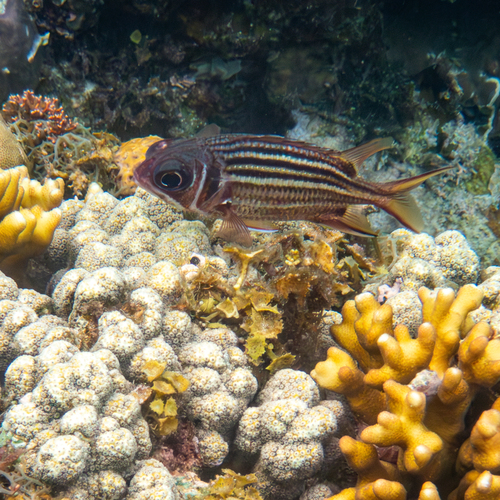
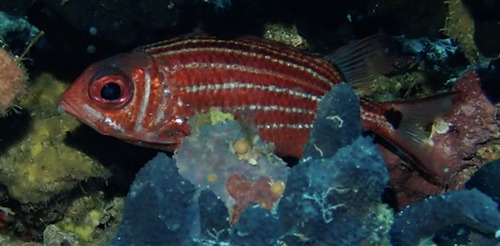
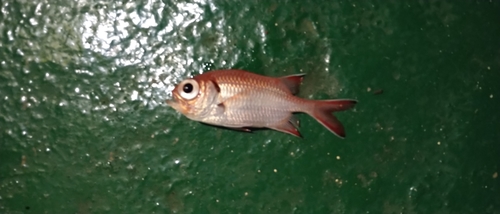
The dusky squirrelfish (Sargocentron vexillarium) is a squirrelfish of the family Holocentridae from the western Atlantic and Caribbean. The species has a reddish body with lighter stripes and large eyes, an adaptation to its nocturnal habits, and reaches about 14 cm. By day it hides in crevices and under ledges of coral reefs and rocky shores; at night it hunts small crustaceans and invertebrates. On the gill cover the species bears a sharp spine that can cause painful puncture wounds when handled. Owing to its small size it has little fishery importance.
Frequently asked questions
How do you recognise the Dusky squirrelfish?
The Dusky squirrelfish is mainly red-orange and shows a horizontal stripes pattern.
Where does the Dusky squirrelfish live?
The Dusky squirrelfish is mostly found around stony or rocky ground.
How big does the Dusky squirrelfish get?
The Dusky squirrelfish grows to a maximum of about 14 cm.
Is the Dusky squirrelfish dangerous to humans?
The Dusky squirrelfish can cause injury; handle it with care.
Is the Dusky squirrelfish edible?
The Dusky squirrelfish is rarely eaten.
Download Fin's Fish Guide
Identify fish in seconds, log your catches and dives. Join the TestFlight beta.
All data
Identification
Appearance
Habitat & distribution
Behaviour & biology
Safety
Status & sources
Same genus Sargocentron

More from the family Holocentridae

Download Fin's Fish Guide
Identify fish in seconds, log your catches and dives. Join the TestFlight beta.