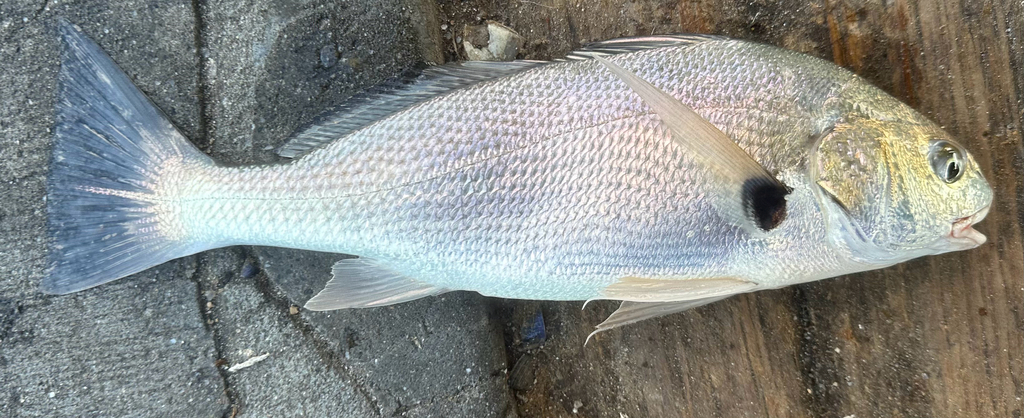
The Croaker (Roncador stearnsii) is a saltwater fish of the family Sciaenidae that grows up to 70 cm.
Description
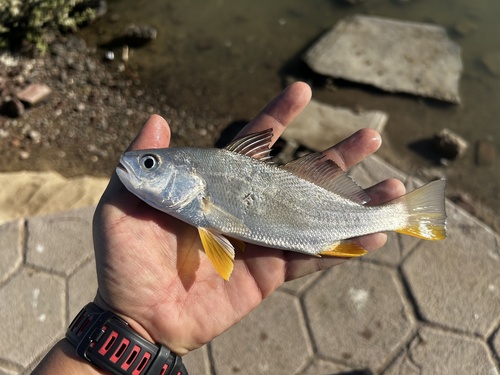
The spotfin croaker is a drum (Sciaenidae) from the eastern Pacific, from California to Baja California. The species reaches about 70 cm and has a silvery body with a conspicuous black spot at the base of the pectoral fin, to which the name refers. It occurs along sandy shores and bays, mainly in shallow surf zones, but also to about 15 m deep, often near rocks and at bay entrances. With its swim bladder it makes drumming sounds. The diet consists of bottom invertebrates. It forms small groups and is a popular surf sport fish.
Frequently asked questions
How do you recognise the Croaker?
The Croaker has a torpedo-shaped body, is mainly silver-grey and shows a plain pattern.
Where does the Croaker live?
The Croaker lives in the sea (marine waters) and is mostly found around sand or mud bottom.
How big does the Croaker get?
The Croaker grows to a maximum of about 70 cm. On average the species is around 30 cm.
Is the Croaker dangerous to humans?
No, the Croaker is harmless to humans.
Is the Croaker edible?
Yes, the Croaker is commonly eaten.
Download Fin's Fish Guide
Identify fish in seconds, log your catches and dives. Join the TestFlight beta.
All data
Identification
Appearance
Habitat & distribution
Behaviour & biology
For anglers
Safety
Status & sources
More from the family Sciaenidae


Download Fin's Fish Guide
Identify fish in seconds, log your catches and dives. Join the TestFlight beta.