
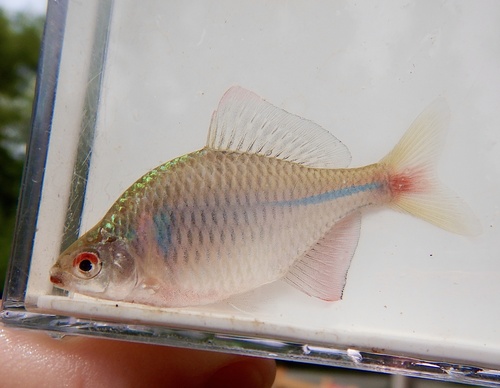
The European bitterling (Rhodeus amarus) is a freshwater fish of the family Cyprinidae that grows up to 11 cm.
Description
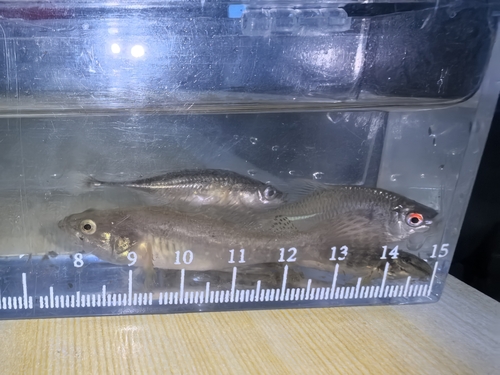
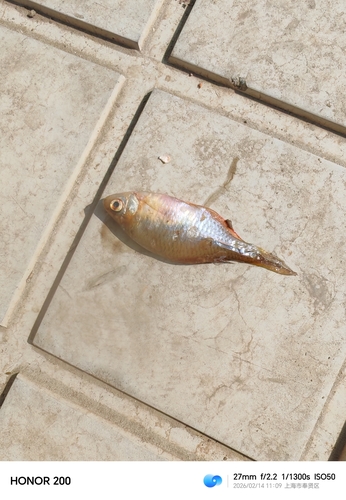
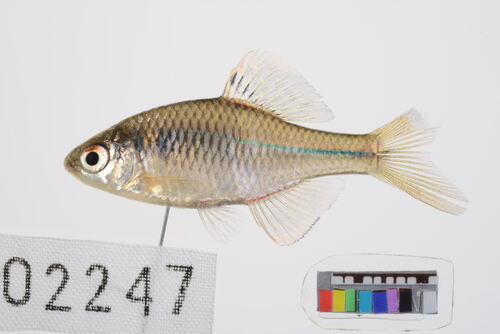
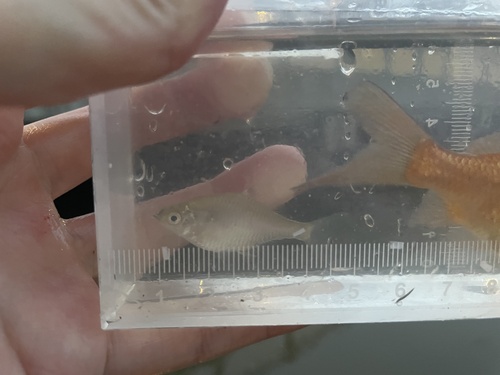
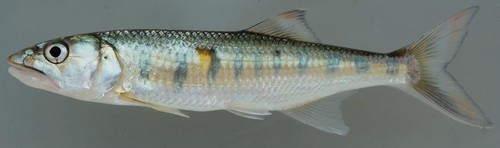
The European bitterling is a small, deep-bodied cyprinid of the family Cyprinidae reaching about 11 cm. The silvery, compressed body has a greenish sheen and a blue-green stripe on the rear flank; in the breeding season males turn a beautiful purple-pink with a metallic green glow. Famous is its reproduction: the female develops a long ovipositor and uses it to lay her eggs in the gill cavity of a living freshwater mussel, where the larvae grow up protected. In return the mussel spreads its own larvae via the bitterling. The species lives in vegetation-rich, still and slow-flowing fresh waters of Europe. It depends on healthy mussel populations and is therefore protected; in the Netherlands it is a protected species.
Frequently asked questions
How do you recognise the European bitterling?
The European bitterling has a torpedo-shaped body, is mainly silver-grey and shows a plain pattern.
Where does the European bitterling live?
The European bitterling lives in fresh water and is mostly found around mixed bottom.
How big does the European bitterling get?
The European bitterling grows to a maximum of about 11 cm. On average the species is around 5 cm.
Is the European bitterling dangerous to humans?
No, the European bitterling is harmless to humans.
Is the European bitterling edible?
The European bitterling is not usually eaten.
Download Fin's Fish Guide
Identify fish in seconds, log your catches and dives. Join the TestFlight beta.
All data
Identification
Appearance
Habitat & distribution
Behaviour & biology
For anglers
Safety
Status & sources
Same genus Rhodeus

More from the family Cyprinidae


Download Fin's Fish Guide
Identify fish in seconds, log your catches and dives. Join the TestFlight beta.