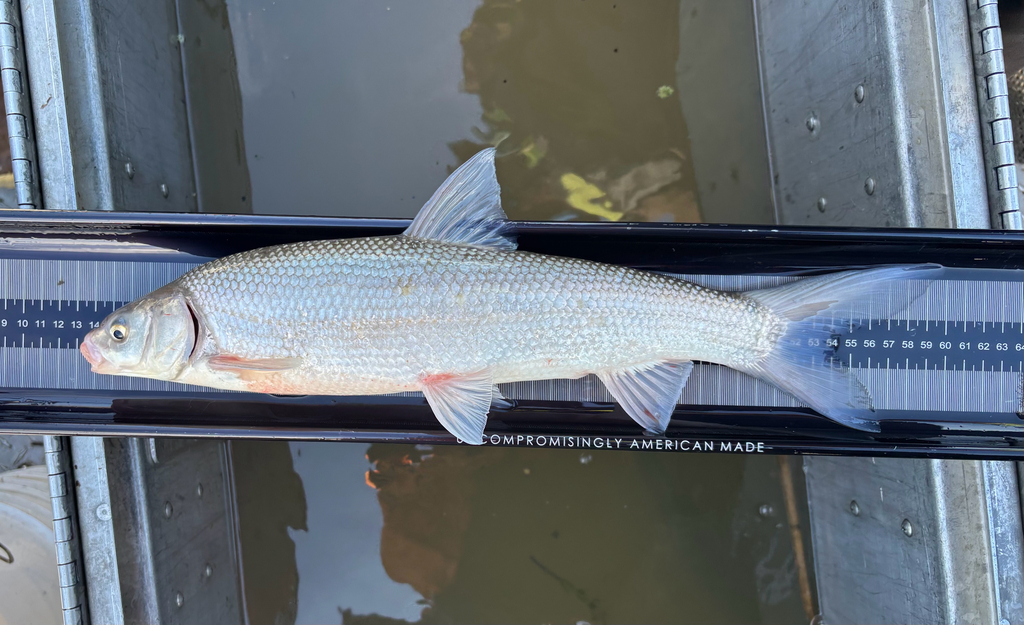
The Sacramento Splittail (Pogonichthys macrolepidotus) is a brackish-water fish of the family Cyprinidae that grows up to 44 cm.
Description
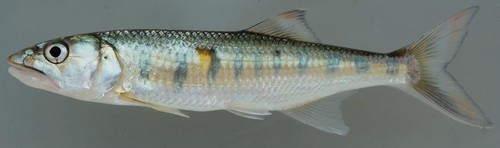
The Sacramento splittail is a cyprinid (Cyprinidae) endemic to California. The species grows to about 30 cm and owes its name to the unequal tail fin, whose upper lobe is larger than the lower. It inhabits lakes, backwaters and pools of rivers and tolerates brackish water; it migrates to flooded floodplains to spawn. As an omnivore it searches the bottom for worms, small crustaceans, molluscs and plant matter. The species is harmless to humans.
Frequently asked questions
How do you recognise the Sacramento Splittail?
The Sacramento Splittail has an elongate, eel-like body, is mainly silver-grey and shows a plain pattern.
Where does the Sacramento Splittail live?
The Sacramento Splittail lives in brackish water and is mostly found around mixed bottom.
How big does the Sacramento Splittail get?
The Sacramento Splittail grows to a maximum of about 44 cm. On average the species is around 30 cm.
Is the Sacramento Splittail dangerous to humans?
No, the Sacramento Splittail is harmless to humans.
Is the Sacramento Splittail edible?
The Sacramento Splittail is rarely eaten.
Download Fin's Fish Guide
Identify fish in seconds, log your catches and dives. Join the TestFlight beta.
All data
Identification
Appearance
Habitat & distribution
Behaviour & biology
For anglers
Safety
Status & sources
More from the family Cyprinidae


Download Fin's Fish Guide
Identify fish in seconds, log your catches and dives. Join the TestFlight beta.