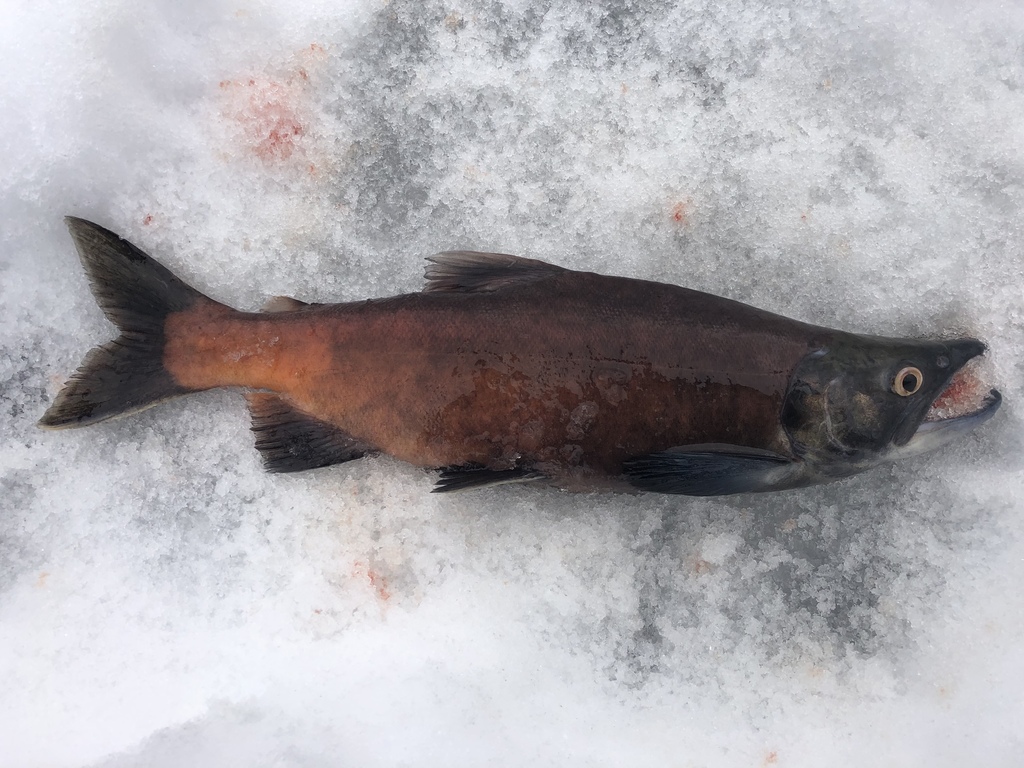
The Blueback (Oncorhynchus nerka) is a fish that lives in both fresh and salt water of the family Salmonidae that grows up to 84 cm.
Description
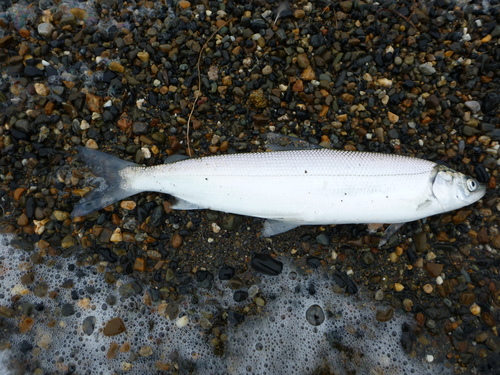
The sockeye salmon (Oncorhynchus nerka) is a Pacific salmon of the family Salmonidae from the North Pacific and adjacent lakes. At sea the species has a streamlined, silvery-blue body, but during the spawning run the fish develop a spectacular bright-red body with a green head. It can reach about 84 cm. The species occurs in two forms: the anadromous sockeye, which grows up at sea and ascends rivers to spawn, and the landlocked kokanee. Adults feed mainly on zooplankton, supplemented with small fishes. The sockeye is one of the most sought-after and commercially important salmon species.
Frequently asked questions
How do you recognise the Blueback?
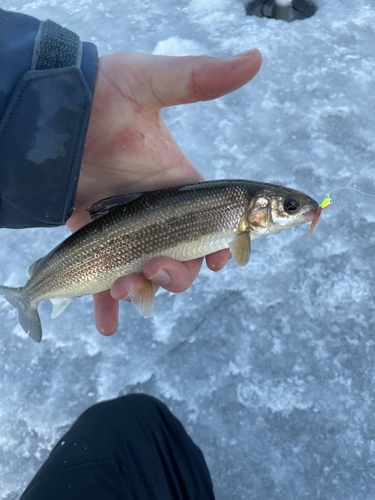
The Blueback has a torpedo-shaped body, is mainly silver-grey and shows a plain pattern.
Where does the Blueback live?
The Blueback lives in both fresh and salt water and is mostly found around open water.
How big does the Blueback get?
The Blueback grows to a maximum of about 84 cm. On average the species is around 45 cm.
Is the Blueback dangerous to humans?
No, the Blueback is harmless to humans.
Is the Blueback edible?
Yes, the Blueback is a highly prized food fish.
Download Fin's Fish Guide
Identify fish in seconds, log your catches and dives. Join the TestFlight beta.
All data
Identification
Appearance
Habitat & distribution
Behaviour & biology
For anglers
Safety
Status & sources
Same genus Oncorhynchus
More from the family Salmonidae

Download Fin's Fish Guide
Identify fish in seconds, log your catches and dives. Join the TestFlight beta.