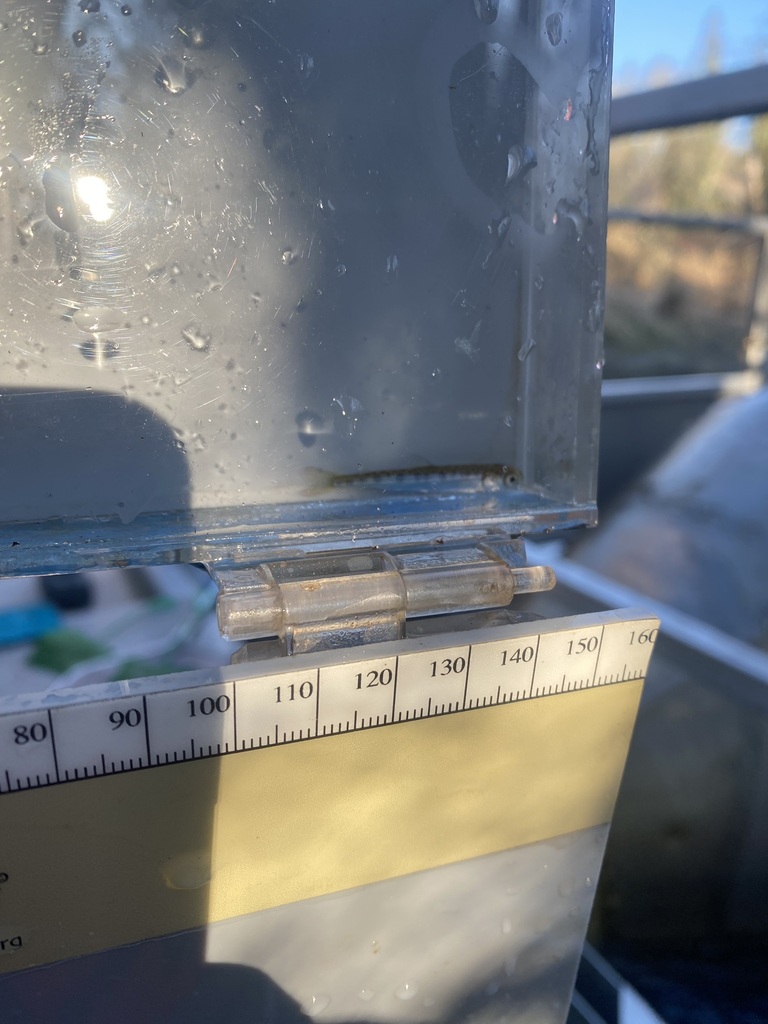
The Chum salmon (Oncorhynchus keta) is a fish that lives in both fresh and salt water of the family Salmonidae that grows up to 100 cm.
Description
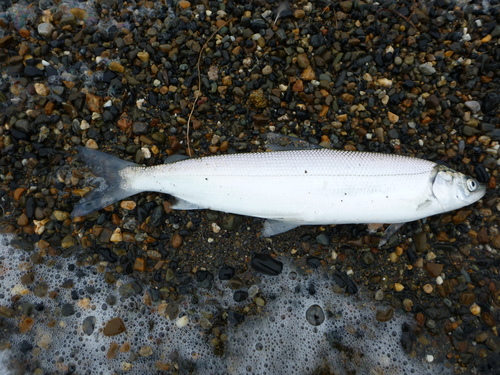
The chum salmon is a large Pacific salmon of the family Salmonidae reaching about 1 metre. At sea it is streamlined and silvery, but spawning fish develop green flanks with purple-red, calico-like vertical bars; males grow a hooked lower jaw and large teeth. The species is anadromous: it grows up in the northern Pacific, where it eats zooplankton, small fish and squid, and migrates to spawn in the rivers of Northeast Asia and Northwest America. Like other Pacific salmon it spawns once and then dies. With its tasty flesh and roe (salmon caviar) it is one of the most important commercial salmon species in the world.
Frequently asked questions
How do you recognise the Chum salmon?
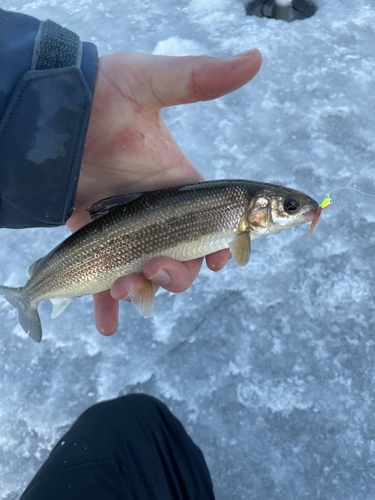
The Chum salmon has a torpedo-shaped body, is mainly silver-grey and shows a vertical stripes pattern.
Where does the Chum salmon live?
The Chum salmon lives in both fresh and salt water and is mostly found around open water.
How big does the Chum salmon get?
The Chum salmon grows to a maximum of about 100 cm. On average the species is around 58 cm.
Is the Chum salmon dangerous to humans?
No, the Chum salmon is harmless to humans.
Is the Chum salmon edible?
Yes, the Chum salmon is a highly prized food fish.
Download Fin's Fish Guide
Identify fish in seconds, log your catches and dives. Join the TestFlight beta.
All data
Identification
Appearance
Habitat & distribution
Behaviour & biology
For anglers
Safety
Status & sources
Same genus Oncorhynchus
More from the family Salmonidae

Download Fin's Fish Guide
Identify fish in seconds, log your catches and dives. Join the TestFlight beta.