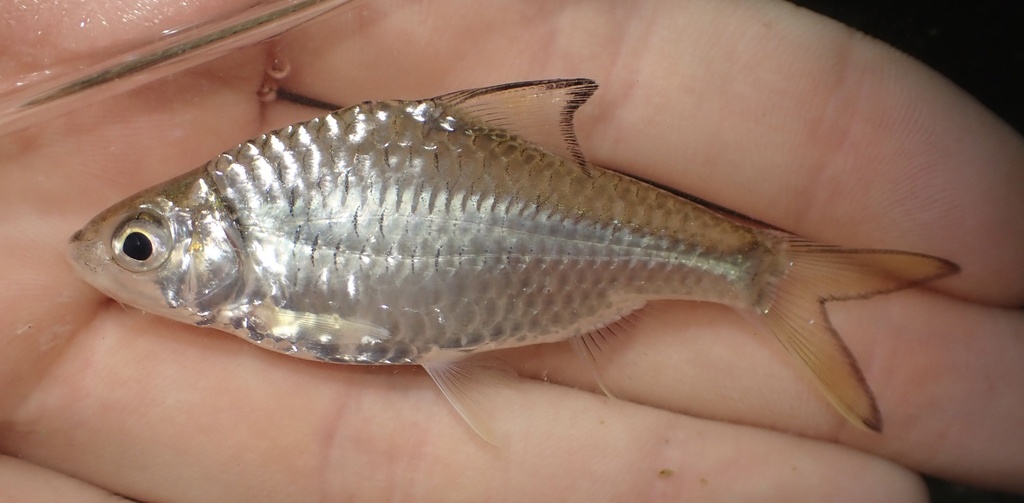
The Spiny-back barb (Mystacoleucus marginatus) is a freshwater fish of the family Cyprinidae that grows up to 20 cm.
Description
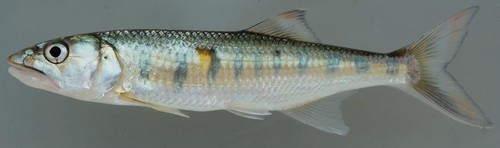
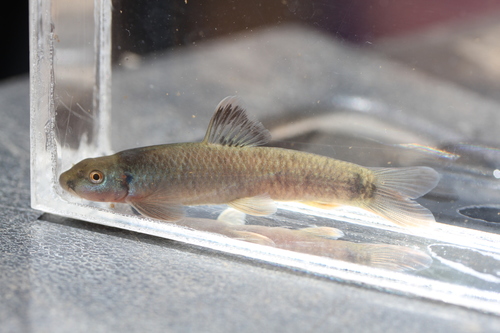
The spiny-back barb is a small cyprinid from fresh water of Southeast Asia. The species grows to about 20 cm and has a streamlined, silvery body with a conspicuous, forward-pointing spine just before the dorsal fin. It schools in rivers, streams and lakes and feeds on algae, insect larvae, small zooplankton and detritus. It is a local food fish. The IUCN assesses the species as Least Concern (LC).
Frequently asked questions
How do you recognise the Spiny-back barb?
The Spiny-back barb has a torpedo-shaped body, is mainly silver-grey and shows a plain pattern.
Where does the Spiny-back barb live?
The Spiny-back barb lives in fresh water and is mostly found around mixed bottom.
How big does the Spiny-back barb get?
The Spiny-back barb grows to a maximum of about 20 cm. On average the species is around 10 cm.
Is the Spiny-back barb dangerous to humans?
No, the Spiny-back barb is harmless to humans.
Is the Spiny-back barb edible?
Yes, the Spiny-back barb is commonly eaten.
Download Fin's Fish Guide
Identify fish in seconds, log your catches and dives. Join the TestFlight beta.
All data
Identification
Appearance
Habitat & distribution
Behaviour & biology
For anglers
Safety
Status & sources
Same genus Mystacoleucus
More from the family Cyprinidae


Download Fin's Fish Guide
Identify fish in seconds, log your catches and dives. Join the TestFlight beta.