
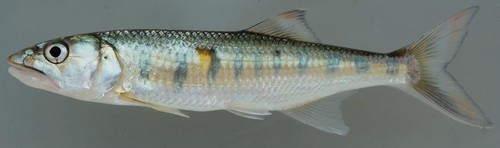
The Long pike carp (Luciobrama macrocephalus) is a brackish-water fish of the family Cyprinidae that grows up to 48 cm.
Description
The Long pike carp is a large, predatory cyprinid (Cyprinidae) from large rivers and lakes of the large rivers of southern China and Southeast Asia. The species grows to about 1 metre and has a very elongate, pike-like, silvery body with a pointed head and a large mouth. As a fast predator of open water it chases small and medium-sized fish. It is locally a valued food fish, but often reduced by overfishing and dams. The fish is harmless to humans.
Frequently asked questions
How do you recognise the Long pike carp?
The Long pike carp has a torpedo-shaped body and is mainly silver-grey.
Where does the Long pike carp live?
The Long pike carp lives in brackish water and is mostly found around open water.
How big does the Long pike carp get?
The Long pike carp grows to a maximum of about 48 cm. On average the species is around 24 cm.
Is the Long pike carp dangerous to humans?
No, the Long pike carp is harmless to humans.
Download Fin's Fish Guide
Identify fish in seconds, log your catches and dives. Join the TestFlight beta.
All data
Identification
Appearance
Habitat & distribution
Behaviour & biology
For anglers
Safety
Status & sources
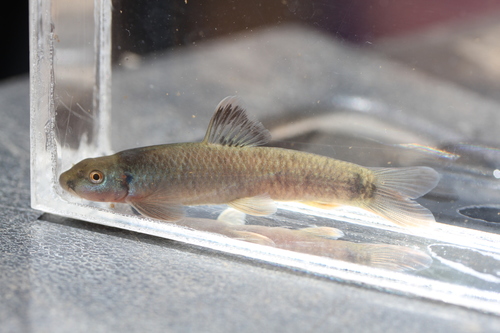
More from the family Cyprinidae


Download Fin's Fish Guide
Identify fish in seconds, log your catches and dives. Join the TestFlight beta.