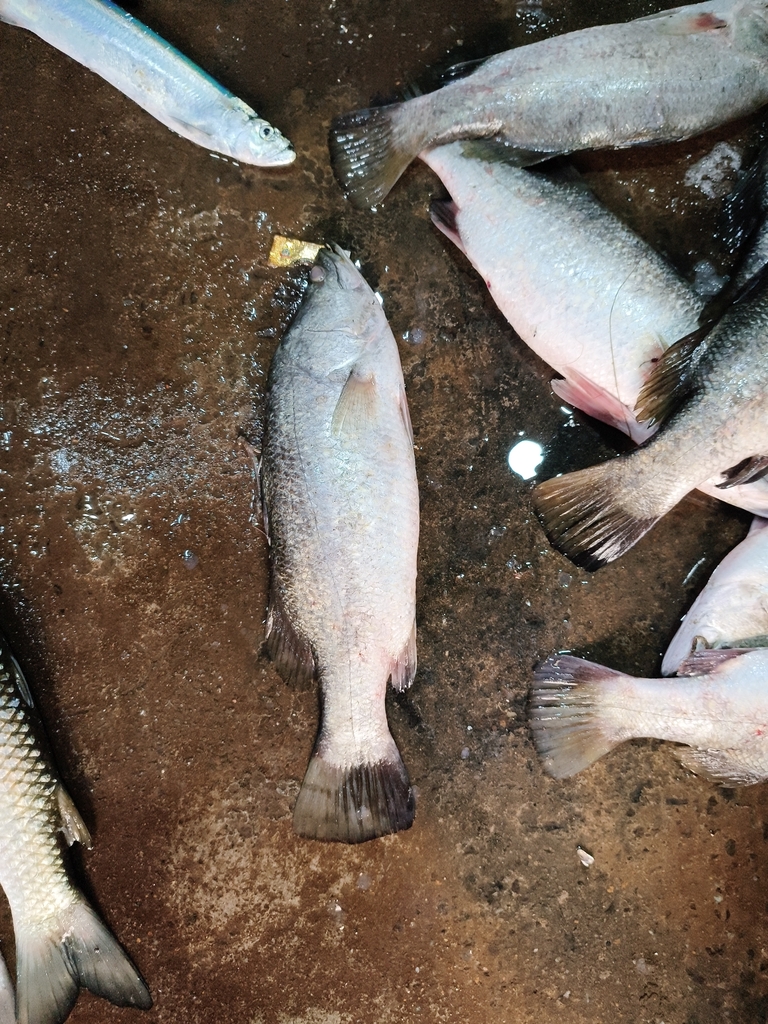
The Asian seabass (Lates calcarifer) is a fish that lives in both fresh and salt water of the family Latidae that grows up to 200 cm.
Description
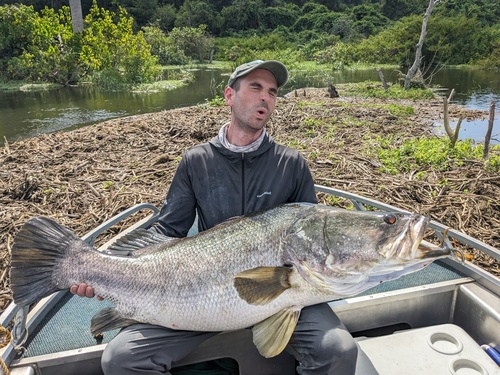
The barramundi is a large, diadromous predatory fish (family Latidae) of the Indo-West Pacific. The species can grow to about 2 m and has a streamlined, silvery body with a large, oblique mouth and a concave head profile. It lives in coastal waters, estuaries and lagoons in clear to turbid water; adults inhabit rivers and return to estuaries to spawn. It is a powerful predator hunting fishes, crustaceans and other invertebrates. Notably the species is a protandrous hermaphrodite: individuals begin as males and later become females. The barramundi is a highly prized aquaculture and sport fish.
Frequently asked questions
How do you recognise the Asian seabass?
The Asian seabass has a torpedo-shaped body, is mainly silver-grey and shows a plain pattern.
Where does the Asian seabass live?
The Asian seabass lives in both fresh and salt water and is mostly found around sand or mud bottom.
How big does the Asian seabass get?
The Asian seabass grows to a maximum of about 200 cm. On average the species is around 150 cm.
Is the Asian seabass dangerous to humans?
No, the Asian seabass is harmless to humans.
Is the Asian seabass edible?
Yes, the Asian seabass is a highly prized food fish.
Download Fin's Fish Guide
Identify fish in seconds, log your catches and dives. Join the TestFlight beta.
All data
Identification
Appearance
Habitat & distribution
Behaviour & biology
For anglers
Safety
Status & sources
Same genus Lates

More from the family Latidae
Download Fin's Fish Guide
Identify fish in seconds, log your catches and dives. Join the TestFlight beta.