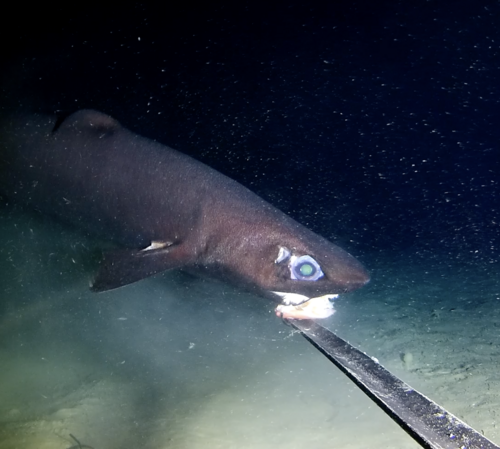
Home · Somniosidae · Greenland shark
Greenland shark (Somniosus microcephalus) — Somniosidae

Greenland shark

Somniosus microcephalus
Family: Somniosidae
VU · Vulnerable

The Greenland shark (Somniosus microcephalus) is a saltwater fish of the family Somniosidae that grows up to 427 cm.

Length
427 cm
Water
Saltwater
Depth
0.0–2992.0 m
Diet
Carnivore
Behaviour
Solitary
Activity
Nocturnal
Body shape
Elongated (eel-like)
Substrate
Mixed bottom
Danger
Venomous / poisonous
Range
North Atlantic and Arctic Ocean
Edibility
Not eaten

Want the complete picture on the Greenland shark?

Get the app

Description

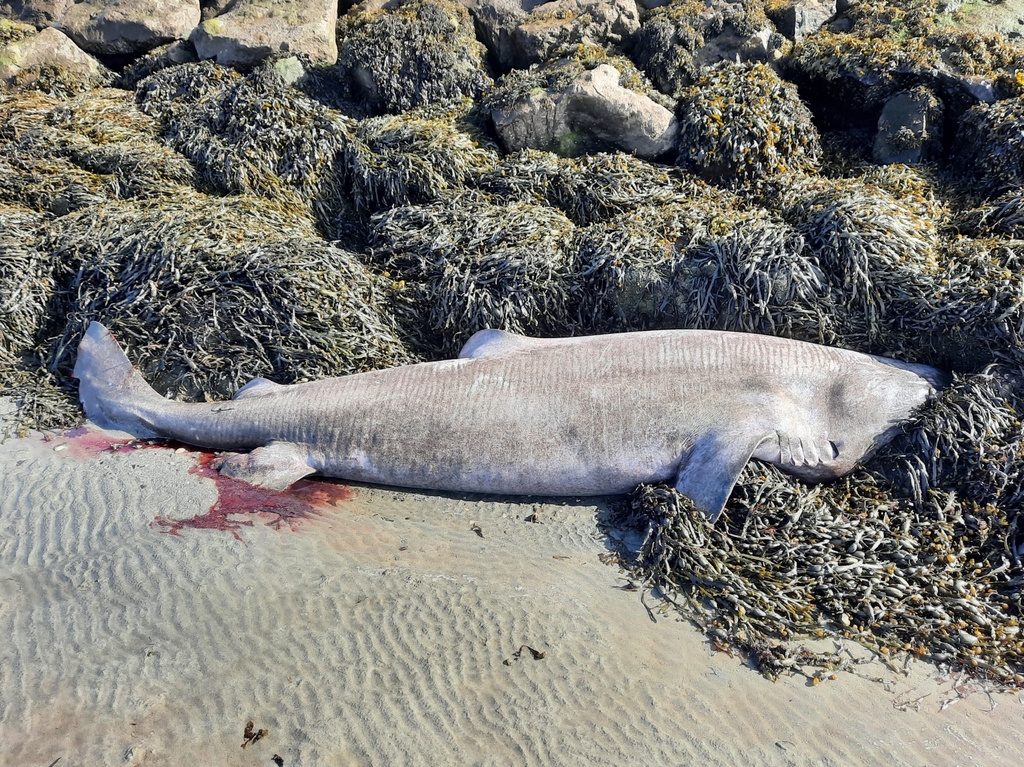
The Greenland shark is a giant, slow-living deep-sea shark from the cold waters of the northern Atlantic and Arctic oceans. The species grows to about 430 cm and is among the longest-lived vertebrates in the world; specimens may reach hundreds of years old. It has a bulky, grey-brown body, small eyes and hunts slowly for fish, seals and carrion. Its flesh contains high concentrations of the toxin trimethylamine oxide; eaten fresh it causes poisoning ('shark drunkenness') and it may only be eaten after lengthy fermentation. The IUCN assesses the species as Vulnerable (VU).

Frequently asked questions

How do you recognise the Greenland shark?

The Greenland shark has an elongate, eel-like body, is mainly brown and shows a plain pattern. One of the longest-living vertebrates; flesh poisonous unless fermented

Where does the Greenland shark live?

The Greenland shark lives in the sea (marine waters) and is mostly found around mixed bottom. North Atlantic and Arctic Ocean

How big does the Greenland shark get?

The Greenland shark grows to a maximum of about 427 cm.

Is the Greenland shark dangerous to humans?

The Greenland shark is venomous — handle spines with care and seek medical help after a sting if needed. Do not eat the flesh fresh: it contains high concentrations of trimethylamine oxide and causes a poisoning with drunkenness-like symptoms. Only edible after lengthy fermentation. Seek medical help if symptoms follow consumption.

Is the Greenland shark edible?

The Greenland shark is not usually eaten.

More photos
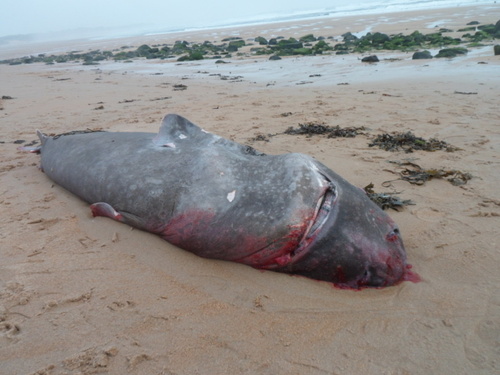
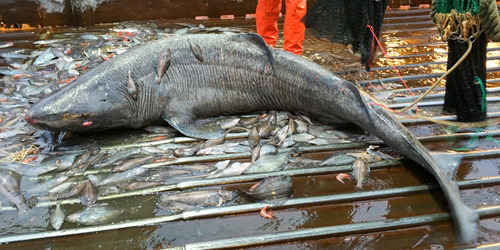
Greenland shark (Somniosus microcephalus) — Somniosidae — 2
iNaturalist ((c) Jane Dixon, some rights reserved (CC BY-NC))
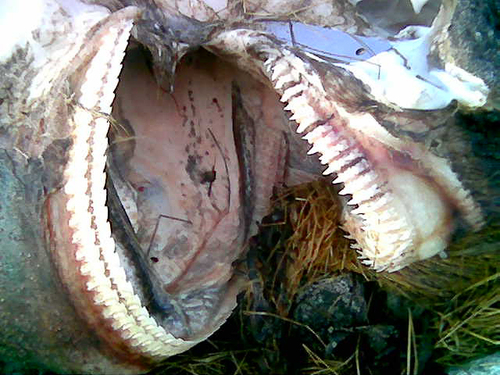
Greenland shark (Somniosus microcephalus) — Somniosidae — 3
Jan Ole Olsen (CC BY 4.0) via GBIF — nbic
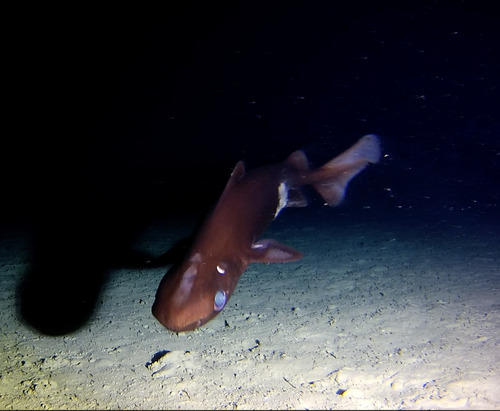
Greenland shark (Somniosus microcephalus) — Somniosidae — 4
iNaturalist ((c) Claude Nozères, some rights reserved (CC BY-NC))
Greenland shark (Somniosus microcephalus) — Somniosidae — 5
iNaturalist ((c) Audun Eriksen, some rights reserved (CC BY-NC))
Fin

Want the complete picture on the Greenland shark?

Point your camera at the fish and Fin names the species in seconds. Free, and the Greenland shark is one of 12,519 species in the app.

Get the app →

All data

Identification

English name
Greenland shark verified
Scientific name
Somniosus microcephalus
Family
Somniosidae
Other names
Greenland shark; Ground shark; Oakettle verified

Appearance

Size class
Extra large verified
Max length (cm)
427.0 verified
Body shape
Elongated (eel-like) sourced
Dominant colour
Brown sourced
Pattern
Plain sourced
Tail shape
Crescent (lunate) inferred
Mouth position
Terminal sourced
Lips
Thin sourced
Barbels
No sourced
Dorsal fins
Two separate sourced
Dorsal spines
No sourced

Habitat & distribution

Water type
Saltwater sourced
Substrate
Mixed bottom sourced
Min depth (m)
0.0 verified
Max depth (m)
2992.0 verified
Natural range
North Atlantic and Arctic Ocean verified
Origin
Native verified

Behaviour & biology

Diet
Carnivore sourced
Diet (detail)
Fishes, seals and carrion inferred
Social behaviour
Solitary sourced
Territorial
No sourced
Activity
Nocturnal sourced
Reproduction
Separate sexes sourced
Sexual dimorphism
No sourced
levensduur_max_jaar
392.0 verified
Seasonality
Giant long-lived deep-sea shark; present year-round. sourced
Special features
One of the longest-living vertebrates; flesh poisonous unless fermented sourced

For anglers

Edibility
Not eaten sourced
Fishing method
Longline fishing sourced
Regulations source
FishBase ↗ inferred

Safety

Danger to humans
Venomous / poisonous sourced
First aid
Do not eat the flesh fresh: it contains high concentrations of trimethylamine oxide and causes a poisoning with drunkenness-like symptoms. Only edible after lengthy fermentation. Seek medical help if symptoms follow consumption. verified

Status & sources

Sources
FishBase via GBIF (DwC-A), CC-BY-NC 4.0

Same genus Somniosus

More from the family Somniosidae

Fin

Want the complete picture on the Greenland shark?

Point your camera at the fish and Fin names the species in seconds. Free, and the Greenland shark is one of 12,519 species in the app.

Get the app →
Is this the Greenland shark? Get the app