Home · Serranidae · Creole-fish
Creole-fish (Paranthias furcifer) — Serranidae

Creole-fish

Paranthias furcifer
Family: Serranidae
LC · Least Concern

The Creole-fish (Paranthias furcifer) is a saltwater fish of the family Serranidae that grows up to 30 cm.

Length
30 cm
Water
Saltwater
Depth
8.0–100.0 m
Diet
Carnivore
Behaviour
Large groups
Activity
Diurnal
Body shape
Torpedo-shaped
Substrate
Stone or rock
Danger
Harmless
Range
Eastern and western Atlantic; coral reefs and hard bottoms of warm coastal waters.
Edibility
Rarely eaten

Want the complete picture on the Creole-fish?

Get the app

Description

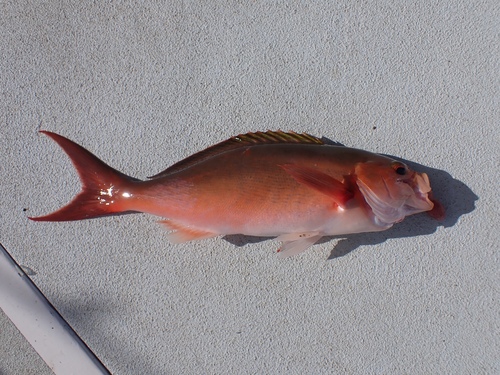
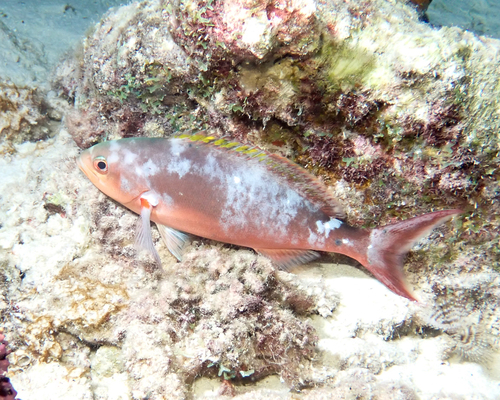
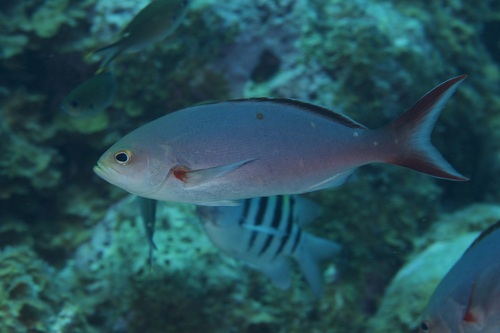
The creole-fish (Paranthias furcifer) is a reef bass of the Atlantic, in the east at Ascension and the Gulf of Guinea islands, and in the west from Bermuda and Florida through the Gulf of Mexico and Caribbean to Brazil. It grows to 30 centimetres and lives on coral reefs and hard bottoms, usually at 10-66 metres. Head and body are reddish brown with a bright orange spot at the pectoral-fin base, three white spots along the back and two blue lines on the cheek. The fish forms large feeding schools that hunt zooplankton in midwater. The species is harmless and is fished.

Frequently asked questions

How do you recognise the Creole-fish?

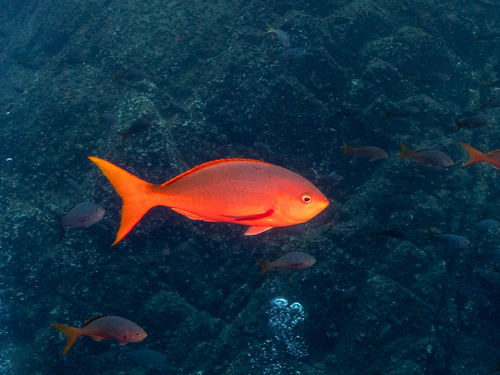
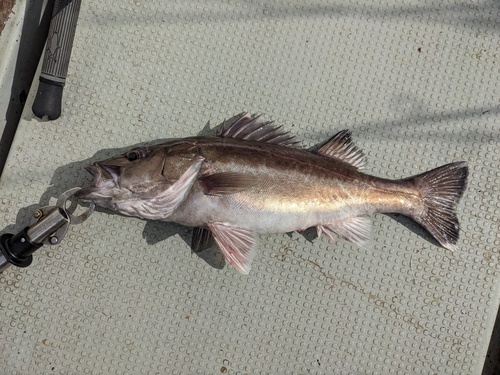
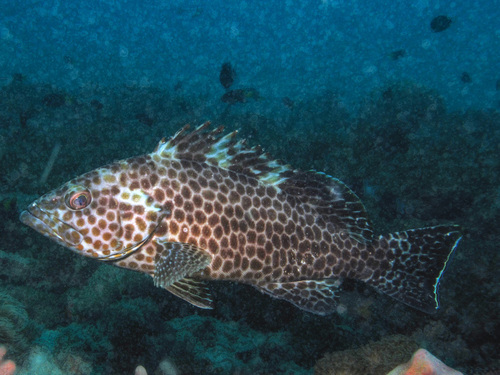
The Creole-fish has a torpedo-shaped body, is mainly red-orange and shows a spots pattern. Bright orange blotch at the base of the pectoral fin, three white blotches on the back and two blue cheek lines; forms large feeding shoals.

Where does the Creole-fish live?

The Creole-fish lives in the sea (marine waters) and is mostly found around stony or rocky ground. Eastern and western Atlantic; coral reefs and hard bottoms of warm coastal waters.

How big does the Creole-fish get?

The Creole-fish grows to a maximum of about 30 cm. On average the species is around 20 cm.

Is the Creole-fish dangerous to humans?

No, the Creole-fish is harmless to humans. None required: this species is harmless to humans.

Is the Creole-fish edible?

The Creole-fish is rarely eaten.

More photos

Creole-fish (Paranthias furcifer) — Serranidae — 2
Wikimedia Commons — Williams, J. T.; Carpenter, K. E.; Van Tassell, J. L.; Hoetjes, P.; Toller, W.; Etnoyer, P.; Smith, M. (CC BY 2.5)
Creole-fish (Paranthias furcifer) — Serranidae — 3
iNaturalist ((c) Luke Foster, some rights reserved (CC BY-NC))
Creole-fish (Paranthias furcifer) — Serranidae — 4
iNaturalist ((c) Roger Rittmaster, some rights reserved (CC BY))
Creole-fish (Paranthias furcifer) — Serranidae — 5
Natascha Borgstein (CC BY-NC 4.0) via GBIF — iNaturalist

Easily confused with

These species look like the Creole-fish and live in the same waters.

Fin

Want the complete picture on the Creole-fish?

Point your camera at the fish and Fin names the species in seconds. Free, and the Creole-fish is one of 12,519 species in the app.

Get the app →

All data

Identification

English name
Creole-fish verified
Scientific name
Paranthias furcifer
Family
Serranidae
Other names
Barber; Bonefin; Creole fish; Atlantic creolefish; Creolefish; Prickle wood; Sea bass; Southern creole-fish verified

Appearance

Size class
Medium verified
Max length (cm)
30.0 verified
Average length (cm)
20 verified
Body shape
Torpedo-shaped sourced
Dominant colour
Red / orange verified
Pattern
Spots verified
Tail shape
Forked verified
Mouth position
Terminal sourced
Lips
Thin inferred
Barbels
No verified
Dorsal fins
One continuous verified
Dorsal spines
Yes verified

Habitat & distribution

Water type
Saltwater sourced
Substrate
Stone or rock sourced
Min depth (m)
8.0 verified
Max depth (m)
100.0 verified
Natural range
Eastern and western Atlantic; coral reefs and hard bottoms of warm coastal waters. verified
Origin
Native verified

Behaviour & biology

Diet
Carnivore verified
Diet (detail)
Zooplankton such as copepods, pelagic tunicates and small shrimps. verified
Social behaviour
Large groups sourced
Territorial
No inferred
Activity
Diurnal sourced
Reproduction
Separate sexes sourced
Sexual dimorphism
No inferred
Seasonality
Reef fish that hunts plankton in large shoals above the reef; eggs and larvae drift in open water. sourced
Special features
Bright orange blotch at the base of the pectoral fin, three white blotches on the back and two blue cheek lines; forms large feeding shoals. verified

For anglers

Edibility
Rarely eaten sourced
Fishing method
Fishing with small natural bait or lures around reefs and hard bottoms; also used as live bait. sourced
Regulations source
FishBase ↗ inferred

Safety

Danger to humans
Harmless sourced
First aid
None required: this species is harmless to humans. verified

Status & sources

Sources
FishBase via GBIF (DwC-A), CC-BY-NC 4.0

Same genus Paranthias

More from the family Serranidae

Fin

Want the complete picture on the Creole-fish?

Point your camera at the fish and Fin names the species in seconds. Free, and the Creole-fish is one of 12,519 species in the app.

Get the app →
Is this the Creole-fish? Get the app