
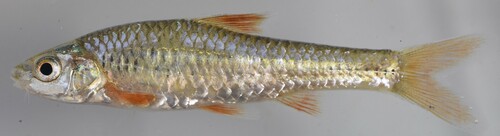
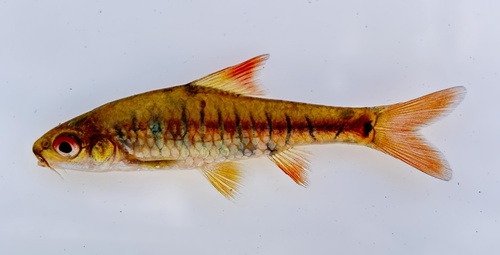
The Congo dwarf barb (Clypeobarbus pleuropholis) is a freshwater fish of the family Cyprinidae that grows up to 3 cm.
Description
The Congo dwarf barb is a very small, slender African barb of the family Cyprinidae reaching only about 3-4 cm. The laterally compressed body has a shiny silver flank, sometimes with a faint golden glow, and bears fine barbels around the mouth. The species lives in schools in streams, rivers and swamps with abundant water plants in the Congo basin of Central Africa. As an omnivore it eats small zooplankton, insect larvae, algae and detritus, taken in the water column and from the bottom. In the rainy season it spawns on flooded margins, where the young grow up quickly. Through its small size and great numbers it is an important prey fish for larger species.
Frequently asked questions
How do you recognise the Congo dwarf barb?
The Congo dwarf barb has a torpedo-shaped body, is mainly silver-grey and shows a plain pattern.
Where does the Congo dwarf barb live?
The Congo dwarf barb lives in fresh water and is mostly found around algae or seagrass beds.
How big does the Congo dwarf barb get?
The Congo dwarf barb grows to a maximum of about 3 cm.
Is the Congo dwarf barb dangerous to humans?
No, the Congo dwarf barb is harmless to humans.
Is the Congo dwarf barb edible?
The Congo dwarf barb is not usually eaten.
Download Fin's Fish Guide
Identify fish in seconds, log your catches and dives. Join the TestFlight beta.
All data
Identification
Appearance
Habitat & distribution
Behaviour & biology
For anglers
Safety
Status & sources
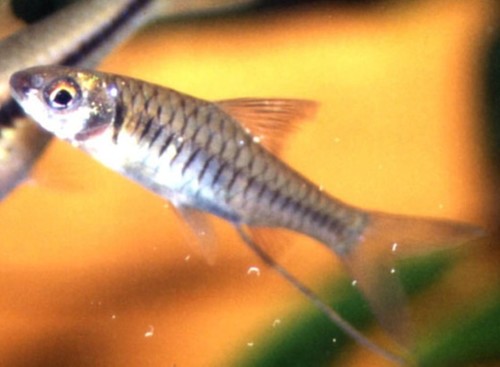
Same genus Clypeobarbus

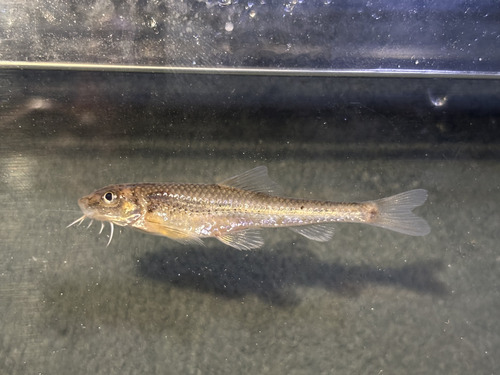
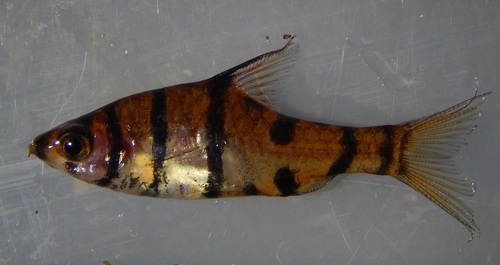
More from the family Cyprinidae


Download Fin's Fish Guide
Identify fish in seconds, log your catches and dives. Join the TestFlight beta.