
The African blind barb (Caecobarbus geertsii) is a freshwater fish of the family Cyprinidae that grows up to 12 cm.
Description
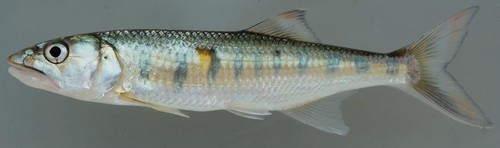
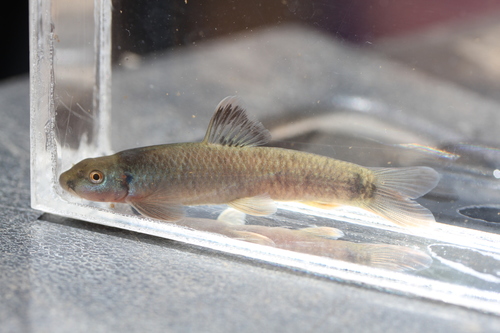
The Congo blind barb is a remarkable cave fish (family Cyprinidae) endemic to limestone caves in the Lower Congo region. The species grows to about 12 cm and is fully adapted to life in complete darkness: it lacks functional eyes and pigment, giving the body a pink to whitish appearance. It lives in cave waters several hundred metres above sea level and feeds on small crustaceans and organic material washed into the caves. Because of its very restricted range and sensitivity to disturbance the species is considered Vulnerable (VU) and is legally protected.
Frequently asked questions
How do you recognise the African blind barb?
The African blind barb has an elongate, eel-like body, is mainly pink-purple and shows a plain pattern.
Where does the African blind barb live?
The African blind barb lives in fresh water and is mostly found around mixed bottom.
How big does the African blind barb get?
The African blind barb grows to a maximum of about 12 cm.
Is the African blind barb dangerous to humans?
No, the African blind barb is harmless to humans.
Is the African blind barb edible?
The African blind barb is not usually eaten.
Download Fin's Fish Guide
Identify fish in seconds, log your catches and dives. Join the TestFlight beta.
All data
Identification
Appearance
Habitat & distribution
Behaviour & biology
For anglers
Safety
Status & sources
More from the family Cyprinidae


Download Fin's Fish Guide
Identify fish in seconds, log your catches and dives. Join the TestFlight beta.