Home · Fistulariidae · Bluespotted cornetfish
Bluespotted cornetfish (Fistularia tabacaria) — Fistulariidae

Bluespotted cornetfish

Fistularia tabacaria
Family: Fistulariidae
LC · Least Concern

The Bluespotted cornetfish (Fistularia tabacaria) is a saltwater fish of the family Fistulariidae that grows up to 200 cm.

Length
200 cm
Water
Saltwater
Depth
0–200.0 m
Diet
Carnivore
Behaviour
Solitary
Activity
Diurnal
Body shape
Elongated (eel-like)
Substrate
Open water
Danger
Harmless
Range
Atlantic Ocean on both sides, over sandy bottoms, seagrass beds and reefs of shallow to moderately deep coastal waters, also around the Macaronesian islands.
Edibility
Rarely eaten

Want the complete picture on the Bluespotted cornetfish?

Get the app

Description

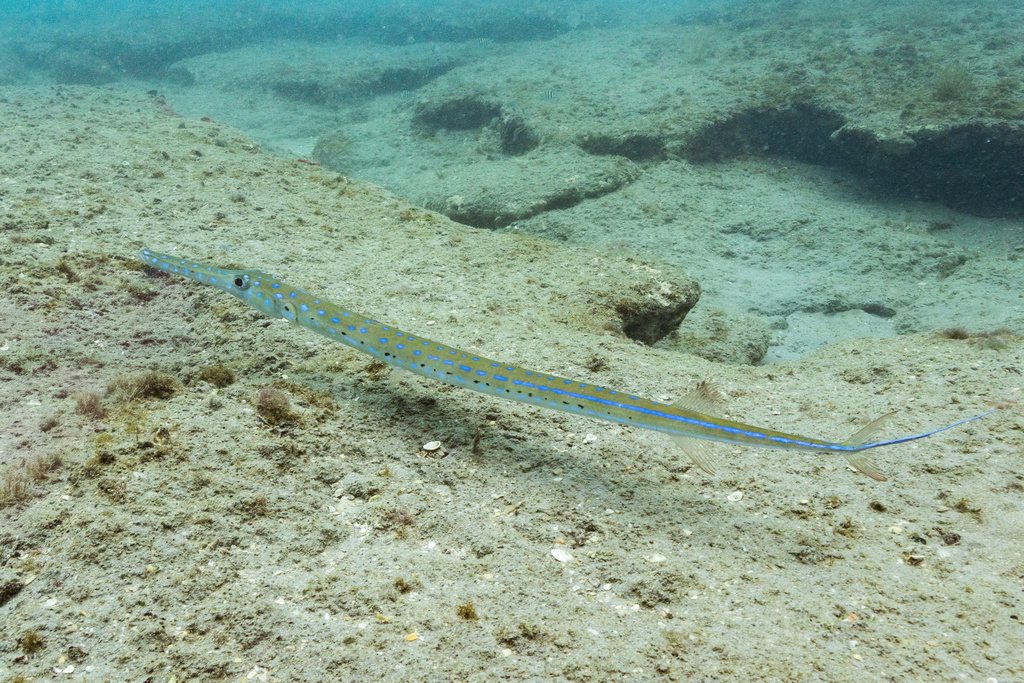
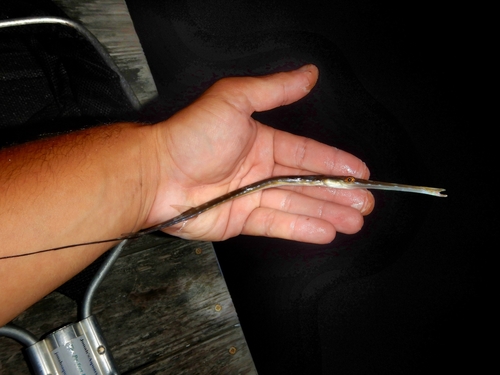
The bluespotted cornetfish is a very long, thin fish of the family Fistulariidae (cornetfishes) that can reach about 2 metres long but stays extremely slender. The snout is extended into a long tube with a small mouth at the end, with which the fish sucks up prey; rows of blue spots run over the brown-green back, and the tail ends in a long, thread-like filament. The species lives above sand bottoms, seagrass beds and reefs of coastal water of the Atlantic on both sides, also around the Macaronesian islands. It often hovers motionless in wait and then sucks in small fish and shrimps in a flash. Because of its bizarre shape it is unmistakable.

Frequently asked questions

How do you recognise the Bluespotted cornetfish?

The Bluespotted cornetfish has an elongate, eel-like body, is mainly brown and shows a spots pattern. Very long, thin fish with a tubular snout, rows of blue spots on the back and a tail that tapers into a long thread-like point.

Where does the Bluespotted cornetfish live?

The Bluespotted cornetfish lives in the sea (marine waters) and is mostly found around open water. Atlantic Ocean on both sides, over sandy bottoms, seagrass beds and reefs of shallow to moderately deep coastal waters, also around the Macaronesian islands.

How big does the Bluespotted cornetfish get?

The Bluespotted cornetfish grows to a maximum of about 200 cm. On average the species is around 120 cm.

Is the Bluespotted cornetfish dangerous to humans?

No, the Bluespotted cornetfish is harmless to humans. None required: this species is harmless to humans.

Is the Bluespotted cornetfish edible?

The Bluespotted cornetfish is rarely eaten.

More photos
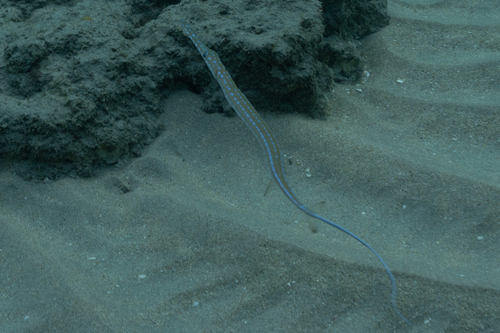
Bluespotted cornetfish (Fistularia tabacaria) — Fistulariidae — 2
iNaturalist ((c) Drew, some rights reserved (CC BY-NC))
Bluespotted cornetfish (Fistularia tabacaria) — Fistulariidae — 3
Wikimedia Commons — SEFSC Pascagoula Laboratory; Collection of Brandi Noble, NOAA/NMFS/SEFSC (Public domain)
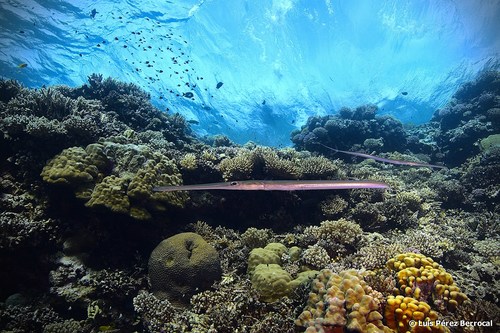
Bluespotted cornetfish (Fistularia tabacaria) — Fistulariidae — 4
elinetsky (CC BY-NC 4.0) via GBIF — iNaturalist
Bluespotted cornetfish (Fistularia tabacaria) — Fistulariidae — 5
Rui Ribeiro (CC BY 4.0) via GBIF — iNaturalist
Fin

Want the complete picture on the Bluespotted cornetfish?

Point your camera at the fish and Fin names the species in seconds. Free, and the Bluespotted cornetfish is one of 12,519 species in the app.

Get the app →

All data

Identification

English name
Bluespotted cornetfish verified
Scientific name
Fistularia tabacaria
Family
Fistulariidae
Other names
Bluespotted cornetfish; Cornet fish; Cornetfish; Trumpetfish; Tobacco trumpetfish; Trumpet fish; Unarmed trumpetfish verified

Appearance

Size class
Extra large verified
Max length (cm)
200.0 verified
Average length (cm)
120.0 verified
Body shape
Elongated (eel-like) verified
Dominant colour
Brown sourced
Pattern
Spots sourced
Tail shape
Forked inferred
Mouth position
Beak-shaped inferred
Lips
Thin inferred
Barbels
No verified
Dorsal fins
One continuous sourced
Dorsal spines
No verified

Habitat & distribution

Water type
Saltwater verified
Substrate
Open water verified
Max depth (m)
200.0 verified
Natural range
Atlantic Ocean on both sides, over sandy bottoms, seagrass beds and reefs of shallow to moderately deep coastal waters, also around the Macaronesian islands. verified
Origin
Native verified

Behaviour & biology

Diet
Carnivore verified
Diet (detail)
Small fishes and shrimps, sucked in with the tubular snout sourced
Social behaviour
Solitary verified
Territorial
No verified
Activity
Diurnal inferred
Reproduction
Separate sexes verified
Sexual dimorphism
No verified
Seasonality
Often hovers motionless above seagrass and reefs, lying in wait; eggs and larvae drift in open water. sourced
Special features
Very long, thin fish with a tubular snout, rows of blue spots on the back and a tail that tapers into a long thread-like point. sourced

For anglers

Edibility
Rarely eaten verified
Fishing method
Angling with lures or (dead/live) baitfish by trolling, casting or drift fishing in open water. inferred
Regulations source
FishBase ↗ inferred

Safety

Danger to humans
Harmless verified
First aid
None required: this species is harmless to humans. sourced

Status & sources

Sources
FishBase via GBIF (DwC-A), CC-BY-NC 4.0

Same genus Fistularia

More from the family Fistulariidae

Fin

Want the complete picture on the Bluespotted cornetfish?

Point your camera at the fish and Fin names the species in seconds. Free, and the Bluespotted cornetfish is one of 12,519 species in the app.

Get the app →
Is this the Bluespotted cornetfish? Get the app