Home · Diodontidae · Birdbeak burrfish
Birdbeak burrfish (Cyclichthys orbicularis) — Diodontidae

Birdbeak burrfish

Cyclichthys orbicularis
Family: Diodontidae
LC · Least Concern

The Birdbeak burrfish (Cyclichthys orbicularis) is a saltwater fish of the family Diodontidae that grows up to 30 cm.

Length
30 cm
Water
Saltwater
Depth
9.0–170.0 m
Diet
Carnivore
Behaviour
Solitary
Activity
Nocturnal
Body shape
Flat / disc-shaped
Substrate
Algae or seagrass meadow
Danger
Venomous / poisonous
Range
Indian and western Pacific Ocean, near reefs, seagrass beds and rocky bottoms of shallow, warm coastal water.
Edibility
Not eaten

Want the complete picture on the Birdbeak burrfish?

Get the app

Description

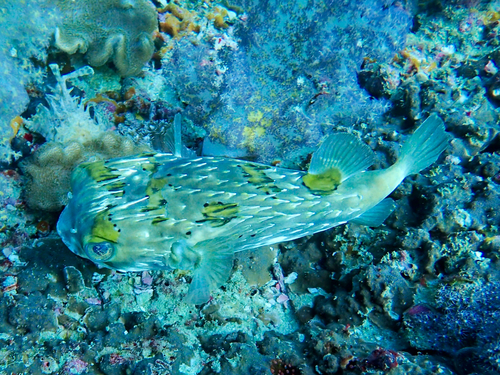
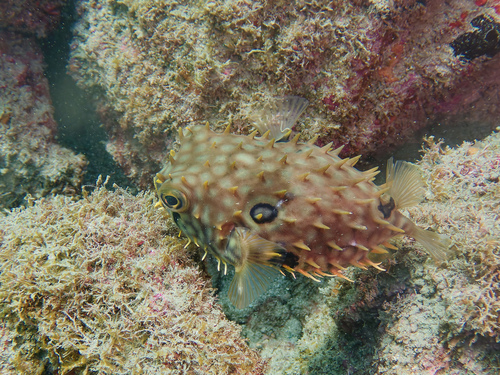
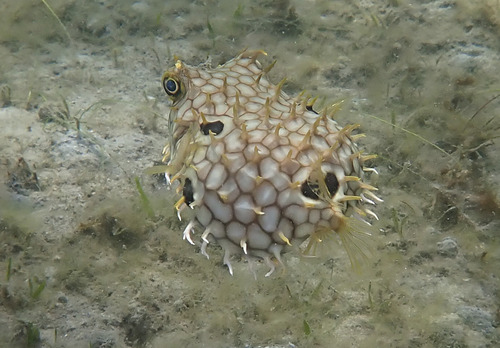
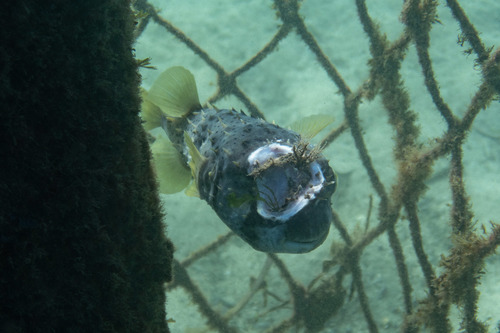
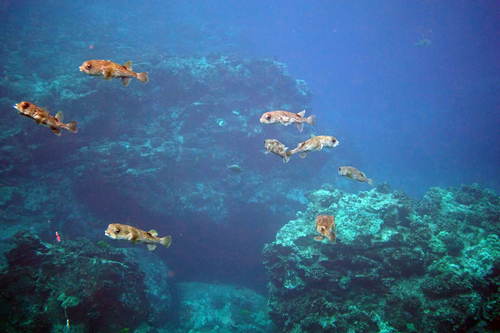
The birdbeak burrfish is a porcupinefish of the family Diodontidae reaching about 30 cm. Unlike many relatives it has short, three-rooted spines that are always erect and cannot be folded flat against the body. The brownish-yellow body bears dark blotches. With its jaws fused into a beak it crushes snails, shellfish, hermit crabs and sea urchins. When threatened it pumps itself up with water into a spiny ball, too large and prickly for most predators. The species lives near reefs, seagrass beds and rocky bottoms of shallow, warm coastal water in the Indian and western Pacific Oceans. Like many puffers and porcupinefishes its skin and organs may contain the poison tetrodotoxin; it should not be eaten.

Frequently asked questions

How do you recognise the Birdbeak burrfish?

The Birdbeak burrfish has a flattened, disc-shaped body, is mainly brown and shows a spots pattern. Porcupinefish with short, fixed spines that always stand upright and a brownish yellow body with dark blotches; a beak-like dentition.

Where does the Birdbeak burrfish live?

The Birdbeak burrfish lives in the sea (marine waters) and is mostly found around algae or seagrass beds. Indian and western Pacific Ocean, near reefs, seagrass beds and rocky bottoms of shallow, warm coastal water.

How big does the Birdbeak burrfish get?

The Birdbeak burrfish grows to a maximum of about 30 cm.

Is the Birdbeak burrfish dangerous to humans?

The Birdbeak burrfish is venomous — handle spines with care and seek medical help after a sting if needed. The skin and organs may contain the nerve poison tetrodotoxin: this fish should not be eaten. The spines can cause puncture wounds.

Is the Birdbeak burrfish edible?

The Birdbeak burrfish is not usually eaten.

More photos

Birdbeak burrfish (Cyclichthys orbicularis) — Diodontidae — 2
Wikimedia Commons — Bernard DUPONT from FRANCE (CC BY-SA 2.0)
Birdbeak burrfish (Cyclichthys orbicularis) — Diodontidae — 3
Wikimedia Commons — Diego Delso (CC BY-SA 4.0)
Birdbeak burrfish (Cyclichthys orbicularis) — Diodontidae — 4
Wikimedia Commons — Bernard DUPONT from FRANCE (CC BY-SA 2.0)
Birdbeak burrfish (Cyclichthys orbicularis) — Diodontidae — 5
Paul Varotsis (CC BY-NC 4.0) via GBIF — iNaturalist
Fin

Want the complete picture on the Birdbeak burrfish?

Point your camera at the fish and Fin names the species in seconds. Free, and the Birdbeak burrfish is one of 12,519 species in the app.

Get the app →

All data

Identification

English name
Birdbeak burrfish verified
Scientific name
Cyclichthys orbicularis
Family
Diodontidae
Other names
Birdbeak burrfish; Orbicular burrfish; Ballonfish; Fixed spine porcupinefish; Porcupinefish; Rounded porcupinefish; Spiny blaasop verified

Appearance

Size class
Medium verified
Max length (cm)
30.0 verified
Body shape
Flat / disc-shaped sourced
Dominant colour
Brown sourced
Pattern
Spots sourced
Tail shape
Rounded inferred
Mouth position
Terminal inferred
Lips
Thick / fleshy inferred
Barbels
No verified
Dorsal fins
One continuous sourced
Dorsal spines
No verified

Habitat & distribution

Water type
Saltwater verified
Substrate
Algae or seagrass meadow verified
Min depth (m)
9.0 verified
Max depth (m)
170.0 verified
Natural range
Indian and western Pacific Ocean, near reefs, seagrass beds and rocky bottoms of shallow, warm coastal water. verified
Origin
Native verified

Behaviour & biology

Diet
Carnivore verified
Diet (detail)
Snails, shellfish, hermit crabs and sea urchins, crushed with the beak-like teeth sourced
Social behaviour
Solitary verified
Territorial
No verified
Activity
Nocturnal inferred
Reproduction
Separate sexes verified
Sexual dimorphism
No verified
Seasonality
Resident reef-dweller that shelters during the day and forages at night; eggs and larvae drift in open water. sourced
Special features
Porcupinefish with short, fixed spines that always stand upright and a brownish yellow body with dark blotches; a beak-like dentition. sourced

For anglers

Edibility
Not eaten verified
Fishing method
Fishing with natural bait (fish, shrimp, worm) or lures close to reef and rock structures. inferred
Regulations source
FishBase ↗ inferred

Safety

Danger to humans
Venomous / poisonous verified
First aid
The skin and organs may contain the nerve poison tetrodotoxin: this fish should not be eaten. The spines can cause puncture wounds. sourced

Status & sources

Sources
FishBase via GBIF (DwC-A), CC-BY-NC 4.0

Same genus Cyclichthys

More from the family Diodontidae
Fin

Want the complete picture on the Birdbeak burrfish?

Point your camera at the fish and Fin names the species in seconds. Free, and the Birdbeak burrfish is one of 12,519 species in the app.

Get the app →
Is this the Birdbeak burrfish? Get the app