 Fin's Fish Guide
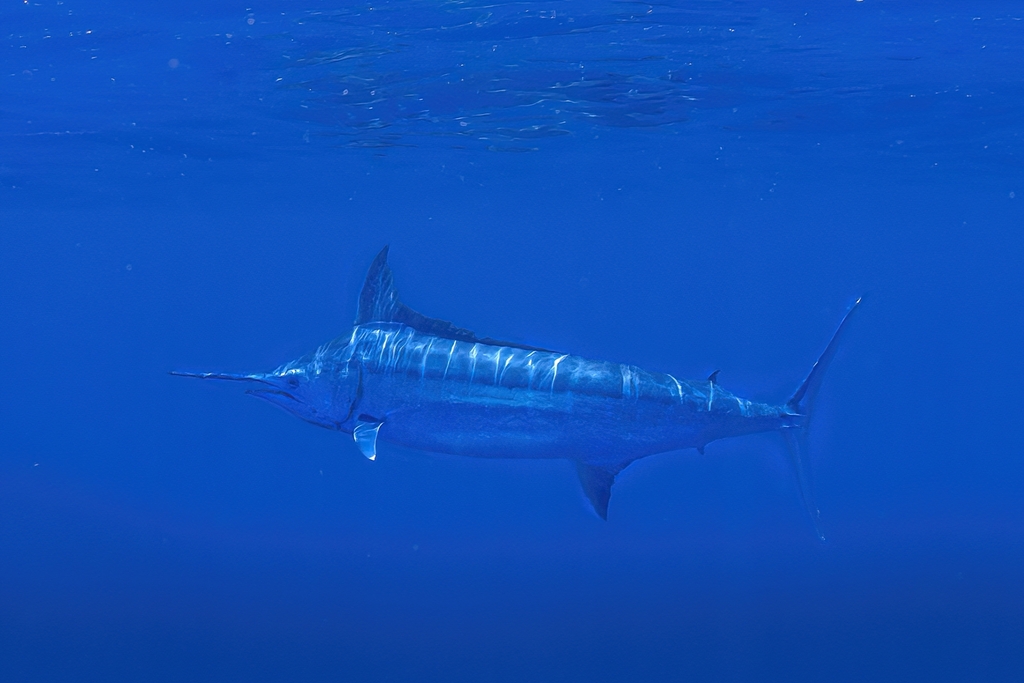
The Atlantic blue marlin (Makaira nigricans) is a saltwater fish of the family Istiophoridae that grows up to 500 cm.
Description
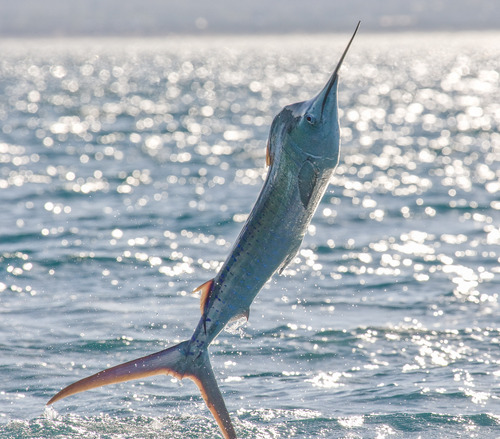
The Atlantic blue marlin is an enormous, fast predator of the billfish family (Istiophoridae) from the open Atlantic. The species can reach about five metres and weigh hundreds of kilos; it has a streamlined, blue-black body with a silvery-white belly and a long, spear-like bill (rostrum). It is an oceanic species preferring warm, blue open water. As a fast apex predator it hunts tuna, mackerel, squid and other surface fishes, which it sometimes stuns with its bill. The Atlantic blue marlin is a prized sport fish; owing to fishing it is listed as Vulnerable (VU). The long bill and immense power can cause injury when angling.
Frequently asked questions
How do you recognise the Atlantic blue marlin?
The Atlantic blue marlin has an elongate, eel-like body, is mainly blue and shows a plain pattern. Marlin up to 5 m long with a long snout (rostrum); fast apex predator, vulnerable (VU) and a sought-after sport fish.
Where does the Atlantic blue marlin live?
The Atlantic blue marlin lives in the sea (marine waters) and is mostly found around open water. Open Atlantic Ocean; warm, blue surface water of the open sea.
How big does the Atlantic blue marlin get?
The Atlantic blue marlin grows to a maximum of about 500 cm. On average the species is around 290 cm.
Is the Atlantic blue marlin dangerous to humans?
No, the Atlantic blue marlin is harmless to humans. Not venomous, but the long, spear-like bill and the immense power of this fish can cause serious injury when angling; keep well clear of a caught or hooked marlin brought aboard.
Is the Atlantic blue marlin edible?
Yes, the Atlantic blue marlin is commonly eaten.
Easily confused with
These species look like the Atlantic blue marlin and live in the same waters.

Want the complete picture on the Atlantic blue marlin?
Point your camera at the fish and Fin names the species in seconds. Free, and the Atlantic blue marlin is one of 12,519 species in the app.
All data
Identification
Appearance
Habitat & distribution
Behaviour & biology
For anglers
Safety
Status & sources
Same genus Makaira
More from the family Istiophoridae


Want the complete picture on the Atlantic blue marlin?
Point your camera at the fish and Fin names the species in seconds. Free, and the Atlantic blue marlin is one of 12,519 species in the app.