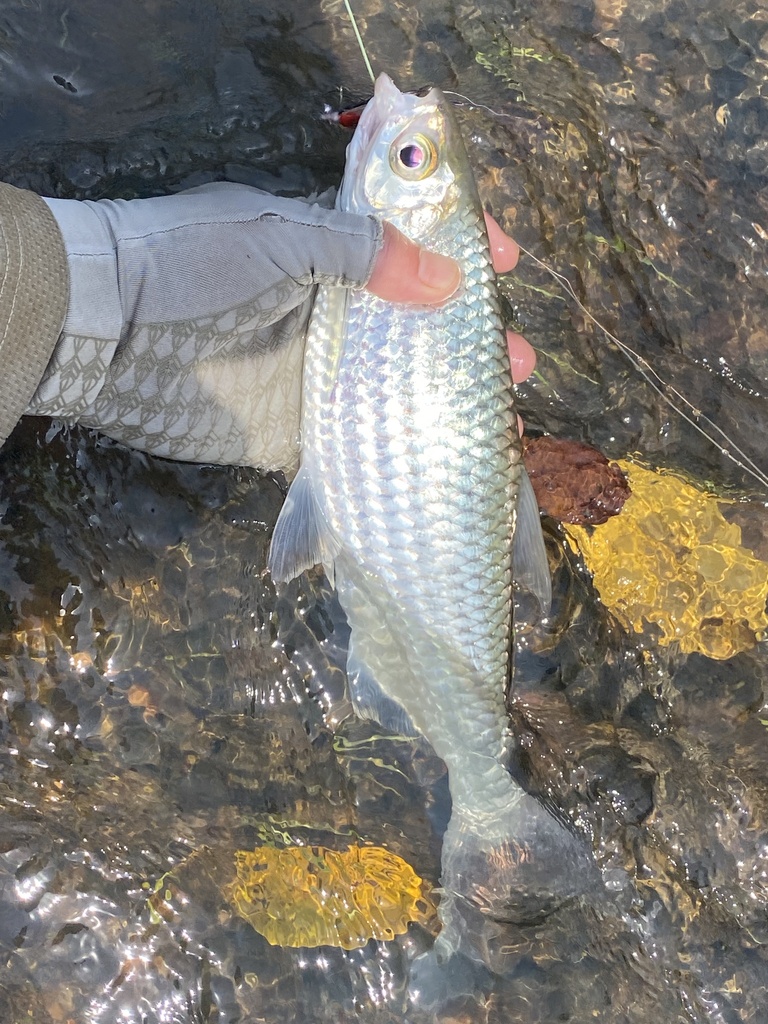
The Bigeye tetra (Alestes macrophthalmus) is a freshwater fish of the family Alestidae that grows up to 60 cm.
Description
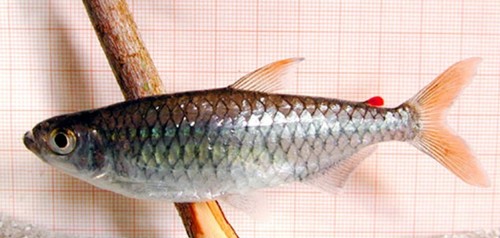
The bigeye tetra is a robust, silvery characin of the family Alestidae (African tetras) reaching about 60 cm. The streamlined body has conspicuously large eyes, large shiny scales and an adipose fin, as in many characins. The species comes from the Congo and parts of the Nile basin in Central Africa and lives in active schools in rivers, lakes and floodplains. As an omnivore it eats insects, seeds, fruits, plant matter and small fish, taken in the water column and at the surface. In the rainy season it spawns on flooded margins. With its size and tasty flesh the bigeye tetra is an important commercial and sport fish in the region.
Frequently asked questions
How do you recognise the Bigeye tetra?
The Bigeye tetra has a torpedo-shaped body, is mainly silver-grey and shows a plain pattern.
Where does the Bigeye tetra live?
The Bigeye tetra lives in fresh water and is mostly found around open water.
How big does the Bigeye tetra get?
The Bigeye tetra grows to a maximum of about 60 cm.
Is the Bigeye tetra dangerous to humans?
No, the Bigeye tetra is harmless to humans.
Is the Bigeye tetra edible?
Yes, the Bigeye tetra is a highly prized food fish.
Download Fin's Fish Guide
Identify fish in seconds, log your catches and dives. Join the TestFlight beta.
All data
Identification
Appearance
Habitat & distribution
Behaviour & biology
For anglers
Safety
Status & sources
Same genus Alestes
More from the family Alestidae


Download Fin's Fish Guide
Identify fish in seconds, log your catches and dives. Join the TestFlight beta.