 Fin's Fish Guide
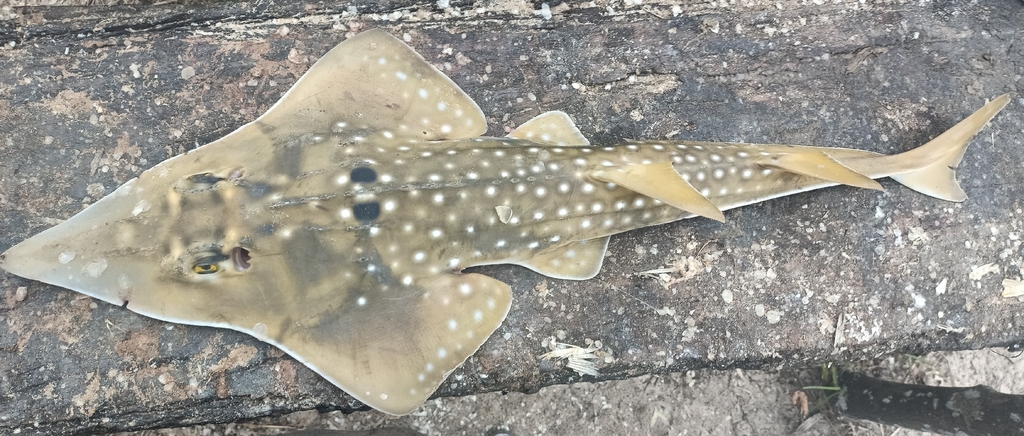
The African wedgefish (Rhynchobatus luebberti) is a saltwater fish of the family Rhinidae that grows up to 300 cm.
Eastern Atlantic along the coast of West Africa, over sandy and silty bottoms of shallow coastal water and estuaries.
Description
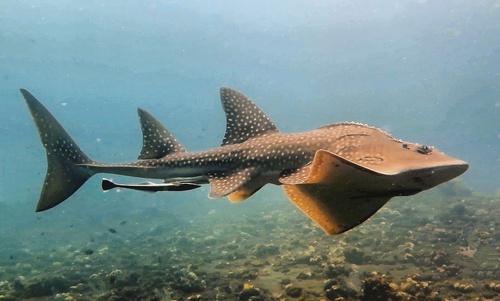
The African wedgefish is a large wedgefish of the family Rhinidae reaching about 3 metres long. It forms a transition between ray and shark: the front is flattened and wedge-shaped, with a pointed snout, while the rear body is powerful and shark-like, with two tall dorsal fins and a strong tail. Rows of thorns run over the head and back. Unlike stingrays it lacks a venomous spine. The species lives on sand and mud bottoms of shallow coastal water and estuaries along the West African coast. On the bottom it crushes crabs, crustaceans, shellfish and small fish with flat tooth plates. Through heavy fishing - partly for the very valuable fins - it has declined sharply and is assessed as Critically Endangered (CR).
Frequently asked questions
How do you recognise the African wedgefish?
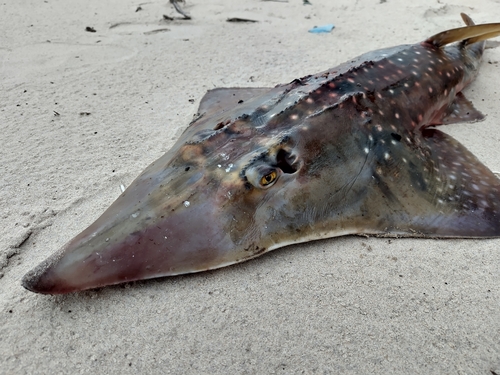
The African wedgefish has a flattened, disc-shaped body, is mainly brown and shows a spots pattern. Large wedgefish: a flattened, wedge-shaped ray-like front merges into a powerful, shark-like rear body with two high dorsal fins.
Where does the African wedgefish live?
The African wedgefish lives in the sea (marine waters) and is mostly found around sand or mud bottom. Eastern Atlantic along the coast of West Africa, over sandy and silty bottoms of shallow coastal water and estuaries.
How big does the African wedgefish get?
The African wedgefish grows to a maximum of about 300 cm. On average the species is around 150 cm.
Is the African wedgefish dangerous to humans?
No, the African wedgefish is harmless to humans. Unlike stingrays a wedgefish has no venomous tail spine and is harmless; the rough skin and thorns on head and back can abrade, however.
Is the African wedgefish edible?
Yes, the African wedgefish is commonly eaten.
More photos

Want the complete picture on the African wedgefish?
Point your camera at the fish and Fin names the species in seconds. Free, and the African wedgefish is one of 12,519 species in the app.
All data
Identification
Appearance
Habitat & distribution
Behaviour & biology
For anglers
Safety
Status & sources
Same genus Rhynchobatus
More from the family Rhinidae
Want the complete picture on the African wedgefish?
Point your camera at the fish and Fin names the species in seconds. Free, and the African wedgefish is one of 12,519 species in the app.