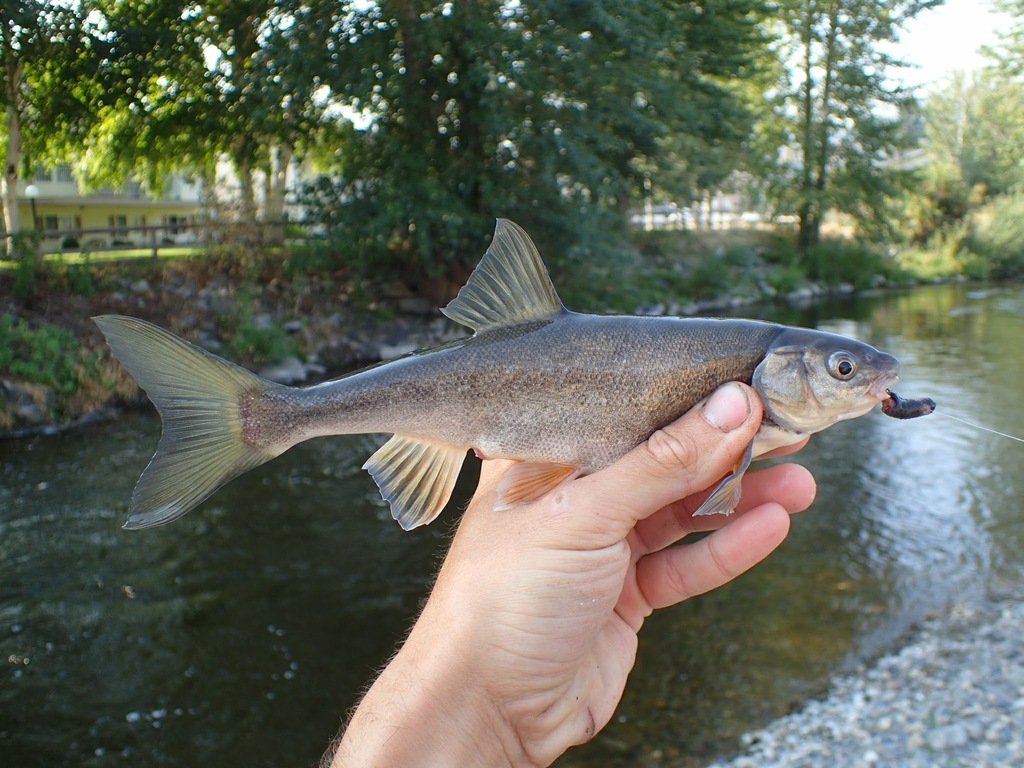
The Bouche coupante (Acrocheilus alutaceus) is a freshwater fish of the family Cyprinidae that grows up to 30 cm.
Description
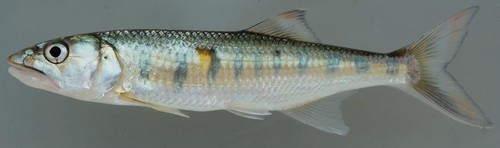
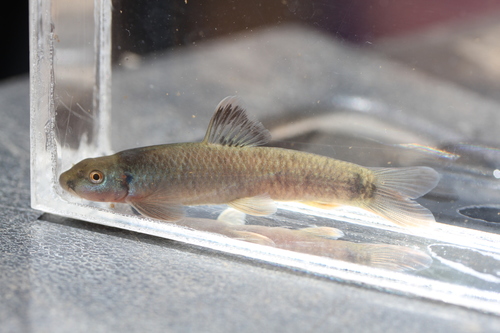
The chiselmouth is a cyprinid freshwater fish from northwestern North America, in the Columbia and Fraser drainages and the Harney basin, in Canada and the United States. It grows to about 30 cm and has a fusiform, grey body with brassy silver sides and a deeply forked tail. A distinctive feature is a hard, chisel-like plate on the lower jaw, used to scrape algae and diatoms from stones; juveniles also take surface insects. The intestine is about twice the body length and the peritoneum is black. The IUCN has not evaluated the species (NE).
Frequently asked questions
How do you recognise the Bouche coupante?
The Bouche coupante has a torpedo-shaped body, is mainly silver-grey and shows a plain pattern.
Where does the Bouche coupante live?
The Bouche coupante lives in fresh water and is mostly found around sand or mud bottom.
How big does the Bouche coupante get?
The Bouche coupante grows to a maximum of about 30 cm. On average the species is around 18 cm.
Is the Bouche coupante dangerous to humans?
No, the Bouche coupante is harmless to humans.
Is the Bouche coupante edible?
The Bouche coupante is not usually eaten.
Download Fin's Fish Guide
Identify fish in seconds, log your catches and dives. Join the TestFlight beta.
All data
Identification
Appearance
Habitat & distribution
Behaviour & biology
For anglers
Safety
Status & sources
More from the family Cyprinidae


Download Fin's Fish Guide
Identify fish in seconds, log your catches and dives. Join the TestFlight beta.