Home · Acanthuridae · Gendarme fish
Gendarme fish (Acanthurus olivaceus) — Acanthuridae

Gendarme fish

Acanthurus olivaceus
Family: Acanthuridae
LC · Least Concern

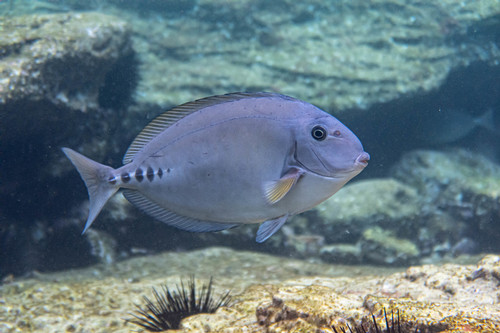
The Gendarme fish (Acanthurus olivaceus) is a saltwater fish of the family Acanthuridae that grows up to 35 cm.

Length
35 cm
Water
Saltwater
Depth
3.0–46.0 m
Diet
Omnivore
Behaviour
Small groups
Activity
Diurnal
Body shape
Flat / disc-shaped
Substrate
Stone or rock
Danger
Harmless
Edibility
Commonly eaten

Description

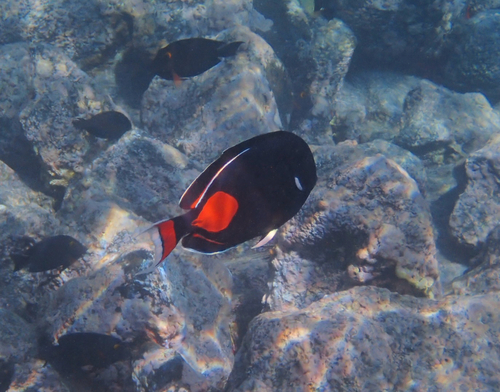
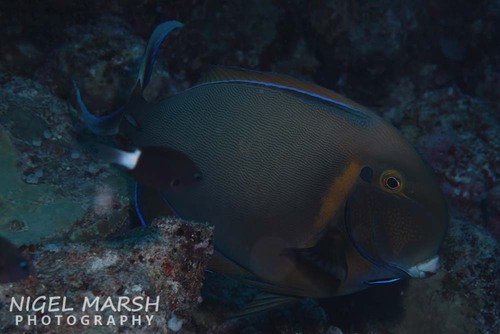
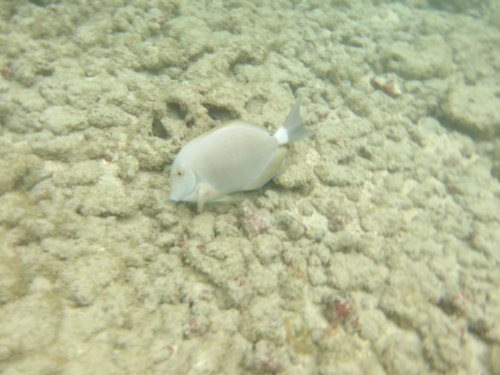
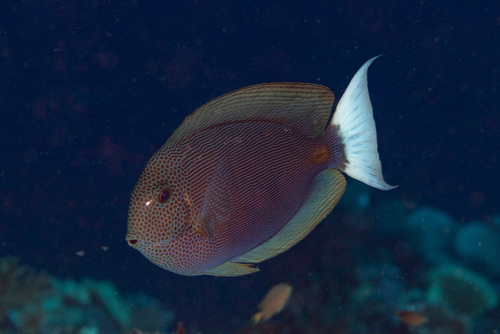
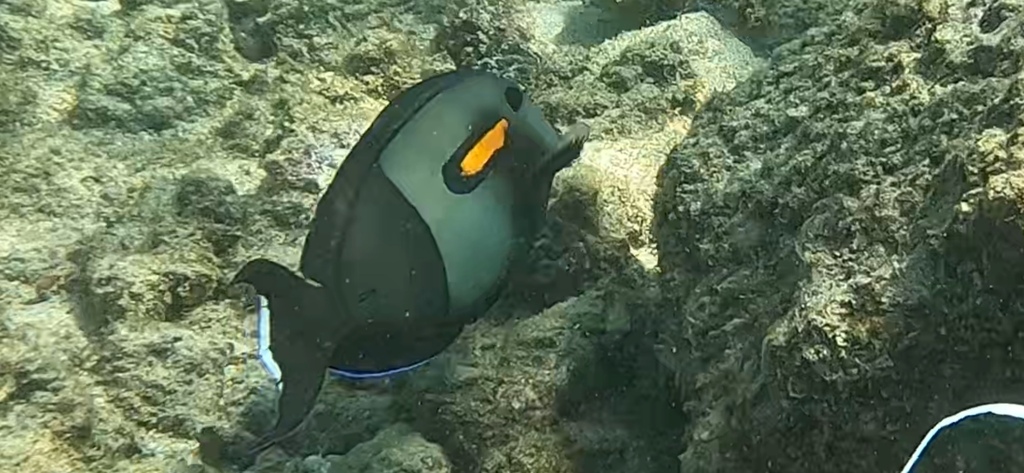
The orangeband surgeonfish is a surgeonfish (Acanthuridae) from the Indo-West Pacific. Adults are grey-brown with a conspicuous orange, blue-edged band behind the head; juveniles are bright yellow. It inhabits seaward reefs with bare rock or mixed rubble and sand, from nine to at least forty-six metres depth. It grazes algae and detritus from the bottom. On each side of the tail base it carries a sharp, scalpel-like spine that can inflict deep cuts.

Frequently asked questions

How do you recognise the Gendarme fish?

The Gendarme fish has a flattened, disc-shaped body, is mainly brown and shows a plain pattern.

Where does the Gendarme fish live?

The Gendarme fish lives in the sea (marine waters) and is mostly found around stony or rocky ground.

How big does the Gendarme fish get?

The Gendarme fish grows to a maximum of about 35 cm.

Is the Gendarme fish dangerous to humans?

No, the Gendarme fish is harmless to humans.

Is the Gendarme fish edible?

Yes, the Gendarme fish is commonly eaten.

Download Fin's Fish Guide

Identify fish in seconds, log your catches and dives. Join the TestFlight beta.

Get the beta →

All data

Identification

Dutch name
Oranjeband-doktersvis sourced
English name
Gendarme fish verified
Scientific name
Acanthurus olivaceus
Family
Acanthuridae
Other names
Gendarmefish; Olive surgeonfish; Orange band surgeonfish; Orange epoulette surgeon; Orange spot tang verified

Appearance

Size class
Medium verified
Max length (cm)
35.0 verified
Body shape
Flat / disc-shaped sourced
Dominant colour
Brown inferred
Pattern
Plain inferred
Tail shape
Crescent (lunate) inferred
Mouth position
Terminal inferred
Lips
Thick / fleshy inferred
Barbels
No sourced
Dorsal fins
One continuous inferred
Dorsal spines
Yes sourced

Habitat & distribution

Water type
Saltwater sourced
Substrate
Stone or rock sourced
Min depth (m)
3.0 verified
Max depth (m)
46.0 verified
Origin
Native sourced

Behaviour & biology

Diet
Omnivore sourced
Social behaviour
Small groups inferred
Territorial
No inferred
Activity
Diurnal inferred
Reproduction
Separate sexes sourced
Sexual dimorphism
No inferred
levensduur_max_jaar
33.0 verified

For anglers

Edibility
Commonly eaten sourced
Fishing method
Vissen met natuurlijk aas (vis, garnaal, worm) of kunstaas dicht bij rif- en rotsstructuren. inferred
Regulations source
FishBase ↗ inferred

Safety

Danger to humans
Harmless sourced

Status & sources

Sources
FishBase via GBIF (DwC-A), CC-BY-NC 4.0

Same genus Acanthurus

More from the family Acanthuridae
Download Fin's Fish Guide

Identify fish in seconds, log your catches and dives. Join the TestFlight beta.

Get the beta →