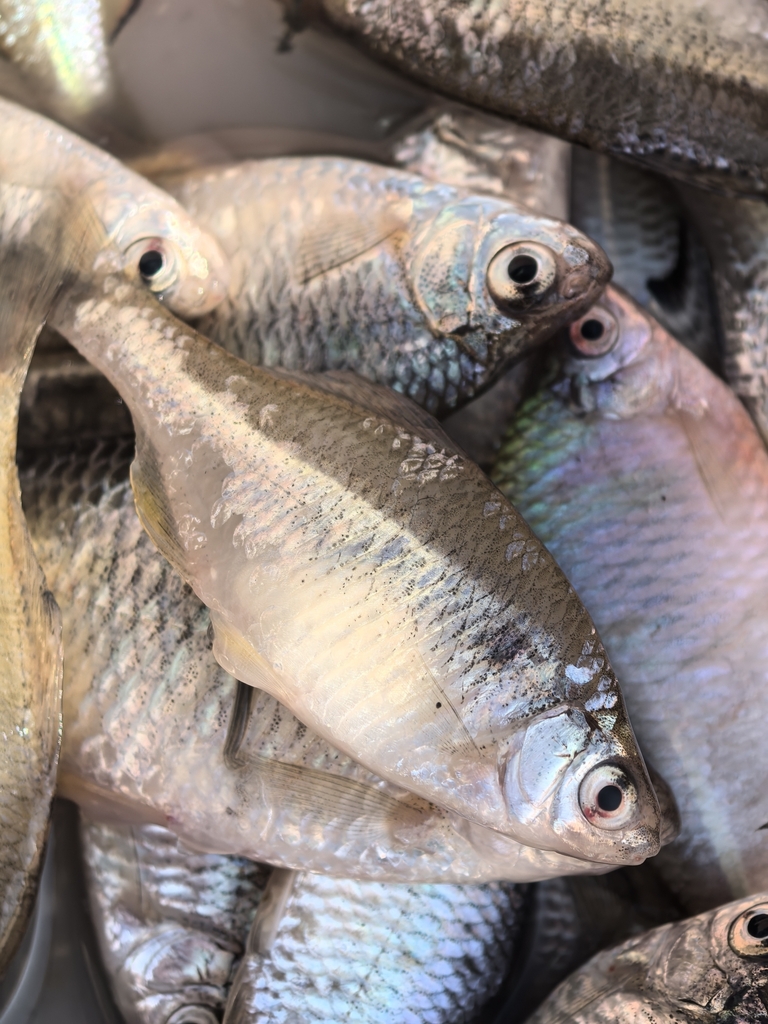
The Khanka spiny bitterling (Acanthorhodeus chankaensis) is a brackish-water fish of the family Cyprinidae that grows up to 14 cm.
Description
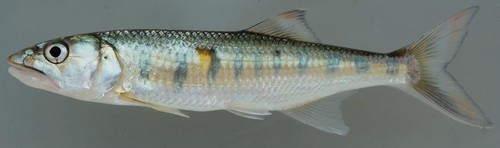
The Khanka spiny bitterling is a cyprinid bitterling from temperate East Asia, occurring in China, Korea and Russia. It grows to about 14 cm and has a laterally compressed, silvery body with two spines in both the dorsal and anal fins. Like all bitterlings it reproduces using freshwater mussels: with a long ovipositor the female lays her eggs inside the mantle cavity of a living mussel, where the young grow sheltered until they can swim. The fish lives in slow-flowing and still fresh and brackish water. The IUCN has not evaluated the species (NE).
Frequently asked questions
How do you recognise the Khanka spiny bitterling?
The Khanka spiny bitterling has a torpedo-shaped body, is mainly silver-grey and shows a plain pattern.
Where does the Khanka spiny bitterling live?
The Khanka spiny bitterling lives in brackish water and is mostly found around mixed bottom.
How big does the Khanka spiny bitterling get?
The Khanka spiny bitterling grows to a maximum of about 14 cm.
Is the Khanka spiny bitterling dangerous to humans?
No, the Khanka spiny bitterling is harmless to humans.
Is the Khanka spiny bitterling edible?
The Khanka spiny bitterling is not usually eaten.
Download Fin's Fish Guide
Identify fish in seconds, log your catches and dives. Join the TestFlight beta.
All data
Identification
Appearance
Habitat & distribution
Behaviour & biology
For anglers
Safety
Status & sources
More from the family Cyprinidae


Download Fin's Fish Guide
Identify fish in seconds, log your catches and dives. Join the TestFlight beta.